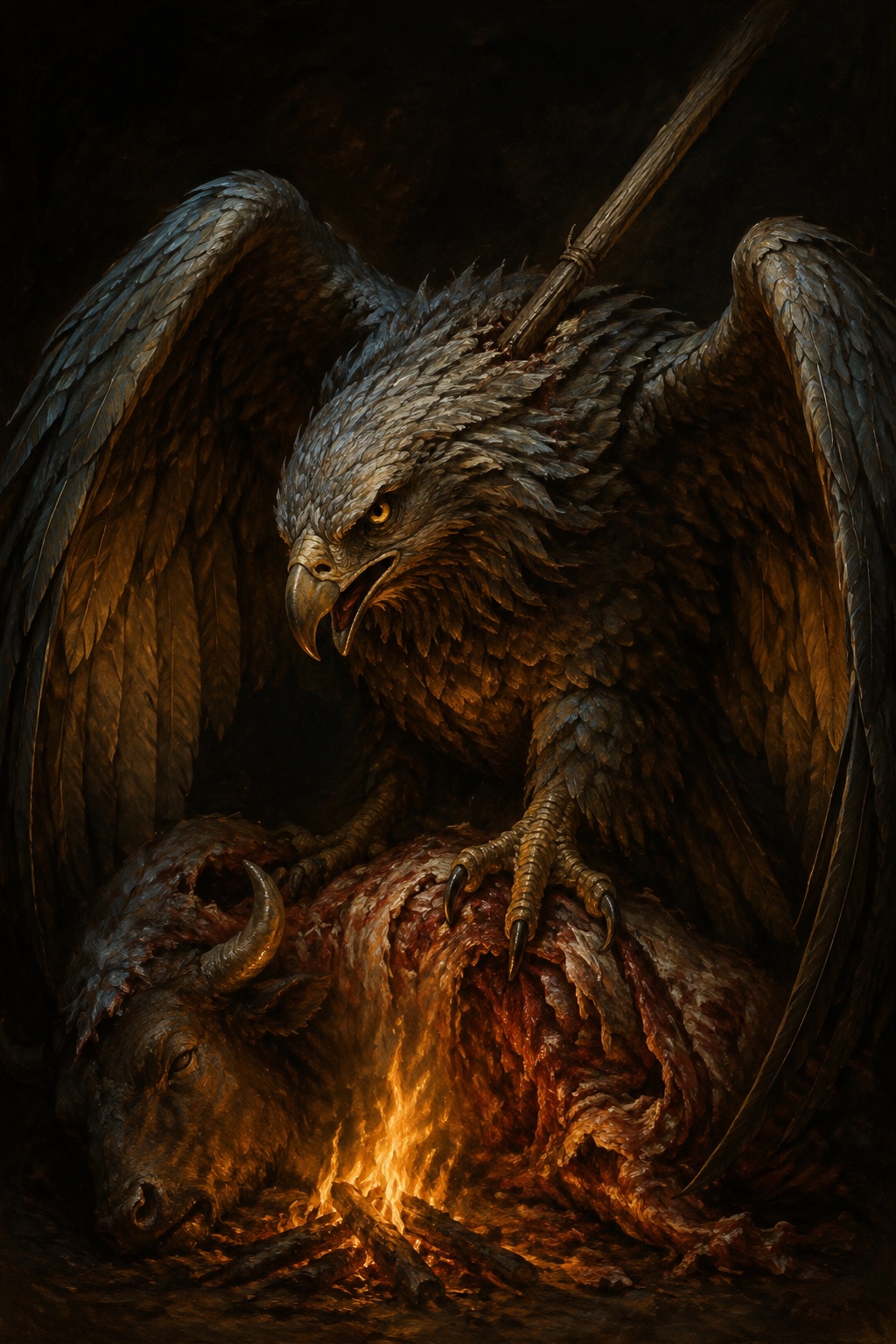
The eagle at the cooking-fire
Iðunn’s entry tells what happened to her, and Skaði’s tells what came of it afterwards. Between the two, Snorri gives Þjazi a scene of his own, and it is the only place in the corpus where a giant gets what he wants by bargaining rather than by force. Óðinn, Loki and Hœnir are on a journey with nothing to eat but an ox they cannot get to cook. A voice from the oak above them says why.
Þá mælti örninn: “Vilið þér gefa mér fylli mína af uxanum, þá mun soðna á seyðinum.” Þeir játa því. Þá lætr hann sígast ór trénu ok sezt á seyðinn ok leggr upp þegar it fyrsta lær uxans tvau ok báða bóguna. Þá varð Loki reiðr ok greip upp mikla stöng ok reiðir af öllu afli ok rekr á kroppinn erninum. Örninn bregzt við höggit ok flýgr upp. Þá var föst stöngin við bak arnarins, en hendr Loka við annan enda stangarinnar.
“Then the eagle said: ‘If ye are willing to give me my fill of the ox, then it will cook in the fire.’ They assented to this. Then he let himself float down from the tree and alighted by the fire, and forthwith at the very first took unto himself the two hams of the ox, and both shoulders. Then Loki was angered, snatched up a great pole, brandished it with all his strength, and drove it at the eagle’s body. The eagle plunged violently at the blow and flew up, so that the pole was fast to the eagle’s back, and Loki’s hands to the other end.” — Snorri Sturluson, Skáldskaparmál 2, tr. A. G. Brodeur
The agreement is honoured on both sides and broken by neither. The eagle asked for his fill and was given it; he then defined his fill as most of the animal, which is greedy but is not cheating, and the gods have no answer except a stick. What the blow buys them is worse than the meat: the pole sticks, Loki’s hands stick, and the eagle simply keeps flying with a god dragging along the ground behind him until Loki will agree to anything. Snorri does not describe Þjazi’s face or his shape here at all. He is a bird with a bargaining position.
Þrymheimr, and the price of letting go
The ransom is Iðunn, and the wording of it belongs in her entry rather than his. What belongs here is that he collects it himself, in the same shape.
En at ákveðinni stundu teygir Loki Iðunni út um Ásgarð í skóg nökkurn ok segir, at hann hefir fundit epli þau, er henni munu gripir í þykkja, ok bað, at hon skal hafa með sér sín epli ok bera saman ok hin. Þá kemr þar Þjazi jötunn í arnarham ok tekr Iðunni ok flýgr braut með ok í Þrymheim til bús síns.
“But at the appointed time Loki lured Idunn out of Ásgard into a certain wood, saying that he had found such apples as would seem to her of great virtue, and prayed that she would have her apples with her and compare them with these. Then Thjazi the giant came there in his eagle’s plumage and took Idunn and flew away with her, off into Thrymheimr to his abode.” — Snorri Sturluson, Skáldskaparmál 2, tr. A. G. Brodeur
The phrase is í arnarham, in the eagle’s coat — a garment he puts on, not a body he is stuck with, and the same word the text uses when Loki borrows Freyja’s hawk-coat to steal her back. Two shape-changers with two borrowed birds, and the one difference that decides the story is that Loki is faster. Þrymheimr, the house he carries her to, is the only property the sources give him; it passes to his daughter, and Skaði’s own entry finds her living in it, on skis, with a bow.
Burned inside the gate
He almost catches Loki. The Æsir have piled plane-shavings against the wall for exactly this, and the passage that kills him is three sentences long.
Þá slógu æsirnir eldi í lokarspánuna, en örninn mátti eigi stöðva sik, er hann missti valsins. Laust þá eldinum í fiðri arnarins, ok tók þá af fluginn. Þá váru æsirnir nær ok drápu Þjaza jötun fyrir innan ásgrindr, ok er þat víg allfrægt.
“then the Æsir struck fire to the plane-shavings. But the eagle could not stop himself when he missed the hawk: the feathers of the eagle caught fire, and straightway his flight ceased. Then the Æsir were near at hand and slew Thjazi the giant within the Gate of the Æsir, and that slaying is exceeding famous.” — Snorri Sturluson, Skáldskaparmál 3, tr. A. G. Brodeur
Er þat víg allfrægt — that slaying is exceeding famous. Snorri says so and then never returns to it; no poem in the corpus retells the fire, and what the sources actually preserve of Þjazi’s death is not the killing but the settlement it forced. The manner of it is worth noticing all the same. He is not fought. He is let in, over a wall he has flown at, and burned on the wrong side of a gate the Æsir chose where to light — the only death in this corpus that is arranged rather than won.
What his daughter came for
The famous part starts the moment he stops. Skaði’s arrival, her choice of a husband by his feet and Loki’s performance with the goat all belong to her entry and are told there; the line that belongs to his is the reason she is standing in the gateway at all.
En Skaði dóttir Þjaza jötuns, tók hjálm ok brynju ok öll hervápn ok ferr til Ásgarðs at hefna föður síns.
“Now Skadi, the daughter of the giant Thjazi, took helm and birnie and all weapons of war and proceeded to Ásgard, to avenge her father.” — Snorri Sturluson, Skáldskaparmál 3, tr. A. G. Brodeur
At hefna föður síns, to avenge her father: it is the first thing the sources ever say about Skaði, and it is a sentence about him. That is the whole shape of Þjazi in the record. He is named in Iðunn’s story as the thing that takes her, in Skaði’s as the debt that has to be paid, and in Njörðr’s marriage as the reason it happened — fifteen files in this wiki have carried his name in someone else’s entry. Three sentences of his own, and every one of them is a bird eating, carrying, or burning.