What is in the chest
Snorri introduces most of the Æsir with a paragraph of attributes. Iðunn gets one sentence, and it is a job description with the fate of the pantheon attached to it.
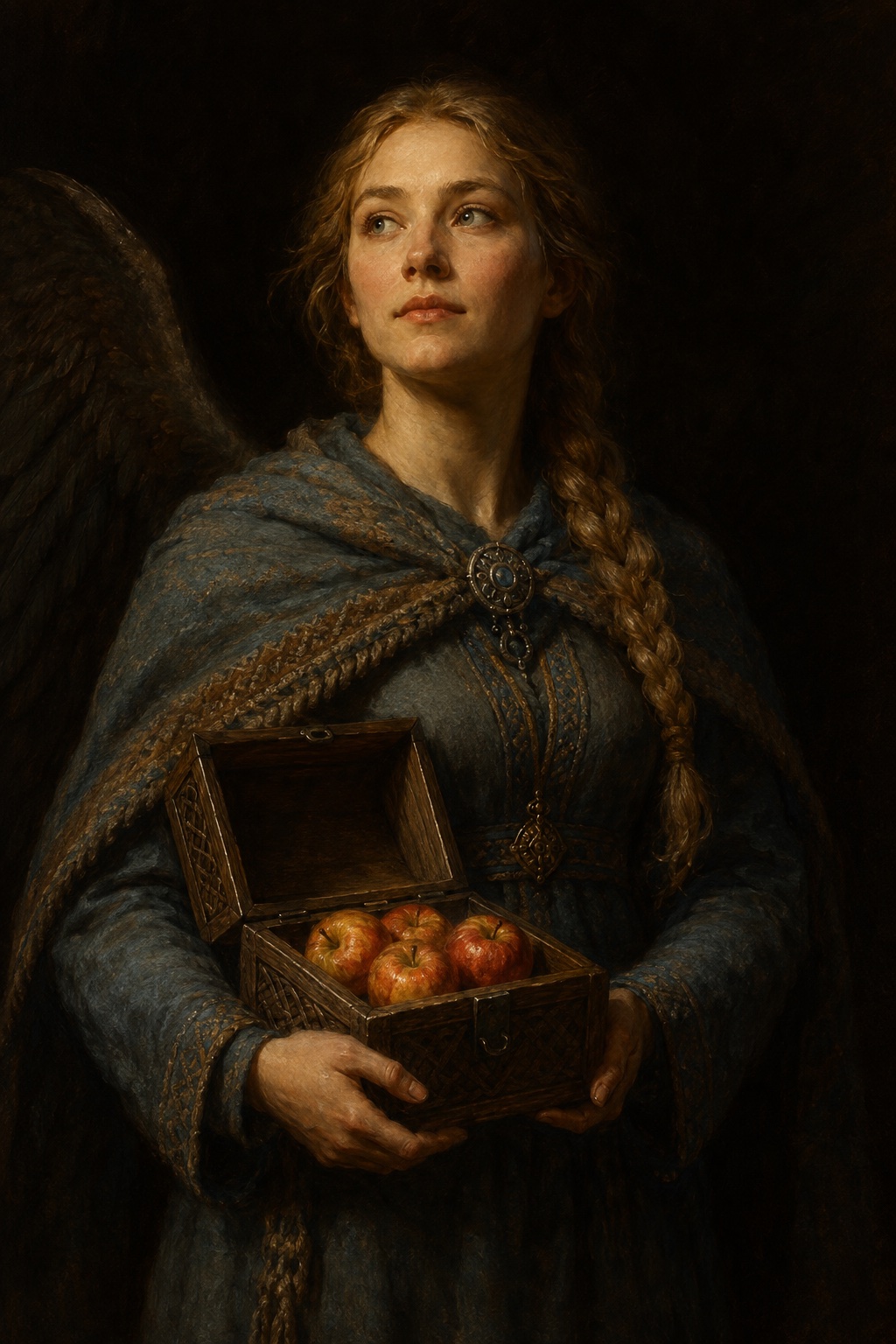
Kona hans er Iðunn. Hon varðveitir í eski sínu epli þau, er goðin skulu á bíta, þá er þau eldast, ok verða þá allir ungir, ok svá mun vera allt til ragnarökrs.” Þá mælti Gangleri: “Allmikit þykkir mér goðin eiga undir gæzlu eða trúnaði Iðunnar.
“His wife is Idunn: she guards in her chest of ash those apples which the gods must taste whensoever they grow old; and then they all become young, and so it shall be even unto the Weird of the Gods.” Then said Gangleri: “A very great thing, methinks, the gods entrust to the watchfulness and good faith of Idunn.” — Snorri Sturluson, Gylfaginning 26, tr. Brodeur
The word for the chest is eski, an ash-wood box, and varðveitir is the ordinary verb for keeping something safe. The theology of the whole passage is in the modal: skulu á bíta, the gods must bite them, when they grow old — which they do. Norse gods are not immortal by nature. They are immortal by maintenance, and the maintenance is a fruit in a box that one goddess looks after until Ragnarök.
She is introduced here as Bragi’s wife, in the chapter about Bragi, which is the only place Snorri finds to put her.
A very great thing to entrust
Gangleri’s response is the closest the Gylfaginning comes to editorial comment, and it is the reason this passage is worth quoting at length. He has just been told that the survival of the gods depends on one person’s gæzla and trúnaðr — her watchfulness and her good faith — and he says out loud that this seems like rather a lot to hang on that.
Hárr’s answer is to laugh loudly and say that it once came near disaster, and that he could tell about it, but first Gangleri must hear more names. The tale is deferred by a chapter and told properly elsewhere. The structure is deliberate: the audience is told the system is fragile, told it has already nearly failed, and then made to wait.
Lured out of Ásgard
The failure is the story Bragi tells at Ægir’s feast. Loki, caught in an eagle’s talons and dangling over rocks and trees with his arms about to leave his shoulders, buys his freedom with an oath: he will bring Iðunn and her apples out of Ásgard.
En at ákveðinni stundu teygir Loki Iðunni út um Ásgarð í skóg nökkurn ok segir, at hann hefir fundit epli þau, er henni munu gripir í þykkja, ok bað, at hon skal hafa með sér sín epli ok bera saman ok hin. Þá kemr þar Þjazi jötunn í arnarham ok tekr Iðunni ok flýgr braut með ok í Þrymheim til bús síns.
“But at the appointed time Loki lured Idunn out of Ásgard into a certain wood, saying that he had found such apples as would seem to her of great virtue, and prayed that she would have her apples with her and compare them with these. Then Thjazi the giant came there in his eagle’s plumage and took Idunn and flew away with her, off into Thrymheimr to his abode.” — Snorri Sturluson, Skáldskaparmál 2, tr. Brodeur
The bait is precisely fitted to her. Loki does not offer treasure or flattery; he offers other apples, better ones, and asks her to bring hers along for comparison. The one thing that will get the keeper of the apples to carry them out of the walls is a professional question about apples. She goes into the wood with the entire stock of the gods’ youth in her hands, and Þjazi is waiting in eagle form.
What follows is not hers. The Æsir go hoary and old within days, work out that she was last seen leaving with Loki, and threaten him into fetching her back — which is how Þjazi comes to be killed inside Ásgard’s gates, and how his daughter Skaði comes armed to the Æsir to demand payment for him. That is Skaði’s story, and this wiki tells it on her page. Iðunn’s own part ends in Þrymheimr.
The one thing she does, and does not do
She has no speech in either passage. Snorri gives her a husband, a box, a function and an abduction, and never a line of dialogue or a decision that is visibly hers. What she has instead is leverage: she is the only figure in the Prose Edda whose absence for a few days visibly ages every god in Ásgard, and the tale exists to demonstrate exactly that.
Her page in Skaði’s account of the affair is worth a note on numbering. This wiki cites the tale of Þjazi and Iðunn as Skáldskaparmál 3, following Brodeur’s chapter divisions; the Old Norse text used here heads the same episode 2. Þjazi jötunn rænti Iðunni. Both labels point at one episode. The difference is where an editor starts counting after the frame story of Ægir’s feast, not a disagreement between sources.