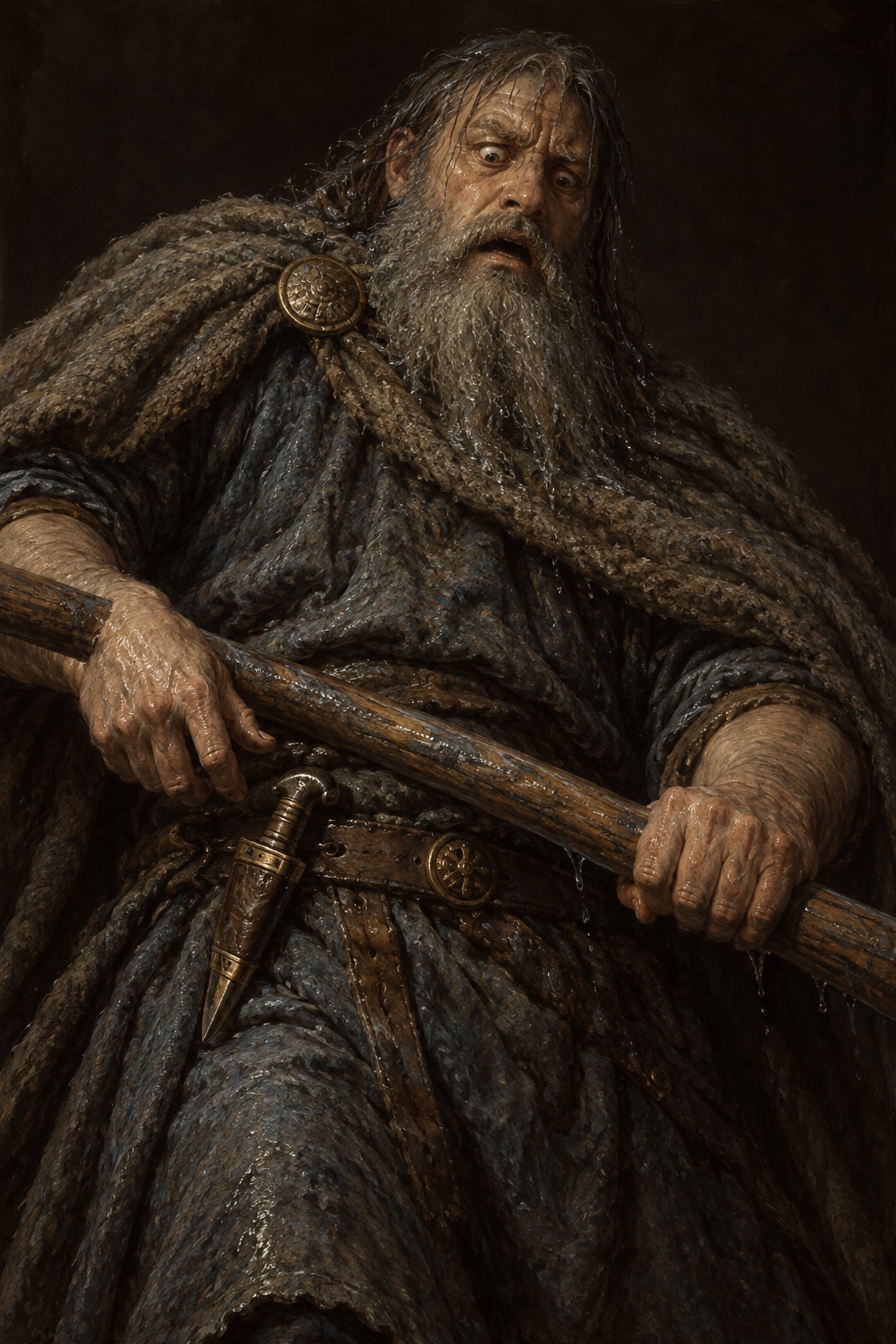
Two whales on one hook
His hall stands east of the Élivágar, at the end of heaven, and the gods want the one thing in it that is big enough to brew for all of them at once. Thor and Týr go to fetch the kettle, and the poem that carries their errand is named after the man who owns it rather than after either of them. What that poem gives Hymir, before it gives him anything else, is competence. He comes home from hunting with ice in his beard, he keeps a boat, and he fishes for a living. When Thor asks to come along, Hymir tells him to find his own bait — and then, with Thor still busy in the stern, does this.
Dró meir Hymir móðugr hvali einn á öngli upp senn tváa, en aftr í skut Óðni sifjaðr Véurr við vélar vað gerði sér
“Two whales on his hook did the mighty Hymir / Soon pull up on a single cast; / In the stern the kinsman of Othin sat, / And Veur with cunning his cast prepared” — Hymiskviða 21 (Bellows prints it as 22), tr. H. A. Bellows
Two of the largest animals in the sea, on one hook, in one cast, by a man who does it every week. The kinsman of Othin in the stern is Thor — Veur is his own by-name in this poem — and he has not baited anything yet. It is the only contest in the story that Hymir wins outright, and the poem gives it to him in half a stanza, without comment, as the ordinary competence of a working fisherman. Everything that follows is a variation on the same joke told against him: he is good at this, and his guest is about to fish for something that is not a fish.
His ox, and his boat
Snorri tells the same fishing trip in Gylfaginning 48, from a different angle and with a different ending. His Thor arrives at the giant’s house in the evening, alone, and asks in the morning to be taken out. Hymir says he is too small to be much use and will freeze if they row as far as Hymir usually rows; then he tells him to get his own bait, which is where the giant’s property starts paying for the story.
öxnaflokk nökkurn, er Hymir átti. Hann tók inn mesta uxann, er Himinhrjóðr hét, ok sleit af höfuðit ok fór með til sjávar. Hafði þá Hymir út skotit nökkvanum.
“a certain herd of oxen, which Hymir owned; he took the largest ox, called Himinbrjotr, and cut off its head and went therewith to the sea. By that time Hymir had shoved out the boat.” — Snorri Sturluson, Gylfaginning 48, tr. A. G. Brodeur
Everything in the boat that day belongs to Hymir except the guest. The ox is his — Brodeur spells it Himinbrjotr where the Old Norse page reads Himinhrjóðr — and the head that goes on the hook is taken out of his herd without asking. The boat is his, and he has it already run out by the time Thor comes down to the water carrying the head. Then Hymir rows in the bow, twice says they have come far enough, and twice gets rowed further. Brodeur renders his mood at that point as sore afraid; the word on the page is allókátr, thoroughly out of sorts, which is a smaller and more exact thing. The fear comes later, and Snorri saves the word for it.
Pale at the gunwale
What Thor catches is Jörmungandr. The serpent takes the ox-head, the hook takes its jaw, and Thor braces so hard that his feet go through the hull, which puts the sea in the boat and the World Serpent at the rail with a god staring it down. Hymir is a working fisherman sitting a few feet from all of it, in a boat whose bottom his guest has just kicked out.
Þá er sagt, at jötunninn Hymir gerðist litverpr, fölnaði ok hræddist, er hann sá orminn ok þat er særinn féll út ok inn of nökkvann. Ok í því bili, er Þórr greip hamarinn ok færði á loft, þá fálmaði jötunninn til agnsaxinu ok hjó vað Þórs á borði, en ormrinn sökkðist í sæinn
“Then, it is said, the giant Hymir grew pale, became yellow, and was sore afraid, when he saw the Serpent, and how the sea rushed out and in through the boat. In the very moment when Thor clutched his hammer and raised it on high, then the giant fumbled for his fish-knife and hacked off Thor’s line at the gunwale, and the Serpent sank down into the sea.” — Snorri Sturluson, Gylfaginning 48, tr. A. G. Brodeur
This is the sentence Hymir is remembered by, and it is worth being exact about whose sentence it is. The knife, the fear and the cut line are Snorri’s, here in Gylfaginning 48 and nowhere else. The surviving Hymiskviða has no knife in it: there Thor strikes the serpent’s head with the hammer and the creature goes back down into the sea, and Hymir’s part in that stanza is only to be joyless on the row home. Other entries in this wiki summarise the cut loosely as the poem’s; the text it comes from is the prose.
Read as Snorri wrote it, the beat is not cowardice so much as arithmetic. Fálmaði is a fumble, the hand groping for a thing it cannot see; the thing it finds is agnsaxit, the small knife for cutting up bait, the least heroic object on board. He does not attack Thor, and he does not stop the hammer. He cuts a line on his own boat while the sea comes in over the side, and the largest creature in the world drops back where it came from. Nothing in the passage says he was wrong.
The goblet, and the ale he cannot boast of again
Back in the hall, the poem turns the same pattern into a wager, and Hymir sets the terms himself: he will call no guest strong who cannot break his drinking-cup. Thor hurls it at the stone pillars, and the pillars are what shatter — the cup is carried back to its owner whole. The woman of the house then tells him where the hardest thing in the room actually is, which is the giant’s own head, and against that the cup goes to pieces while the skull comes through undamaged. Hymir speaks the next stanza himself.
Mörg veit ek mæti mér gengin frá, er ek kálki sé ór knéum hrundit;” karl orð of kvað: “knákat ek segja aftr ævagi, þú ert, ölðr, of heitt
“Fair is the treasure that from me is gone, / Since now the cup on my knees lies shattered;” So spake the giant: “No more can I say / In days to be, ‘Thou art brewed, mine ale.’” — Hymiskviða 32 (Bellows prints it as 33), tr. H. A. Bellows
He does not mourn the kettle he is about to lose. He mourns a sentence. What he can never say again is the toast he used to say over his own brewing, and the loss he names is the loss of a small domestic habit — the cup on his knees, the ale called ready, a household that ran the way he liked it. It is the only interior line either source gives him, and it is about manners rather than defeat.
The kettle goes with them. Hymir concedes it to whoever can carry it out of his house; Týr tries twice and cannot shift it, and Thor lifts it onto his head and walks out with the rings clattering about his heels. It ends at Ægir’s, which is where the gods drink their ale in the autumn thereafter, and Ægir’s own entry tells that half. Hymir himself is left unresolved on purpose. Snorri’s ending is a humiliation and not a death: Thor boxes his ear, the giant goes over the side, and Thor wades ashore. The poem sends a many-headed host after the pair and has Thor kill all of them with the hammer, but it never names Hymir among the dead, and no other text closes the question. He owns the ox, the boat, the knife, the cup and the kettle; by the end of both stories he has lost every one of them, and neither story bothers to say whether he survived it.