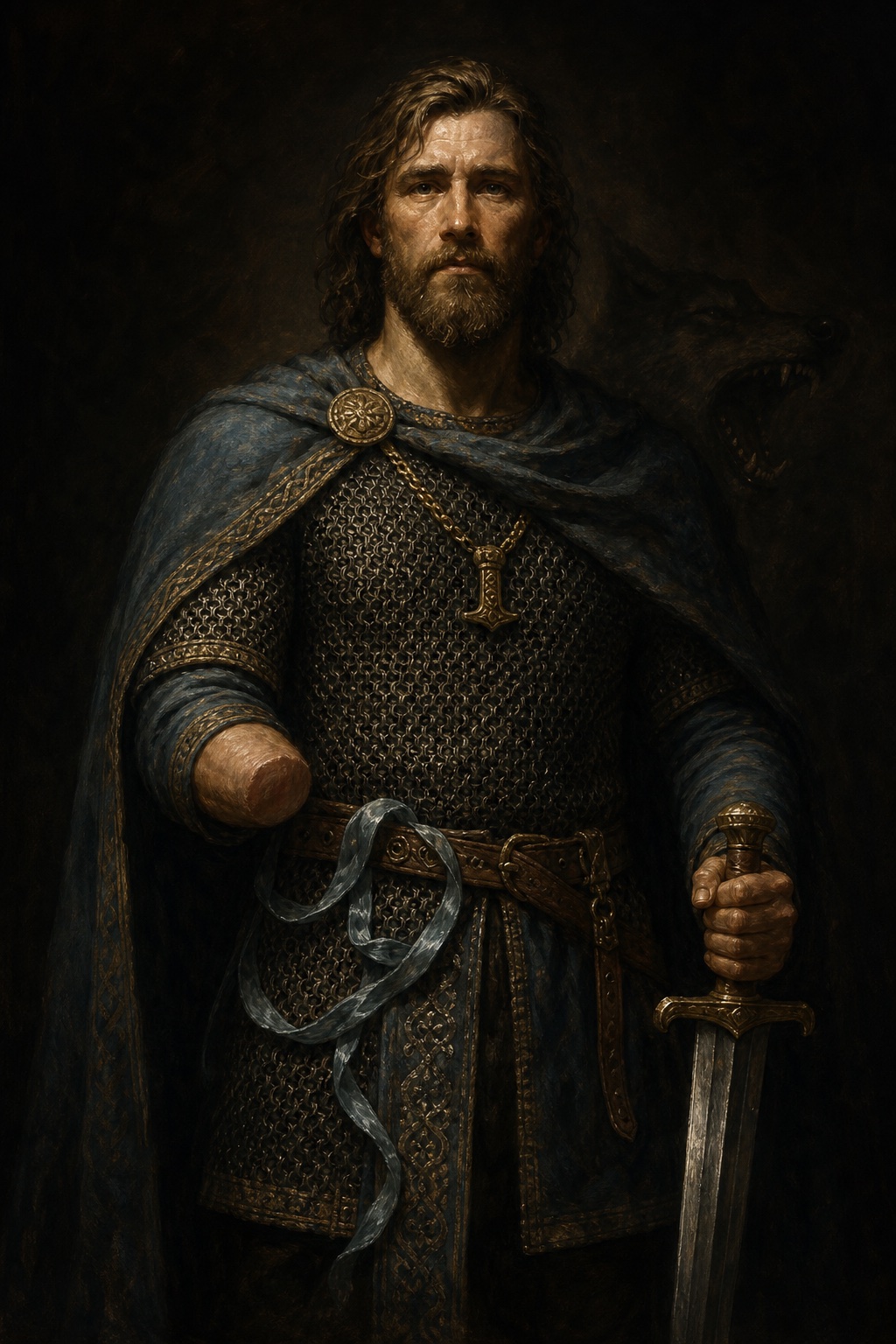
One token of his daring
When Gangleri asks whether the catalogue of the Æsir has anyone left worth naming, Hárr’s answer is Týr — introduced by two by-names before a single deed is told. He is Týr-valiant, “who surpasses other men and does not waver,” and Týr-prudent, for “he that is wisest is Týr-prudent.” Only then does Snorri explain what earns the names.
Sá er enn áss, er Týr heitir. Hann er djarfastr ok bezt hugaðr, ok hann ræðr mjök sigri í orrostum. Á hann er gott at heita hreystimönnum. Þat er orðtak, at sá er týhraustr, er um fram er aðra menn ok ekki sést fyrir. Hann var ok vitr, svá at þat er ok mælt, at sá er týspakr, er vitrastr er. Þat er eitt mark um djarfleik hans, þá er æsir lokkuðu Fenrisúlf til þess at leggja fjöturinn á hann, Gleipni, þá trúði hann þeim eigi, at þeir mundu leysa hann, fyrr en þeir lögðu honum at veði hönd Týs í munn hans, en þá er æsir vildu eigi leysa hann, þá beit hann höndina af, þar er nú heitir úlfliðr, ok er hann einhendr ok ekki kallaðr sættir manna
“Yet remains that one of the Æsir who is called Týr: he is most daring, and best in stoutness of heart, and he has much authority over victory in battle; it is good for men of valor to invoke him. It is a proverb, that he is Týr-valiant, who surpasses other men and does not waver. He is wise, so that it is also said, that he that is wisest is Týr-prudent. This is one token of his daring: when the Æsir enticed Fenris-Wolf to take upon him the fetter Gleipnir, the wolf did not believe them, that they would loose him, until they laid Týr’s hand into his mouth as a pledge. But when the Æsir would not loose him, then he bit off the hand at the place now called ‘the wolf’s joint;’ and Týr is one-handed, and is not called a reconciler of men.” — Snorri Sturluson, Gylfaginning 25, tr. Brodeur
Every phrase in that closing sentence is doing work. Old Norse at veði — “as a pledge” — is the vocabulary of a legal gage, not a battlefield boast: Fenrir does not trust the Æsir’s word on its own, so he demands collateral he can hold in his teeth. Týr is the only one of them who offers it, matching the wolf’s suspicion with the one form of proof it will accept. He keeps his side of the bargain exactly as far as it costs him a hand, and the place goes on being called “the wolf’s joint” long after — a landmark named for the one time bravery and honesty pointed the same direction and still lost something.
Fosterer of the wolf
Snorri’s kennings for Týr, catalogued separately in Skáldskaparmál, include a second title that the Gylfaginning story never quite explains: úlfs fóstra, “Fosterer of the Wolf.” No surviving passage narrates the fostering itself — the epithet is the only trace that it happened. What it implies, read against the hand-pledge, is that the wolf’s suspicion was personal. Fenrir did not doubt a stranger’s word; he doubted the household that had raised him, and it was the hand of the one who had fed him as a cub that he took when the fetter proved real.
This corpus tells the fuller binding — the two chains Fenrir snaps like thread, the impossible ribbon the dwarfs forge from a cat’s footfall and a mountain’s roots, the wolf’s mounting suspicion — from the other side, in Fenrir’s own entry. What belongs here is only the frame the kenning adds: Fosterer of the Wolf and the One-handed God, back to back on the same list of names, are not two facts about Týr but one, told from either end of a single relationship.
The flyting at Ægir’s hall
Lokasenna stages a different kind of testimony. Loki forces his way into a banquet the gods are holding at Ægir’s hall and works down the table, needling each god in turn with whatever will land hardest. When he reaches Týr, what he reaches for is the same missing hand — this time as an insult rather than an epitaph.
Þegi þú, Týr, þú kunnir aldregi bera tilt með tveim; handar innar hægri mun ek hinnar geta, er þér sleit Fenrir frá
“Be silent, Tyr! for between two men Friendship thou ne’er couldst fashion; Fain would I tell how Fenrir once Thy right hand rent from thee.” — Lokasenna 38, tr. Bellows
Loki and Snorri agree on the fact and part ways on the verdict. Gylfaginning frames the missing hand as the price of the one pledge Fenrir would accept — daring, paid for honestly. Loki turns the identical fact into a character flaw, a god who “between two men” could never broker a friendship. It lands close enough to Snorri’s own “not called a reconciler of men” that the two texts read like the same judgment delivered twice: once as sober record, once as a taunt thrown across a feast Týr never asked to attend.
A father, or two
The same Skáldskaparmál catalogue that names Týr the One-handed God and Fosterer of the Wolf also calls him víga guð, son Óðins — Brodeur’s “God of Battles, Son of Odin.” Filed beside Odin’s other sons in this corpus — Thor, Baldr, Váli, Víðarr — it reads as the expected line, one more name under a father everyone already knows.
Ragnarök, and Garmr
At the world’s end, Týr is matched against Garmr, the hound chained before Gnipa’s Cave and, in Snorri’s account, “the greatest monster” of that whole bestiary — the two are fated to kill each other rather than let either survive the other’s death. It is the same shape of ending this corpus gives Heimdall and Loki, old enemies granted no third party to intervene, except that this rivalry owes nothing to the missing hand at all. Garmr is no kin of the wolf and has no stake in the pledge at Gleipnir; he needs no better reason to fight Týr than that Ragnarök seats them against each other. The god the rest of the record defines by what he already gave up meets, at the very end, an opponent he owes nothing to.