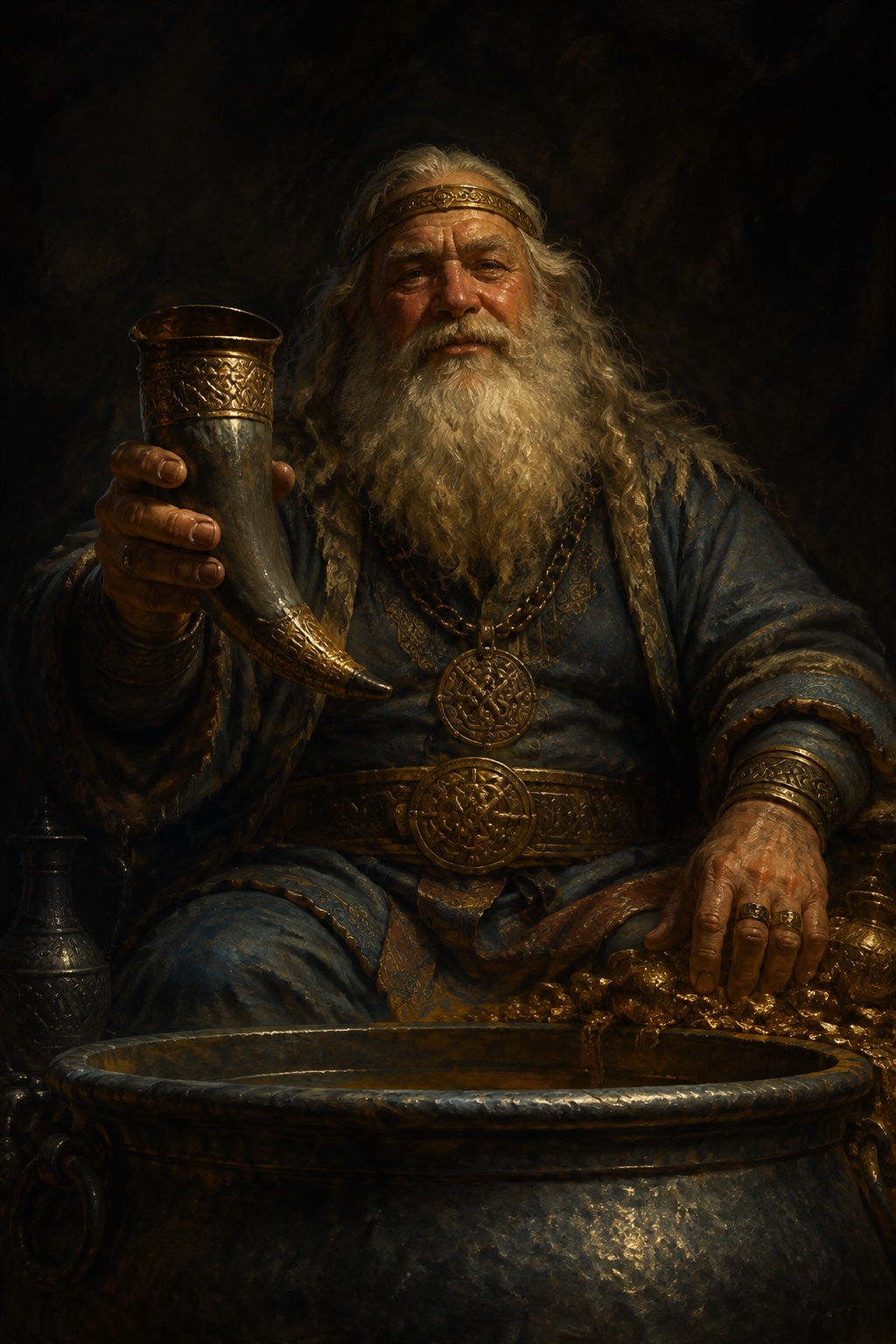
The ale, and what it cost to brew
Six entries in this wiki already happen at his house. Týr’s flyting, Bragi’s one speaking part, Frigg’s silence, Iðunn’s abduction told as after-dinner entertainment, Skaði seated among the goddesses — all of it is staged at a feast, and this is whose feast it is.
er öðru nafni hét Gymir, hann hafði búit ásum öl, þá er hann hafði fengit ketil inn mikla
“Ægir, who was also called Gymir, had prepared ale for the gods, after he had got the mighty kettle, as now has been told.” — Lokasenna, prose prologue, tr. H. A. Bellows
“As now has been told” points back at an entire poem. Hymiskviða exists because the gods wanted to drink at Ægir’s and he had no vessel big enough: they find good cheer at his place, Thor stares him down and tells him he will be brewing for the Æsir regularly, and Ægir — annoyed, and planning something — answers by demanding a kettle large enough to brew for all of them at once, which he knows they do not have. Thor has to go to the giant Hymir and carry back a cauldron a mile deep. The poem closes on what the errand was for.
en véar hverjan vel skulu drekka ölðr at Ægis eitt hörmeitið
“So gladly their ale the gods could drink In Ægir’s hall at the autumn-time.” — Hymiskviða 39 (Bellows prints it as 40), tr. H. A. Bellows
The demand was a test and he lost it, which is the first thing to know about him: he is a giant who sets the gods a task, and the task turns into a standing invitation.
A hall that serves itself
The prologue then describes the room, and the description is not of a hall but of a technology.
Sjálft barst þar öl. Þar var griðastaðr mikill
“the ale came in of itself; and great was the peace.” — Lokasenna, prose prologue, tr. H. A. Bellows
Glittering gold, Bellows adds just before this, they had in place of firelight. Two of his three marvels are the same idea: there is no hearth and no fire, only gold that gives light, and there are servants — Fimafeng and Eldir — but the ale carries itself to the bench. The third is the griðastaðr, the sanctuary, a place where quarrels are put down at the door. That is what makes the hall worth writing about and what makes what happens in it unbearable.
Loki cannot stand hearing the guests praise how good Ægir’s servants are, and he kills Fimafeng. The gods drive him into the woods and go back to drinking; he comes back, talks his way past Eldir, and works down the table insulting every god and goddess in the room. The most famous scene of slander in Norse literature happens inside the one building in the mythology that is explicitly a place of peace, and the sanctuary is exactly what makes it possible: nobody may strike him there.
Hlér, on his island
Snorri opens the Skáldskaparmál by sending the visit the other way.
Einn maðr er nefndr Ægir eða Hlér. Hann bjó í eyju þeiri, er nú er kölluð Hlésey. Hann var mjök fjölkunnigr
“A certain man was named Ægir, or Hlér. He dwelt on the island which is now called Hlér’s Isle, and was deeply versed in black magic.” — Snorri Sturluson, Skáldskaparmál 1, tr. A. G. Brodeur
Einn maðr — a certain man. Snorri does not call him a god, and does not call him a giant either; Bellows’ note on Hymiskviða settles for “a giant who is also the god of the sea”, which is about as far as the sources allow. What he is given instead is fjölkunnigr, deeply skilled in the hidden arts, and an island named after his other name.
This time he travels to Ásgard, and the Æsir put on a display for a guest who is known for his own: Odin has swords brought into the hall so bright that they light it, and no other light is used while the drinking lasts. It is the same trick as the gold in his hall, returned to him by hosts who know exactly whom they are entertaining. The whole of the Skáldskaparmál — the handbook of poetic language, Bragi’s stories of Þjazi and Iðunn included — is told to Ægir at that table.
The nine daughters
The sea is his in the kennings, and his family is the vocabulary for it.
Dætr þeira Ægis ok Ránar eru níu, ok eru nöfn þeira fyrr rituð: Himinglæva, Dúfa, Blóðughadda, Hefring, Uðr, Hrönn, Bylgja, Dröfn, Kólga
“The daughters of Ægir and Rán are nine, and their names are recorded before: Himinglæva, Dúfa, Blódughadda, Hefring, Udr, Hrönn, Bylgja, Dröfn, Kólga.” — Snorri Sturluson, Skáldskaparmál, tr. A. G. Brodeur
They are waves, and the names say so: Bylgja is billow, Hrönn is the roller, Blóðughadda is the bloody-haired one, Kólga the cold. Snorri’s list of ways to call the sea puts him at the centre of it — Ymir’s blood, the visitor of the gods, the husband of Rán, the father of Ægir’s daughters — so that naming the sea in a skaldic poem means naming his household.
This is also where Heimdall comes from. His entry here already gives him nine mothers, sisters, daughters of Ægir, and the wave-maidens are who that means. A god born of nine waves at the world’s edge and posted to watch the rainbow bridge is a genealogy with a shape: the sentinel of the sky begins at the shore.
One caution the sources themselves raise. The Lokasenna prologue says Ægir was also called Gymir, and Bellows notes that Gymir is elsewhere the name of a different giant altogether — Gerðr’s father, whom Freyr’s suit is addressed to. The two are not the same figure, and the compiler who wrote the prologue was, on Bellows’ reading, less well informed about the mythology than the poet he was annotating.