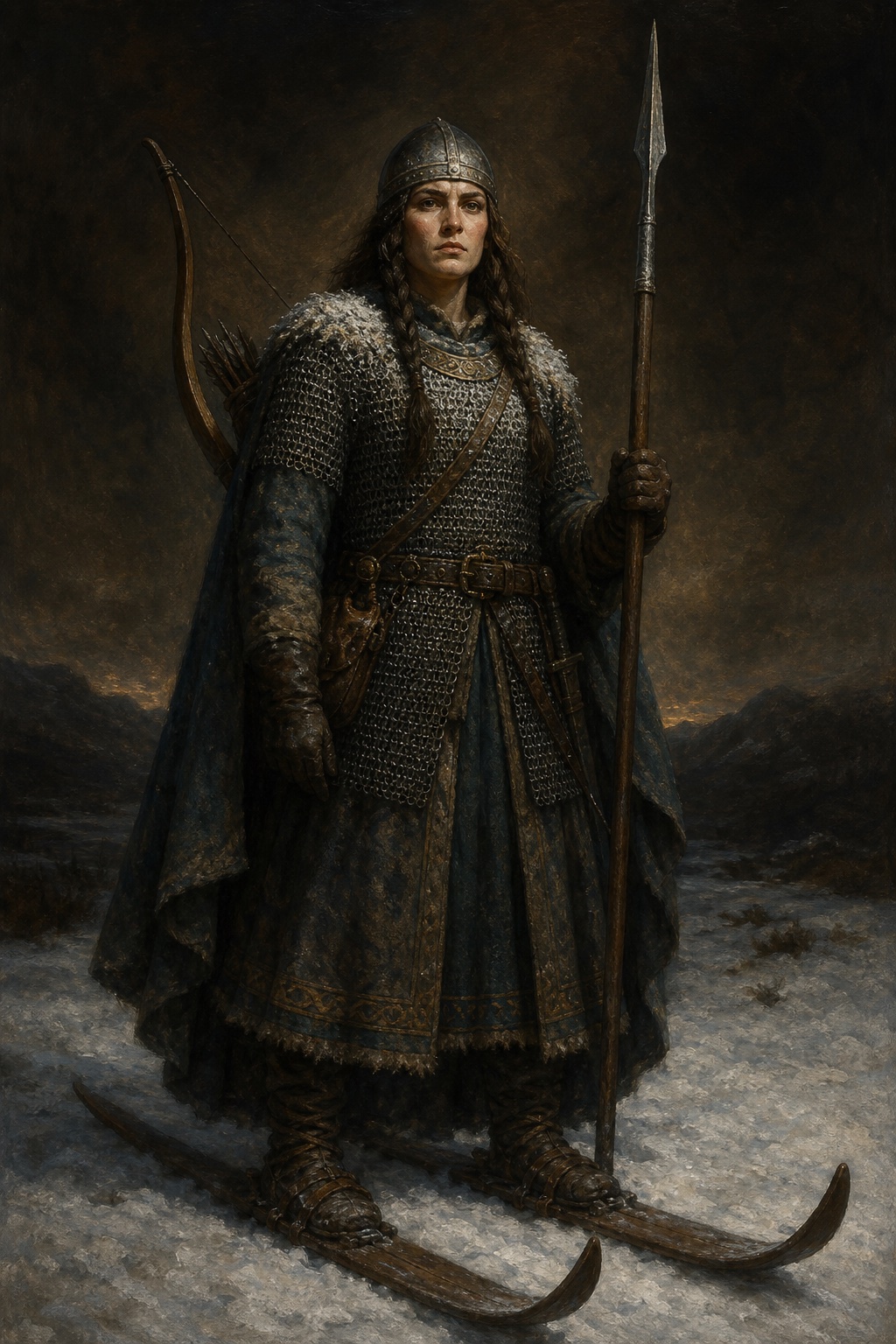
Armed for her father’s blood
By the time Skaði enters her own story, her father is already dead. Þjazi the jötunn had pursued Loki home in eagle shape; his feathers catch fire mid-flight, and the Æsir kill him within their own gates — a slaying, Snorri says, that becomes famous in its own right. Skáldskaparmál, the tale the god Bragi tells at Ægir’s feast, picks up exactly there, with the daughter rather than the aftermath of the kill. She does not come to mourn.
En Skaði dóttir Þjaza jötuns, tók hjálm ok brynju ok öll hervápn ok ferr til Ásgarðs at hefna föður síns. En æsir buðu henni sætt ok yfirbætr ok it fyrsta, at hon skal kjósa sér mann af ásum ok kjósa at fótum ok sjá ekki fleira af. Þá sá hon eins manns fætr forkunnarfagra ok mælti: “Þenna kýs ek. Fátt mun ljótt á Baldri.” En þat var Njörðr ór Nóatúnum. Þat hafði hon ok í sættargerð sinni, at æsir skyldu þat gera, er hon hugði, at þeir skyldu eigi mega, at hlægja hana. Þá gerði Loki þat, at hann batt um skegg geitar nökkurrar ok öðrum enda um hreðjar sér, ok létu þau ýmsi eftir ok skrækði hvárt tveggja hátt. Þá lét Loki fallast í kné Skaða, ok þá hló hon. Var þá ger sætt af ásanna hendi við hana
“Now Skadi, the daughter of the giant Thjazi, took helm and birnie and all weapons of war and proceeded to Ásgard, to avenge her father. The Æsir, however, offered her reconciliation and atonement: the first article was that she should choose for herself a husband from among the Æsir and choose by the feet only, seeing no more of him. Then she saw the feet of one man, passing fair, and said: ‘I choose this one: in Baldr little can be loathly.’ But that was Njördr of Nóatún. She had this article also in her bond of reconciliation: that the Æsir must do a thing she thought they would not be able to accomplish: to make her laugh. Then Loki did this: he tied a cord to the beard of a goat, the other end being about his own genitals, and each gave way in turn, and each of the two screeched loudly; then Loki let himself fall onto Skadi’s knee, and she laughed. Thereupon reconciliation was made with her on the part of the Æsir.” — Snorri Sturluson, Skáldskaparmál 3, tr. Brodeur
Vengeance turns out to be negotiable. The Æsir do not fight her; they offer terms, and the terms are stranger than a battle would have been. She may pick any husband from among them, on the condition that she judges purely by the feet, seeing nothing else of him first. Reading a clean, well-formed pair as a sign of youth, she is certain she has chosen Baldr, the most radiant of the gods, and gets Njörðr instead, ruler of the sea and no one’s obvious match for a mountain giant’s daughter. Her second condition is worse: the Æsir must make her laugh, sworn as she is that nothing could. Loki is the one who manages it, tying himself to a goat by the most undignified cord imaginable until the yelping fit lands him, still attached, in Skaði’s lap — and for exactly as long as it takes to close the deal, the court of the gods becomes a stage act.
A jötunn’s daughter among the Ásynjur
Snorri introduces her, in that same passage, as Þjazi’s daughter — jötunn-born, the same stock as Loki and Angrboða and the frost-giants the Æsir spend most of their myths fighting off. Nothing in this material calls her gýgr, an ogress, the way it does Angrboða; instead, elsewhere in the same work, Snorri names her plainly among the Ásynjur, the goddesses proper, seated at Ægir’s second feast beside Frigg and Freyja.
A giant father does not bar the daughter from the company the Æsir keep, any more than jötunn birth bars Loki from their hall. What settles her status is not blood but where the story finally puts her: married in, and, as it turns out, married out again, Skaði keeps the standing of a goddess for as long as the tradition survives.
Snowshoe-goddess of Þrymheimr
Once the marriage founders, this is where the record goes looking for her: not back to a father’s hall, since Þjazi is dead, but up onto Þrymheimr, the mountain stronghold that had been his and is now hers. Snorri’s Gylfaginning, closing out from the other side the same divorce that Skáldskaparmál narrates as backstory, gives her a permanent occupation there and a pair of names to go with it.
Þá fór Skaði upp á fjall ok byggði í Þrymheimi, ok ferr hon mjök á skíðum ok með boga ok skýtr dýr. Hon heitir öndurgoð eða öndurdís
“Then Skadi went up onto the mountain, and dwelt in Thrymheimr. And she goes for the more part on snowshoes and with a bow and arrow, and shoots beasts; she is called Snowshoe-Goddess or Lady of the Snowshoes” — Snorri Sturluson, Gylfaginning 23, tr. Brodeur
Skis, a bow, and a habit of hunting rather than gathering: this is not a domestic coda to the marriage but a return to the terrain she announced from the first line of her own story, arriving at Ásgarðr armed and ready to look after herself. The two bynames Snorri gives her here are the only ones the record attaches to her at all — earned, unlike Njörðr’s placid harbor cult, on skis and with a bow in hand rather than at a hearth.
A marriage the mountains would not allow
The choice by the feet, in the opening scene, is the marriage’s beginning, not its whole story. What Skaði gets for a husband is Njörðr — a match the settlement itself frames as compensation, not romance, and the two of them discover almost at once that neither can live where the other does. Snorri records the parting a second time, later in the same Skáldskaparmál, mentioning it in passing as settled history rather than news.
What both traditions agree on is the direction of the failure. It is Skaði who leaves — the mountains keep her, the sea does not — and every later mention of the marriage in Snorri’s work treats that as the ending, not a temporary rift.