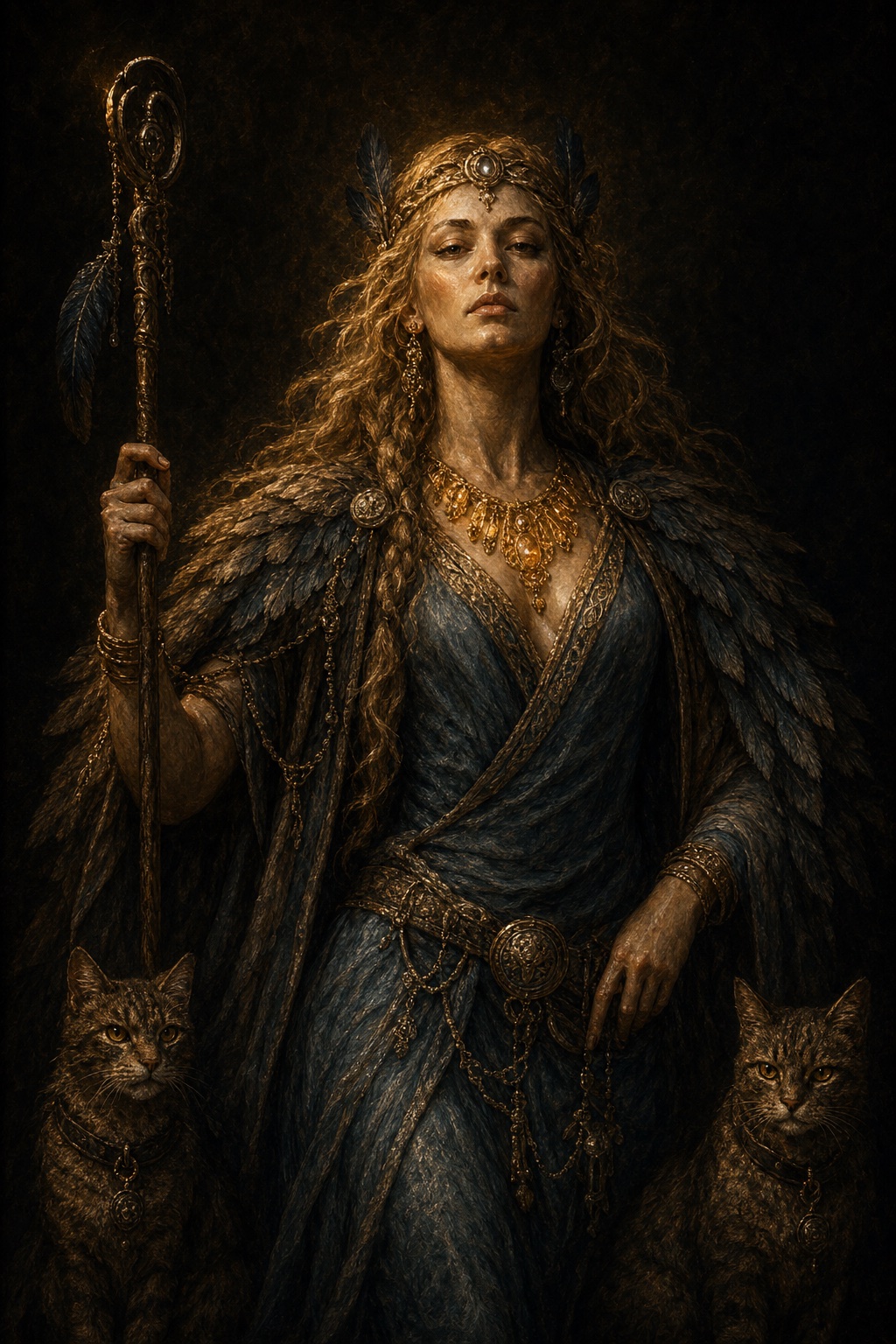
Freyja is the foremost goddess of the Vanir, sent to live among the Æsir with her father Njörðr and twin brother Freyr as part of a truce between the two divine clans. She governs love, beauty, and fertility, but her domain is broader and darker than that alone: she is a master of seiðr, the magic of prophecy and fate, which she is said to have taught to Odin himself. She wears the glittering necklace Brísingamen, won from four dwarven smiths, rides in a chariot drawn by cats, and can don a cloak of falcon feathers to fly between the worlds. She weeps tears of red gold for her husband Óðr, who wanders far from her.
Freyja is also a goddess of the battlefield. Of those who fall in war, she has first choice, taking half to her hall Sessrúmnir in the meadow Fólkvangr — the rest go to Odin’s Valhalla.
Fólkvangr er inn níundi, en þar Freyja ræðr sessa kostum í sal; halfan val hon kýss hverjan dag, en halfan Óðinn á
“The ninth is Folkvang, where Freyja decrees / Who shall have seats in the hall; / The half of the dead each day does she choose, / And half does Othin have.” — Grímnismál 14, tr. Bellows
Norse sources call her simply “the lady,” and by the late Viking Age her name may have stood in for goddesses generally, a measure of how central her cult was.