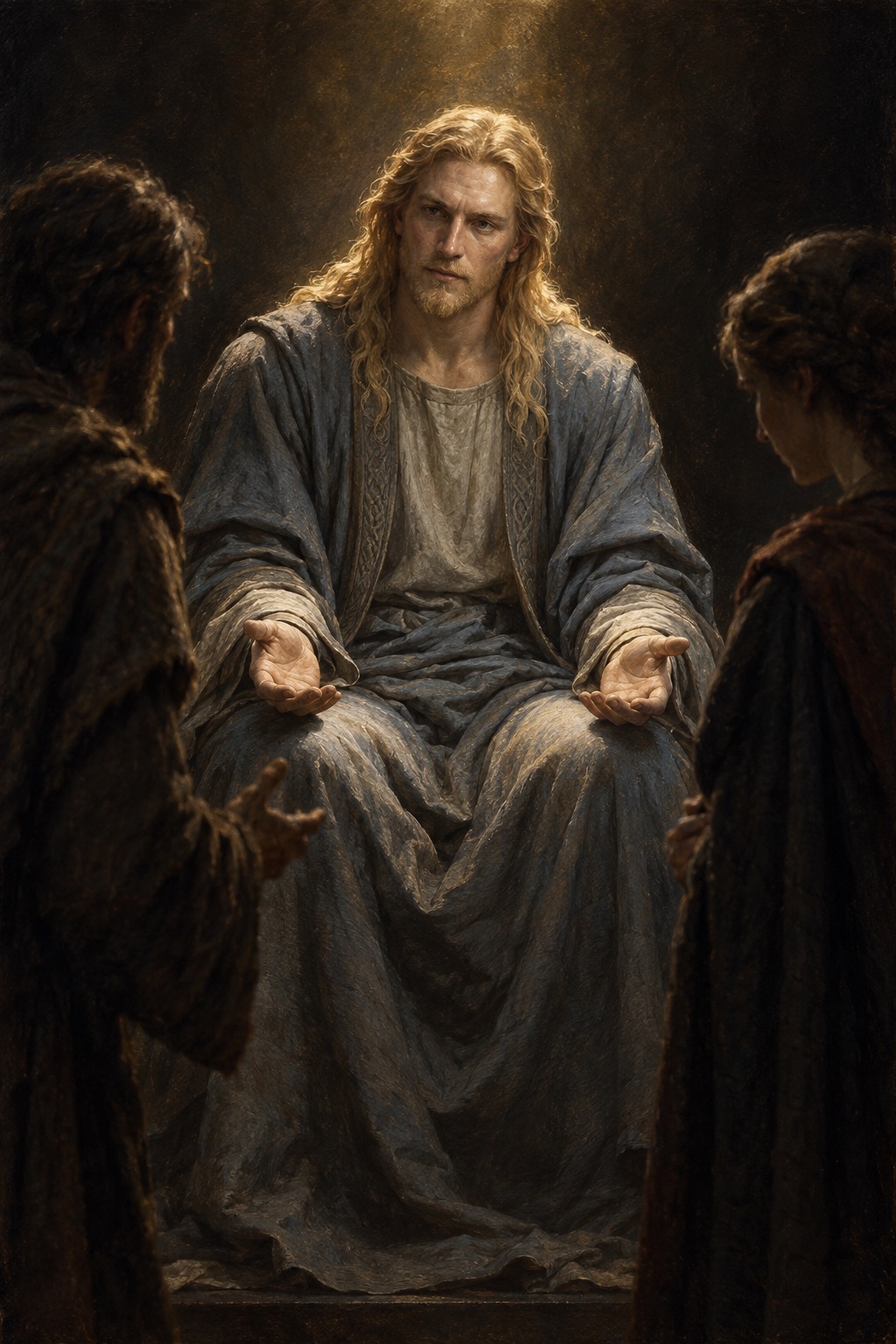
A chapter of his own
Snorri gives Forseti a chapter of Gylfaginning to himself, headed Frá Forseta, and then moves straight on to Loki in the next one. Before it turns to a poem, the chapter is four sentences of prose, and this is all of them.
Forseti heitir sonr Baldrs ok Nönnu Nepsdóttur. Hann á þann sal á himni, er Glitnir heitir. En allir, er til hans koma með sakarvandræði, þá fara allir sáttir á braut. Sá er dómstaðr beztr með goðum ok mönnum.
“Forseti is the name of the son of Baldr and Nanna daughter of Nep: he has that hall in heaven which is called Glitnir. All that come to him with such quarrels as arise out of law-suits, all these return thence reconciled. That is the best seat of judgment among gods and men” — Snorri Sturluson, Gylfaginning 32, tr. A. G. Brodeur
Take the four sentences apart and very little is left standing. The first is a parentage. The second gives him a building. The third says what happens to the people who come to the building. The fourth grades the building against every other one like it. Nothing in the chapter describes Forseti — not his face, not his age, not what he wears or carries, not one adjective of his own. Nothing in it happens on a particular day, to a named person, with a named outcome. Baldr, earlier in the same catalogue, gets light coming off his body and a hall into which nothing unclean may come; Loki, in the chapter immediately after this one, gets a father, a mother, two brothers and a character. Forseti gets an address and a job.
Glitnir, and the stanza behind the chapter
The hall is his one real attribute, and it comes from a poem rather than from Snorri. Grímnismál runs through the dwellings of the gods in order, and Glitnir is the tenth of them.
Glitnir er inn tíundi, hann er gulli studdr ok silfri þakðr it sama; en þar Forseti byggir flestan dag ok svæfir allar sakir.
“The tenth is Glitnir; its pillars are gold, / And its roof with silver is set; / There most of his days does Forseti dwell, / And sets all strife at end.” — Grímnismál 15, tr. H. A. Bellows
Snorri did not arrive at his account separately. Immediately after the sentence about the best seat of judgment, his chapter says Svá segir hér — thus it is said here — and quotes this same stanza, numbering it 41 in his own running tally of citations rather than 15. So the two records of Forseti are not two witnesses that happen to agree. One is a stanza in a catalogue of halls; the other is a prose gloss on that stanza, with a genealogy fixed to the front of it.
The stanza Snorri copied is also not quite the stanza the poem carries. Where Grímnismál opens Glitnir er inn tíundi, the tenth, his text reads Glitnir heitir salr, which Brodeur renders “A hall is called Glitnir” — the numbering falls away, because in Gylfaginning the hall is not tenth in anything. The closing verb comes through differently too. Bellows has Forseti set “all strife at end”; Brodeur, translating Snorri’s copy, writes that Forseti “puts to sleep all suits”, which stays closer to svæfir, the verb both texts use. Gold pillars, a silver roof, most of the day spent there: that much is identical in both, and all of it describes the building.
An office, not an episode
Everything said about Forseti is said in the present tense of a standing arrangement. He has the hall. All who come to him with suits go away reconciled. He dwells there most of the day. No case is described, no party is named, no judgement is quoted, and nothing is dated to a particular occasion. Most of the Norse material is episode — Thor goes somewhere and fights, Odin bargains and travels under a false name, Týr puts his hand in a wolf’s mouth, Loki is bound under a snake. Forseti is handed a function and left standing in it, and no source reachable from here comes back to look at him again.
The function is worth reading slowly, because of what the parties do afterwards. Gylfaginning calls Glitnir a dómstaðr, a judgment-place, which Brodeur gives as a seat of judgment. People arrive at it with sakarvandræði, the trouble of lawsuits, and they leave sáttir — reconciled, settled with each other. Nobody is sentenced, no loser is named, and no penalty is mentioned. Grímnismál says the same thing with a quieter verb: he svæfir allar sakir, puts every suit to sleep. In everything this corpus can reach, no other hall in the Norse world is described doing that to the people who walk into it.
The son of Baldr and Nanna
Half of what is recorded about him is whose son he is, and the other half is a building, so the parentage carries more weight here than it would anywhere else. Snorri’s praise of Baldr ends on a qualification that readers have argued about ever since: none of his judgements can be made to stand. His son holds the best seat of judgment among gods and men. What is worth noticing is that neither source notices. The stanza does not mention Baldr at all — Forseti is simply the one who lives in the tenth hall. Snorri states the parentage and the office in a single breath, draws no line between them, offers no explanation, and never returns to either. The contrast is real, and it is entirely the reader’s to make.
Past his father and his mother, Nanna, the family stops. No reachable source gives him a wife, a child, a brother or a sister. Nothing this corpus can reach records his death, puts him anywhere in the events of Ragnarök, or gives him a line of speech. Modern scholarship has long connected his name with Fosite, a god of the Frisian coast, but no Norse text quoted on this page knows anything about that connection, and it is recorded here as a scholarly observation rather than as something the sources say.
So the domains on this page really are the whole of him: justice for the seat, order for the state the parties are in when they leave it. He is a god with an address, an office and no biography. That is not a gap in the record. That is the record.