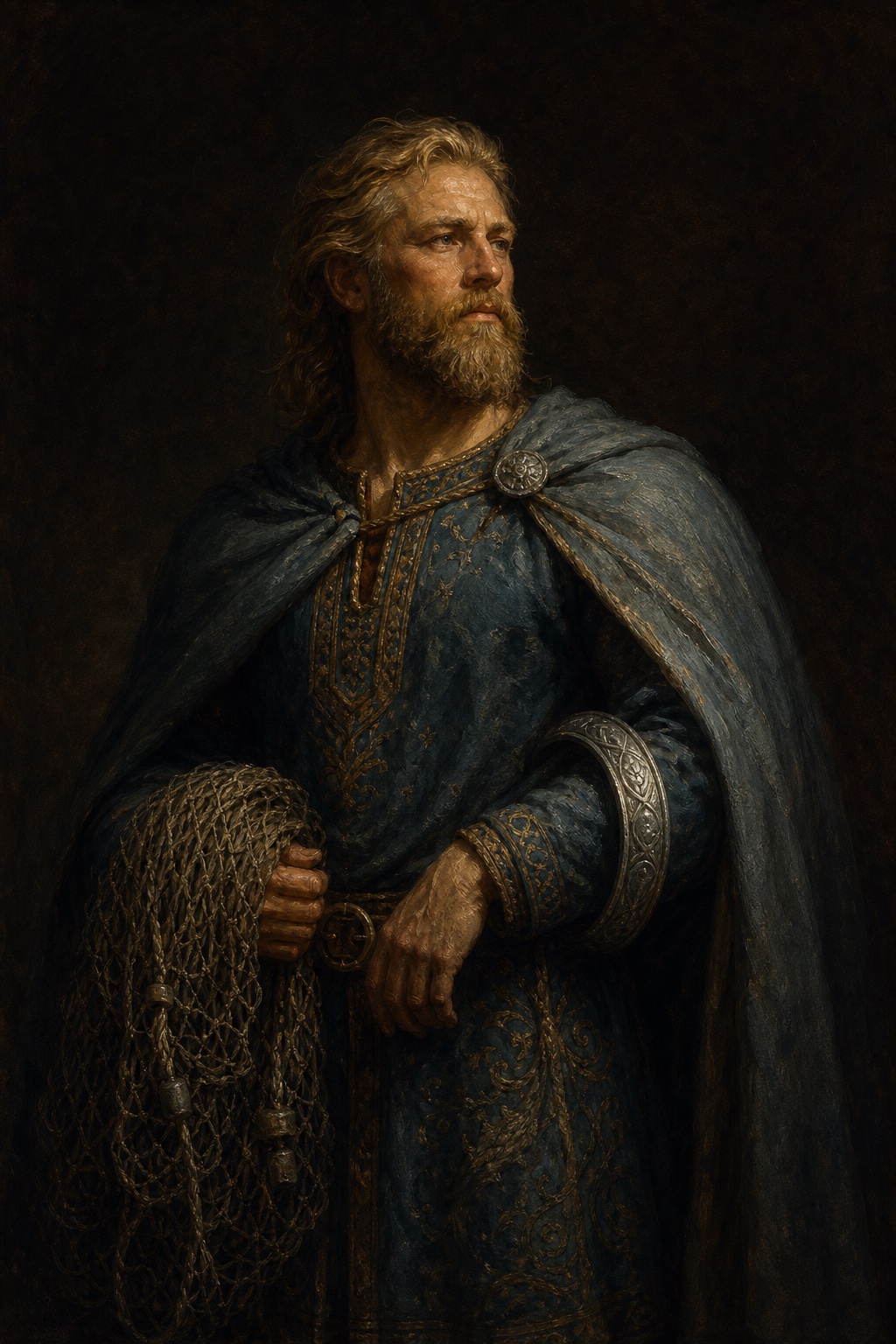
Njörðr is not an Áss. Snorri says so plainly, in the middle of listing him among the Æsir: he was raised in Vanaheimr, and the Vanir handed him over as a hostage when the two families of gods made peace. Hœnir went the other way. So the god who governs the sea, the wind and seafaring holds his position in Ásgarðr by treaty, not by birth — and the treaty is the reason Freyja and Freyr, the two most popular deities in the Norse record, are inside the pantheon at all.
What he actually does is unglamorous and enormously practical. He calms the sea and the fire, he is invoked for voyages and for fishing, and he is so wealthy that he can hand out land and goods to anyone who asks properly. In a religion whose most famous god hangs himself on a tree for knowledge, Njörðr is the one you pray to when you want the boat to come back.
His one memorable scene is a marriage that does not work. Skaði, a giant’s daughter, is owed compensation for her father’s death and chooses a husband from among the gods by looking only at their feet; she picks the cleanest pair expecting Baldr, and gets Njörðr. They then discover that neither can live where the other lives.
Leið erumk fjöll, vark-a ek lengi á, nætr einar níu; ulfa þytr mér þótti illr vera hjá söngvi svana
“Loath were the hills to me, I was not long in them, nights only nine; to me the wailing of wolves seemed ill, after the song of swans.” — Snorri Sturluson, Gylfaginning 23, tr. Brodeur
Skaði answers in the same metre and the same shape, and it is the mirror image: she cannot sleep by the sea for the screaming of gulls. Nine nights in her mountains, nine in his Nóatún, and then they simply stop. She goes back up to Þrymheimr to ski and hunt, he stays by the water. No betrayal, no curse, no revenge — the marriage fails because the sea and the mountains are incompatible and neither party is willing to pretend otherwise.
That is a strikingly domestic note for a mythology usually read for its apocalypse, and it is the clearest surviving statement of a distinction the Norse cared about: sea and shore against upland and forest, the settled coast against the wild interior. Njörðr is the coast, personified and comfortable. It is also worth noticing that the Vanir lost the war and then supplied the gods people actually prayed to — a pattern Greece repeats with the Titans, where the defeated generation keeps the sun, the memory and the oracle while the winners keep the throne.