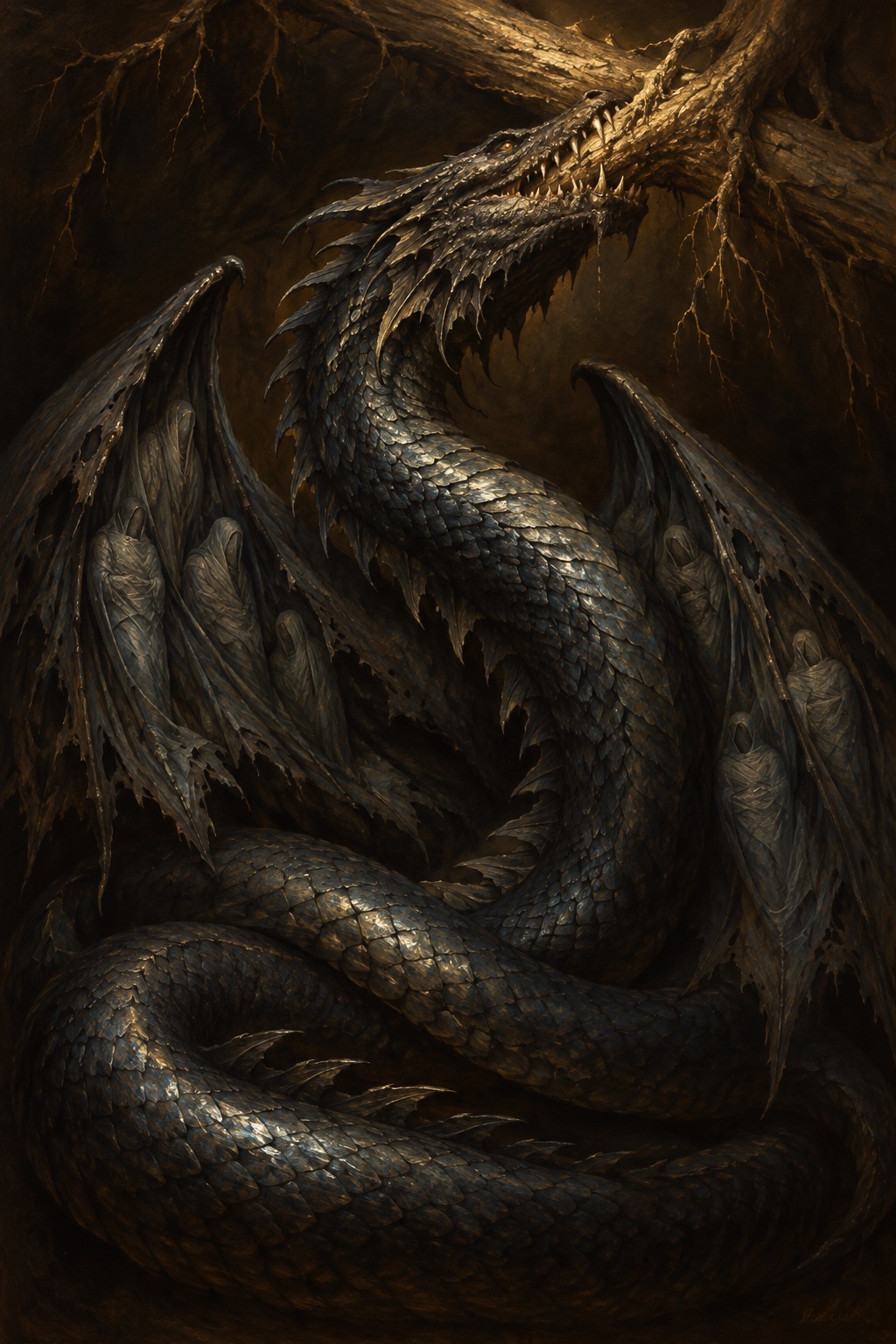
Beneath the ash
Níðhöggr has no story of his own. The texts on this page, two poems and Snorri’s prose, give him a line or two at a time. The fullest picture of where he lives comes from Grímnismál. The poem is the speech of a stranger who calls himself Grímnir. A king has him tortured and sets him between two fires, and he sits there for eight nights before he speaks. In the last stanza he names himself Odin.
In the middle of the speech Grímnir turns to the ash Yggdrasil, and five stanzas tell what lives on it and under it. Stanza 31 gives the tree three roots that run three ways: Hel lives under the first, the frost-giants under the second, and men under the third. A squirrel runs on the tree, and four harts nibble at it. Stanza 34 says that more serpents lie under the ash than a fool would think, and it names six of them and says that they will always gnaw at the tree’s twigs. Then the poem sums up the harm.
Askr Yggdrasils drýgir erfiði meira en menn um viti: hjörtr bítr ofan, en á hliðu fúnar, skerðir Niðhöggr neðan
“Yggdrasil’s ash great evil suffers, Far more than men do know; The hart bites its top, its trunk is rotting, And Nithhogg gnaws beneath” — Grímnismál 35, tr. H. A. Bellows
The stanza names three harms, one for each part of the tree. A hart bites it from above, hjörtr bítr ofan. Its side rots, á hliðu fúnar. And from below, skerðir Niðhöggr neðan, which Bellows translates “And Nithhogg gnaws beneath”. Of the three, only Níðhöggr has a name. The poem does not say which root is his, what kind of creature he is, or what he looks like. The line gives him a place, beneath the tree, and an act in the present tense, which does not stop. Bellows, in his note on the harts of stanza 33, calls Níðhöggr “the only authentic dragon under the root of the ash”, and he thinks the serpents of stanza 34 are a later growth out of him.
Snorri Sturluson tells the same thing in his own prose, in Gylfaginning 15, and he is more exact. His ash also has three roots, but they are not the poem’s three: one is among the Æsir, one is among the frost-giants, and the third stands over Niflheim.
undir þeiri rót er Hvergelmir, en Níðhöggr gnagar neðan rótina
“under that root is Hvergelmir, and Nídhöggr gnaws the root from below” — Snorri Sturluson, Gylfaginning 15, tr. A. G. Brodeur
Only Snorri says which root Níðhöggr gnaws, and only Snorri puts Hvergelmir under it. The five stanzas of Grímnismál name neither Niflheim nor Hvergelmir, and their three roots cover Hel, the frost-giants and men. Snorri’s verb is his own too: gnagar, where the poem has skerðir, though Brodeur and Bellows both translate “gnaws”. In the next chapter Snorri quotes Grímnismál 35 as his proof, and he adds a detail that the poem does not give. So many serpents are in Hvergelmir with Níðhöggr, in Brodeur’s English, “that no tongue can tell them”.
Words from the eagle
Three stanzas before the gnawing, Grímnismál 32 gives Níðhöggr his one link with the top of the tree.
Ratatoskr heitir íkorni, er renna skal at aski Yggdrasils, arnar orð hann skal ofan bera ok segja Niðhöggvi niðr
“Ratatosk is the squirrel who there shall run On the ash-tree Yggdrasil; From above the words of the eagle he bears, And tells them to Nithhogg beneath” — Grímnismál 32, tr. H. A. Bellows
The squirrel is Ratatoskr, and he has one task. He carries the eagle’s words, arnar orð, from above, ofan, and he tells them to Níðhöggr below, niðr. In the poem the words go one way only. The stanza does not say what the eagle says, and it does not say that Níðhöggr ever answers. The eagle has no name here, and nothing in the stanza but its words. Bellows, in his note, translates the squirrel’s name as “The Swift-Tusked”.
Snorri gives the errand a second direction and a tone. In Gylfaginning 16 an eagle sits in the limbs of the ash, with the hawk Veðrfölnir between its eyes, and Ratatoskr runs up and down the tree: berr öfundarorð milli arnarins ok Níðhöggs, he carries words of envy between the eagle and Níðhöggr. Brodeur translates the clause “bearing envious words between the eagle and Nídhöggr”. Now the words go both ways, and they are envious. Neither text says what the eagle and the dragon envy in each other, or why.
This wiki records Ratatoskr as Níðhöggr’s messenger on the evidence of the poem: the squirrel carries the words down, and Níðhöggr is the one who receives them.
The hall on Náströnd
Völuspá is the speech of a seeress, a völva, whom Odin has called on to speak, as Bellows’s first note puts it. In the Old Norse, stanza 39 speaks of her in the third person, Sá hon, she saw, and Bellows puts it in the first person. Níðhöggr comes into the poem at stanza 39, as part of what she saw on Náströnd. Stanza 38 comes first and sets the scene, and the scene is not his. It is a hall far from the sun on Náströnd, with its doors facing north. Venom drops in through the smoke-vent, and serpents wind around the walls. Bellows’s note translates the name Náströnd as “Corpse-Strand”.
Sá hon þar vaða þunga strauma menn meinsvara ok morðvarga ok þann er annars glepr eyrarúnu; þar saug Niðhöggr nái framgengna, sleit vargr vera
“I saw there wading through rivers wild Treacherous men and murderers too. And workers of ill with the wives of men; There Nithhogg sucked the blood of the slain, And the wolf tore men” — Völuspá 39, tr. H. A. Bellows
Three kinds of people wade the streams there: menn meinsvara, oath-breakers; morðvarga, murderers; and a third kind that Bellows translates as “workers of ill with the wives of men”. His note calls that third line probably a later addition, and it says that the stanza shows the torments of the two worst kinds of criminal, oath-breakers and murderers.
Then comes Níðhöggr’s line, þar saug Niðhöggr nái framgengna. Bellows translates it “There Nithhogg sucked the blood of the slain”, but the Old Norse names no blood. Saug is sucked, and nái framgengna are the corpses of the dead. The same word, nái, closes stanza 66, and there Bellows translates it “The bodies of men”. The stanza does not say whose corpses they are, and it does not say why Níðhöggr is on Náströnd at all. The last half-line belongs to another creature: sleit vargr vera, the wolf tore men. The stanza does not name the wolf, and Bellows’s note takes it to be Fenrir.
In the same note Bellows translates the name Níðhöggr as “the Dread Biter”, and he calls him the dragon that lies beneath the ash and gnaws at its roots, with a pointer to Grímnismál 32 and 35. That link is the translator’s. Völuspá itself never puts Níðhöggr under the tree, and Grímnismál never puts him on Náströnd.
The dragon dark
Völuspá names Níðhöggr once more, at its very end. Near the close of the poem the seeress sees the earth rise again out of the waves, all green, and a hall fairer than the sun, roofed with gold, on Gimlé. In stanza 65 the mighty one comes, öflugr ofan, from above, the one who rules all. Stanza 66 answers from below.
Þar kemr inn dimmi dreki fljúgandi, naðr fránn, neðan frá Niðafjöllum; berr sér í fjöðrum, - flýgr völl yfir, - Niðhöggr nái
“From below the dragon dark comes forth, Nithhogg flying from Nithafjoll; The bodies of men on his wings he bears, The serpent bright” — Völuspá 66, tr. H. A. Bellows
Both stanzas turn on the same verb, kemr, comes. The mighty one comes ofan, from above. The dragon comes neðan, from below, from Niðafjöll. Bellows’s note translates Niðafjöll as “the Dark Crags” and says that the name is found nowhere else.
This is the only stanza that shows Níðhöggr’s body, and it shows the body in motion. He comes fljúgandi, flying. He carries the corpses í fjöðrum, in his feathers, which Bellows makes his wings. And flýgr völl yfir, he flies over the plain. Reginsmál and Fáfnismál give Fáfnir neither wings nor legs. Níðhöggr has wings and flies. The stanza still gives him no legs, no fire and no size.
The same four lines give him two names, one dark and one bright. He is inn dimmi dreki, the dark dragon, and he is naðr fránn, which Bellows translates “The serpent bright”. Fránn is the word that Sigurd uses for Fáfnir in Fáfnismál 19, Inn fráni ormr. Völuspá gives the dark and the bright to the same creature in one stanza and does not choose between them.
Then the poem stops. After the dragon comes a half-line, Nú mun hon sökkvask, now she will sink. Bellows translates it “but now must I sink”. His note says that the manuscripts have “must she”, and that by its gender the half-line refers to the seeress, not to the dragon. Bellows thinks that the stanza fits badly with the stanzas before it and may be a later addition. He reports a suggestion that the dragon makes a last attempt to rise and is destroyed, and he himself thinks the stanza belongs in the account of the great battle. The poem says neither of these things. It leaves Níðhöggr in the air, over the plain, with the dead in his wings, and the seeress sinks.
None of the three works on this page, Grímnismál, Völuspá and Gylfaginning, gives Níðhöggr a father, a mother or a beginning. He is under the root in Grímnismál and in Snorri, on Náströnd in Völuspá 39, and in the air in Völuspá 66. No text says how he goes from one place to the next. Fáfnir and Jörmungandr both come with a family. Níðhöggr has only his places and his acts.
This wiki files Níðhöggr with the monsters for the two names that Völuspá gives him, dreki and naðr, dragon and serpent. Death is for the corpses: the dead that he sucks on Náströnd and the bodies that he carries in his wings. Chaos is for the root: in Grímnismál 35 he is one of the harms that the ash suffers, the one that comes from below, and Bellows’s note makes him a symbol of “the destructive elements in the universe”.