The otter’s ransom
Fáfnir’s story is first told by his brother. In the prose of Reginsmál, Reginn is fostering the young Sigurd, and he tells him about his own family. The father is Hreiðmarr. There are three sons, Fáfnir, Reginn and Otr, and two daughters, Lyngheiðr and Lofnheiðr, whom the poem first names when their father calls on them as he dies. Otr often went into Andvari’s waterfall in the shape of an otter. One day he caught a salmon and sat on the bank eating it with his eyes shut, and Loki threw a stone at him and killed him. Odin, Hœnir and Loki skinned the otter, and that evening they asked for a night’s lodging at Hreiðmarr’s house and showed him what they had caught.
The family seized the three gods and set the price of their lives. They had to fill the otter’s skin with gold and then cover it on the outside with red gold as well. The gods sent Loki to get it. He borrowed Rán’s net and cast it in Andvari’s fall, where the dwarf Andvari lived in the shape of a pike, and caught him. He took all of Andvari’s gold, and one ring that the dwarf tried to hold back. Andvari went into his rock and put a curse on the gold: it would bring death to two brothers and harm to eight heroes, and no man would have joy of it. The gods filled the skin and heaped gold over it. Hreiðmarr found one whisker still showing, and Odin covered it with the ring. Then Loki spoke his own curse over the payment. Hreiðmarr’s sons would find no fortune in it, he said, and it would be the bane of both. Hreiðmarr answered that he would rule the red gold as long as he lived, and that he had no fear of their threats.
Fáfnir and Reginn asked their father for a share of the payment for their brother’s death. Hreiðmarr refused.
En Fáfnir lagði sverði Hreiðmar, föður sinn, sofanda
“Fafnir thrust his sword through the body of his father, Hreithmar, while he was sleeping” — Reginsmál, prose after st. 9, tr. H. A. Bellows
The Old Norse sentence begins with En, “and” or “but”, and so the killing follows the refusal with no pause between them. There is no quarrel, no challenge and no fight. The last word of the sentence is sofanda, sleeping. Fáfnir’s first act in Reginsmál is to kill a man in his sleep, and the man is his father.
Hreiðmarr does not die at once. He calls on his daughters, Lyngheiðr and Lofnheiðr, and tells them that his life is lost. Lyngheiðr answers that a sister will seldom take revenge on her brother, even when she loses her father. Hreiðmarr then asks for revenge one generation further on. If she has no son by a prince, she must bear a daughter and find the girl a husband, and the son of that marriage will avenge the wrong. Then Hreiðmarr dies, and Fáfnir takes all the gold. Reginn asks for his inheritance from their father, and Fáfnir refuses him too. Lyngheiðr advises Reginn to ask his brother kindly, and not to try to take Fáfnir’s treasure with the sword. Reginn tells all of this to Sigurd.
The worm on the gold
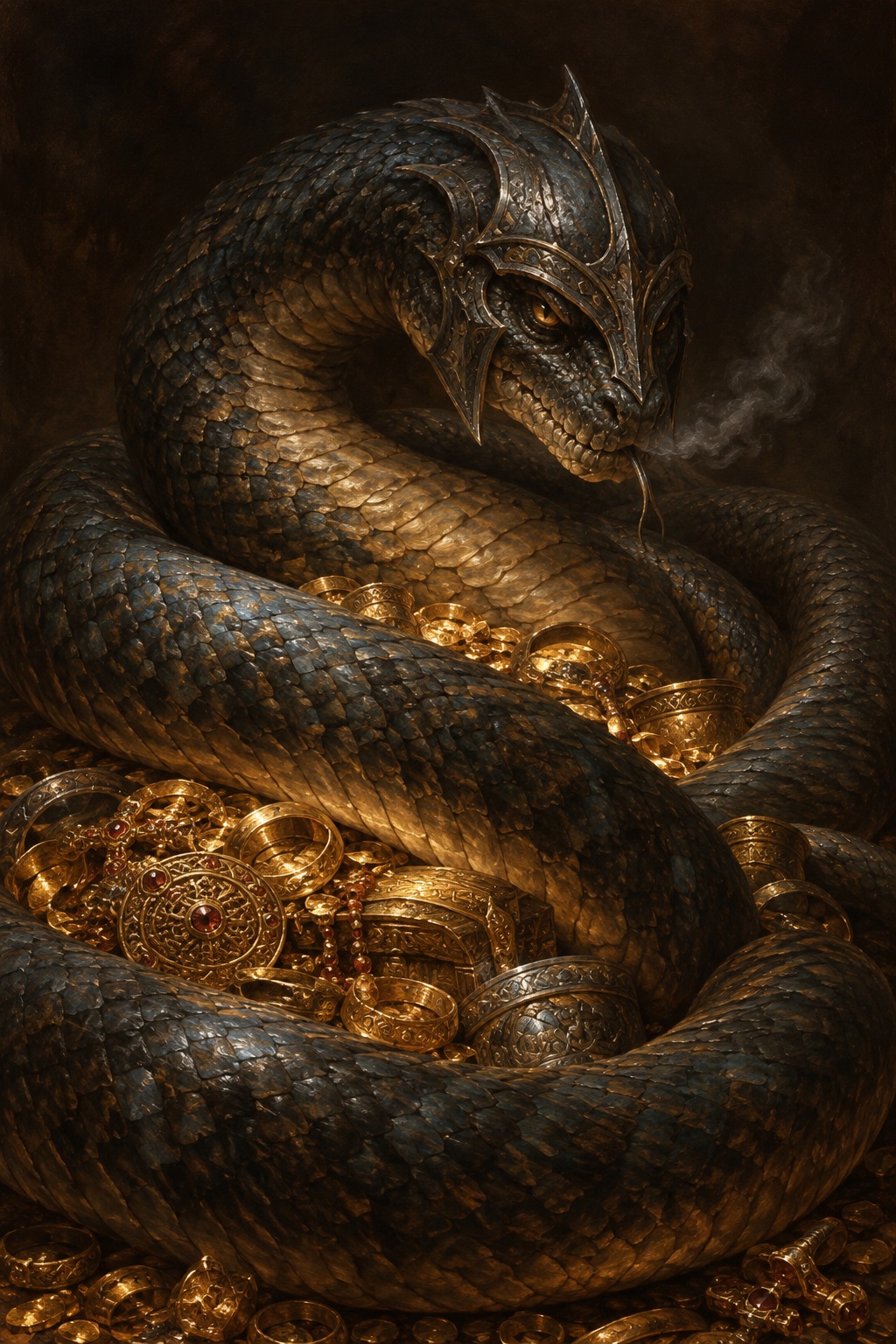
Reginn ends his account with the news that sends Sigurd out. Fáfnir lies on Gnitaheiðr, í orms líki, in the shape of a serpent, and he has a helm, the ægishjálmr, which every living creature fears. That is all that Reginsmál says about what he became. It does not say how he came to take a serpent’s shape, or when. Bellows translates the phrase as “the shape of a dragon”, but the Old Norse word is ormr, the ordinary word for a serpent or a worm.
Fáfnismál, which in the manuscript follows straight on from the prose of Reginsmál, shows what the body does. Fáfnir has a track that he makes when he crawls to water, and the verb is skreið, crawled. When he crawls from the gold he blows venom, blés hann eitri. When the sword goes into him, he shakes himself and beats with his head and his tail, barði höfði ok sporði. That is the whole of his body in the Old Norse: a head, a tail, a track on the ground and the venom that he blows. Neither poem gives him wings or legs, and what he breathes out is venom, never fire.
His own account of the years on the gold comes in the middle of his dying conversation with Sigurd.
Ægishjalm bar ek of alda sonum, meðan ek of menjum lák; einn rammari hugðumk öllum vera, fannk-a ek svá marga mögu
“The fear-helm I wore to afright mankind, While guarding my gold I lay; Mightier seemed I than any man, For a fiercer never I found” — Fáfnismál 16, tr. H. A. Bellows
This is his own summary of what he was, and he measures himself against men. He wore the helm of alda sonum, against the sons of men, and he thought himself stronger than all of them. He does not compare himself with gods or with giants. He lay of menjum, over the treasures, and Bellows turns the line into “While guarding my gold I lay”. That line is the ground for this page’s guardianship domain: in his own words, the gold is something he lies on and keeps, not something he uses.
Sigurd answers that the fear-helm protects no one where angry men must fight, and that a man who comes among many finds out that nobody is the bravest of all. Fáfnir’s reply is only half there in the Old Norse edition, which prints the first half of the stanza and then a gap; Bellows fills the gap with two lines in brackets. What survives is another boast about the gold and the venom: Eitri ek fnæsta, I blew venom, er ek á arfi lá miklum míns föður, when I lay on my father’s great inheritance. The word he uses for the hoard is arfi, inheritance. It is the same thing that Reginn asked him for after their father died, föðurarf, his inheritance from his father, and Fáfnir refused it.
Sigurd’s answer names what he sees. Inn fráni ormr, he calls him, which Bellows translates as “Glittering worm”. You made a great hissing, Sigurd says, and you showed a hard heart, but men hate the owner of that helm all the more.
A dying man’s counsel
Sigurd and Reginn go up to Gnitaheiðr and find the track. Sigurd digs a great pit across the path and gets down into it. Fáfnir crawls from the gold, blowing venom, and the venom comes down from above over Sigurd’s head. When Fáfnir crawls over the pit, Sigurd drives his sword into him, up to the heart. Fáfnir shakes himself and beats with his head and his tail. Sigurd jumps out of the pit, and the two of them look at each other.
Then Fáfnir speaks. His first stanza is a question: whose son is this young man, who has reddened his bright sword on Fáfnir? Its last line is about himself: Stöndumk til hjarta hjörr, the sword stands in my heart. Sigurd hides his name, and the prose gives the reason. People believed in old times that the words of a dying man had great power if he cursed his enemy by name. So Sigurd gives a false name and says that he has no father and no mother. Fáfnir sees through it at once and asks by what wonder he was born, then. Sigurd names himself: Sigurd, the son of Sigmund.
What follows is a conversation, not a single curse. Fáfnir asks who drove Sigurd to the deed, and taunts him as a captive, bound and taken in battle. Sigurd answers that he is free. Fáfnir says that Sigurd hears hatred in everything he says, but that he speaks only the truth, and he gives his first warning: the gold, the glowing wealth and the rings will be Sigurd’s bane. Sigurd answers that every man wants to hold wealth until the one fated day, because every man must die once. Fáfnir answers him with the Norns. Sigurd will meet the judgement of the Norns off the headlands, he says, and he will drown if he rows in the wind.
Then Sigurd asks him questions, because Fáfnir is said to be wise and to know a great deal. Who are the Norns who help mothers in childbirth? Fáfnir answers that the Norns are of different births and not of one kin. Some are kin to the Æsir, some are kin to the elves, and some are the daughters of Dvalinn. What is the name of the island where Surtr and the Æsir will mix their blood? It is Óskópnir, Fáfnir says, where all the gods will fight with spears. The bridge will break as they cross it, and their horses will swim in the river. The dying Fáfnir knows who the Norns are and how the gods will end, and he tells it to the man who has killed him.
After the stanzas about the helm and the venom, he gives his warning a second time, and now it is complete.
Ræð ek þér nú, Sigurðr, en þú ráð nemir, ok ríð heim heðan; it gjalla gull ok it glóðrauða fé, þér verða þeir baugar at bana
“I counsel thee, Sigurth, heed my speech, And ride thou homeward hence; The sounding gold, the glow-red wealth, And the rings thy bane shall be” — Fáfnismál 20, tr. H. A. Bellows
The last two lines are the same in the Old Norse as the last two lines of stanza 9. There they came after his protest that he spoke only the truth. Here they come after Ræð ek þér nú, I counsel you now, and after a plain instruction, ríð heim heðan, ride home from here. The gold has three names in the two lines: gjalla gull, the ringing gold; glóðrauða fé, the glow-red wealth; and baugar, rings. It is the gold of the otter’s ransom, which Andvari cursed and which Fáfnir killed his father to get. Now he lies dying on the track from it, and he tells his killer to go home without it.
Sigurd refuses. The counsel has been given, he says, but he will ride to the gold that lies in the heather, and Fáfnir can lie in his death throes until death takes him. Fáfnir’s last stanza turns from the gold to his brother. Reginn mik réð, he says, which Bellows translates as “Regin betrayed me”, and Reginn will betray Sigurd too, and he will be the death of them both. Fáfnir speaks of himself by name: Fáfnir must lose his life. His last line gives Sigurd the victory: þitt varð nú meira megin, your strength was the greater now.
Both brothers
Reginn was not there for the fight. He went some distance away while Sigurd fought Fáfnir, and he comes back while Sigurd is wiping the blood from his sword. He praises the victory, and he calls the dead Fáfnir his brother: bróður minn hefr þú benjaðan, you have slain my brother, he says, and he claims a share of the deed for himself. Sigurd answers that Reginn was far away while he fought, and that he matched his own strength against the serpent’s might, orms megin, while Reginn lay in the heather. Reginn replies that Sigurd would have let þann inn aldna jötun, that old giant, lie long in the heather, if it were not for the sword that Reginn made for him. (The Old Norse edition numbers these two stanzas 28 and 29. Bellows puts stanzas 26 to 31 in a different order and numbers these two 26 and 27; outside that group the two editions agree.) In one exchange, Fáfnir is a serpent to the man who killed him and a giant to his own brother.
Then Reginn cuts the heart out of Fáfnir with a sword called Riðill and drinks the blood from the wound. He asks Sigurd to roast the heart while he sleeps. Sigurd roasts it on a spit and tests it with his finger, burns himself, and puts the finger in his mouth. When Fáfnir’s heart’s blood touches his tongue, he understands the speech of birds. The nuthatches in the thicket say that Reginn plans to betray him. Sigurd says that both brothers must soon die, and he cuts off Reginn’s head. Then he eats Fáfnir’s heart and drinks the blood of both brothers, Reginn’s and Fáfnir’s.
Fáfnir’s last warning comes only half true. Reginn did plan to betray Sigurd, but it is Reginn who dies, by Sigurd’s hand. Andvari’s curse promised death to two brothers. The stanza does not say which two, and Bellows notes that the one name in it cannot be identified. But by the end of Fáfnismál both of Hreiðmarr’s sons who asked for a share of the otter’s ransom are dead, and the same man has drunk the blood of both.
Sigurd then rides along Fáfnir’s track to his lair. It is dug down into the earth, with doors of iron and every beam of iron. He fills two chests with gold, and he takes the fear-helm, a golden mail-coat, the sword Hrotti and many other treasures, and he loads them on his horse Grani. The helm that Fáfnir wore against the sons of men now belongs to the man who killed him. The other end of the story belongs to Rán: the net that caught Andvari was hers, and her page tells how the gold was first taken.
The poems give Fáfnir two words for what he is. Reginsmál puts him í orms líki, and Sigurd calls him ormr more than once; to Reginn he is þann inn aldna jötun, that old giant. Bellows translates ormr as “dragon” in the Reginsmál prose and in Sigurd’s boast about the serpent’s might, and as “worm” when Sigurd calls him “Glittering worm”. Neither word gives him wings or legs, and nothing in either poem breathes fire. He has a father, brothers and sisters, and his serpent’s shape is something he took on; the poems do not say how. His brother Otr went about in the shape of an otter, and Andvari lived in the shape of a pike, so in this story a shape is something a person can take. This wiki files Fáfnir with the monsters for the shape he took. Guardianship is for the hoard that he lay on and, in his own words, guarded. Fate is for his death scene: the curses of Andvari and Loki on the gold, the Norns and the end of the gods, and his warning that the rings will be Sigurd’s bane all come in the conversation of a dying serpent with the man who killed him.