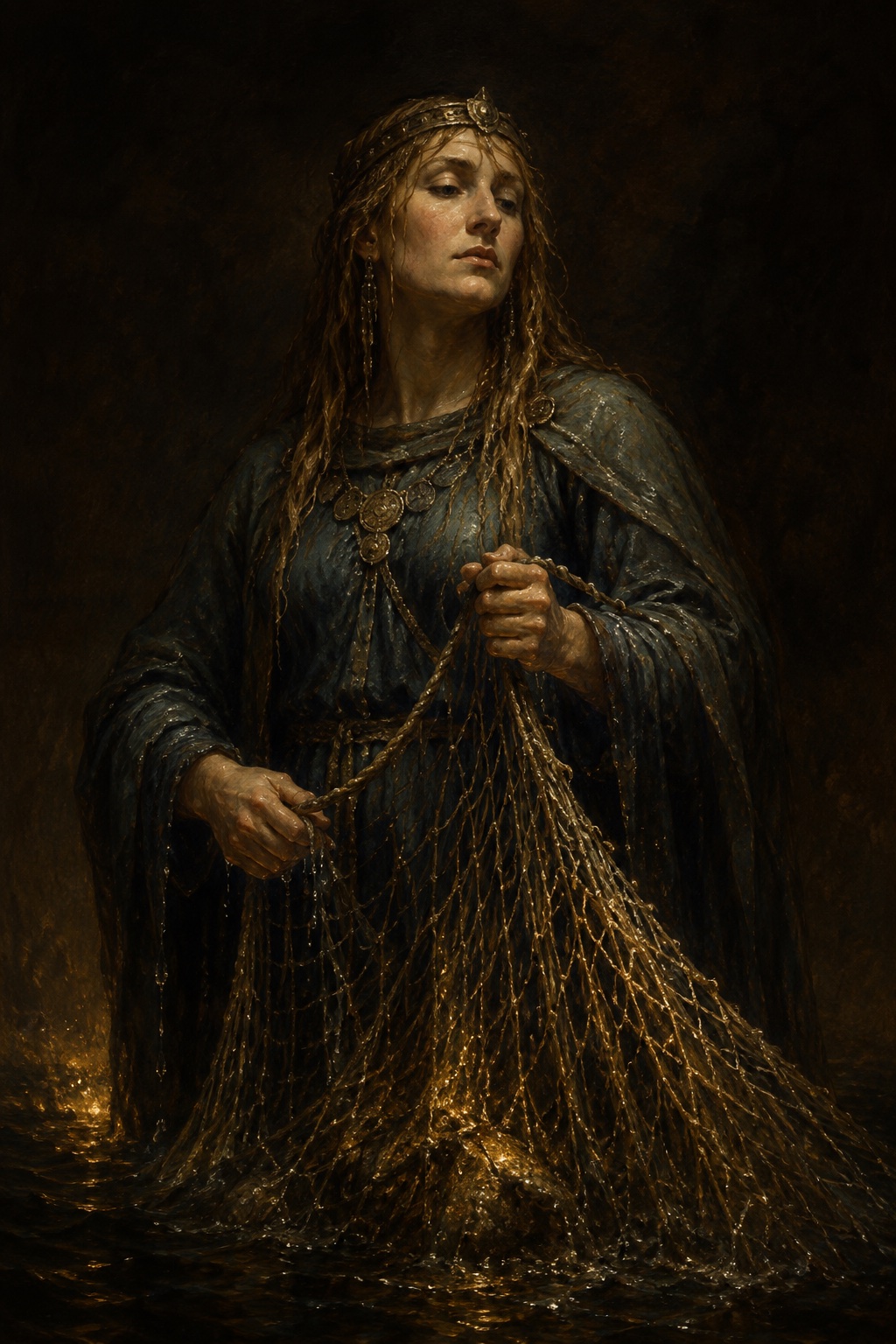
The net
Ægir’s hall is the best-appointed room in the mythology — the mile-deep kettle, gold in place of firelight, ale that carries itself to the bench — and Snorri describes that feast twice. The second telling exists to explain a kenning, and partway through it he stops to record one more thing the household keeps. It is a single sentence, and it is the only sentence in the whole Prose Edda in which Rán does anything at all.
Rán átti net þat, er hon veiddi í menn alla, þá er á sæ kómu
“Rán had that net wherein she was wont to catch all men who go upon the sea” — Snorri Sturluson, Skáldskaparmál 41 (Brodeur numbers it XXXIII), tr. A. G. Brodeur
Veiddi is a fishing verb, and its object is everyone. The gods are at the table when they notice, which is what gives the sentence its weight: the hostess pouring for them keeps tackle for a catch of men. Nothing in it calls her cruel and nothing calls her just. She is not the storm and not the wave — those belong to her husband and to her daughters. She is where the drowned go, and the whole point of a net is that what it takes does not merely sink. It is gathered, and hauled, and kept.
The net in Loki’s hands
The one other place the net appears, it is not in her hands. Loki has killed an otter that turned out to be a man’s son, and he, Odin and Hœnir owe the father an otter-skin filled with gold and covered over with red gold; Loki is the one sent to find it. The prose prologue to Reginsmál records where he goes first, and it is not to a dwarf or a dragon.
Hann kom til Ránar ok fekk net hennar ok fór þá til Andvarafors ok kastaði netinu fyrir gedduna, en hon hljóp í netit
“he went to Ron and got her net, and went then to Andvari’s fall and cast the net in front of the pike, and the pike leaped into the net” — Reginsmál, prose prologue, tr. H. A. Bellows
Bellows writes Ron — here in the prose, and in both of the notes where he glosses her as the wife of the sea-god who draws drowning men down with her net. It is his own anglicisation of the name, not a second figure and not a printer’s slip, and a quotation of Bellows keeps his spelling rather than borrowing this page’s.
The pike is the dwarf Andvari, and the gold Loki strips off him is cursed the moment it changes hands. Everything downstream of it — the ring, Fáfnir, Reginn, Sigurd, the whole ruin of the Volsungs — begins with that one catch, made with borrowed tackle. Rán is out of the story by the end of the sentence and is blamed for none of what follows. What the episode settles is what her property is for: the net is the one instrument in this mythology built to take something out of the water that does not want to come.
Ægir’s wife, and the nine
Two sentences before the net, in the same chapter, Snorri gives her the only kin she has anywhere: Rán is named as his wife, and their daughters are nine. His list of ways to say “sea” names them.
Dætr þeira Ægis ok Ránar eru níu, ok eru nöfn þeira fyrr rituð: Himinglæva, Dúfa, Blóðughadda, Hefring, Uðr, Hrönn, Bylgja, Dröfn, Kólga
“The daughters of Ægir and Rán are nine, and their names are recorded before: Himinglæva, Dúfa, Blódughadda, Hefring, Udr, Hrönn, Bylgja, Dröfn, Kólga.” — Snorri Sturluson, Skáldskaparmál, tr. A. G. Brodeur
Every one of the nine is a wave, and between the three of them the household divides the sea by depth: Ægir hosts on his island, the daughters are the surface, and Rán is what lies under it. She is given no hall, no island and no realm of her own — Hlésey is named for Ægir’s second name, not for hers — so the net does the work a hall does for everyone else in this mythology. What she owns is not a place. It is a grip.
What the poets do with her name
Snorri’s reason for recording the net at all is technical. The sentence directly after it turns the scene into vocabulary: this, he explains, is why gold is called “Fire or Light or Brightness of Ægir, of Rán, or of Ægir’s daughters”, and from there fire of the sea, and of every other word for the sea, and of rivers and waters besides. A skald reaching for a way to say treasure reaches for her household, which is how her name survives in a great many poems that have no story to tell about her.
The verse tradition also uses her the way the net does. In Helgakviða Hundingsbana I, Helgi’s ships are at sea off Gnipalund and Sigrún, from above, keeps the men and their voyage safe; the king’s vessel comes away, in Bellows’ English, out of “the claws of Ron”, where the Old Norse says only Rán ór hendi — out of Rán’s hand. Nothing in the stanza has her fight and lose. A ship is simply taken back out of a hold that had already closed on it, which is the net seen from the other side: what she catches is not normally recovered, and this once it was.