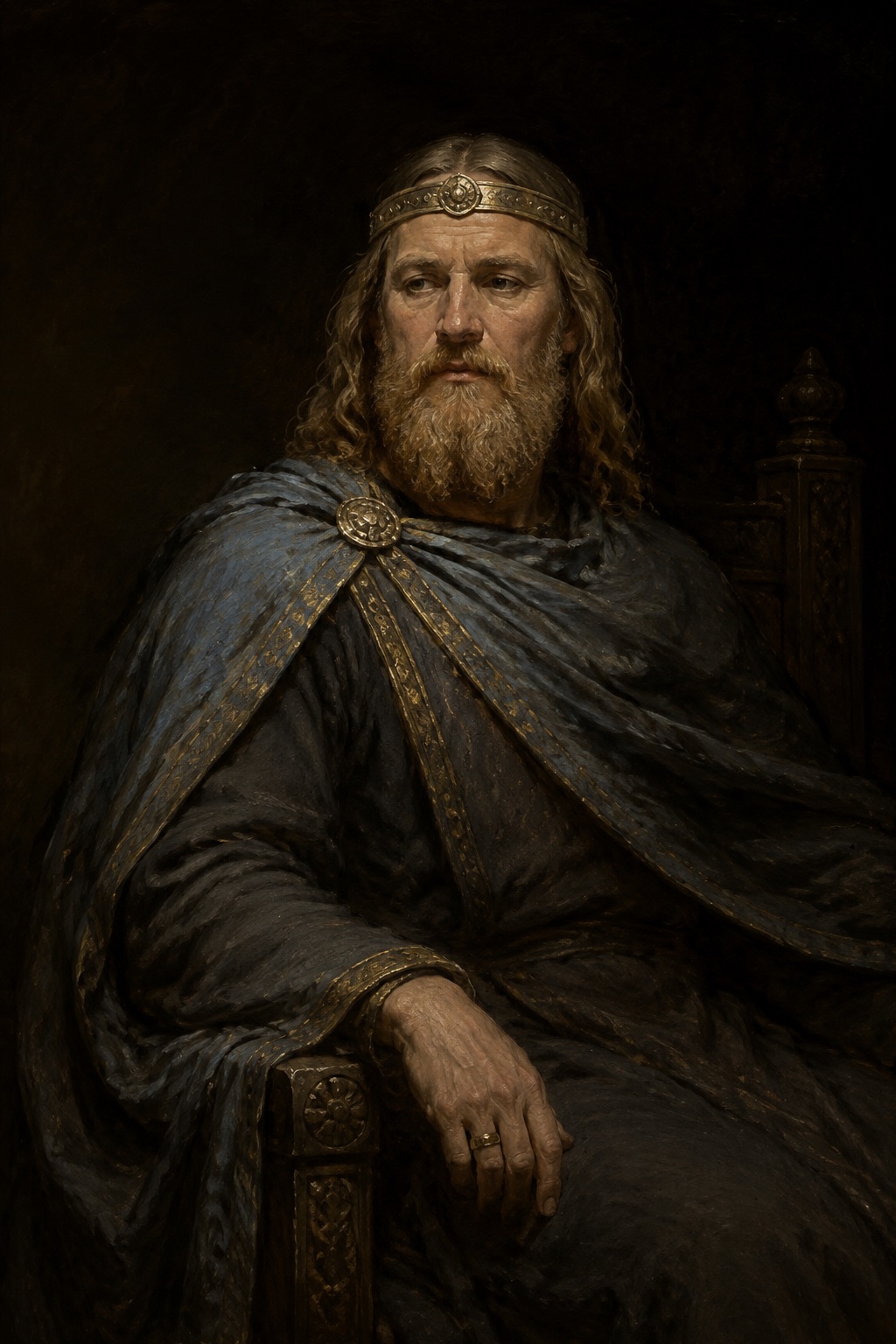
The hostage who could not answer
When the Æsir and the Vanir stopped fighting they settled it by exchanging men. The Vanir gave up Njörðr, and his entry opens on that treaty; the Æsir sent Hœnir the other way, a big man and the handsomest of them, and sent Mímir with him, who was the wisest man they had. The Vanir made Hœnir a chief the day he arrived. Then Heimskringla tells, in a single paragraph, everything he ever does.
En er Hœnir kom í Vanaheim, þá var hann þegar höfðingi gerr; Mímir kendi honum ráð öll. En er Hœnir var staddr á þingum eða stefnum, svá at Mímir var eigi nær, ok kœmi nökkur vandamál fyrir hann, þá svaraði hann æ hinu sama: ráði aðrir, sagði hann. Þá grunaði Vani, at Æsir mundi hafa falsat þá í mannaskiptinu; þá tóku þeir Mími ok hálshjoggu ok sendu höfuðit Ásum
“Now, when Hæner came to Vanaheim he was immediately made a chief, and Mimir came to him with good counsel on all occasions. But when Hæner stood in the Things or other meetings, if Mimir was not near him, and any difficult matter was laid before him, he always answered in one way,—‘Now let others give their advice;’ so that the Vanaland people got a suspicion that the Asaland people had deceived them in the exchange of men. They took Mimir, therefore, and beheaded him, and sent his head to the Asaland people.” — Snorri Sturluson, Ynglinga saga 4, tr. Samuel Laing
Ráði aðrir, let others give their advice, is the only line of direct speech he has anywhere in the corpus, and it is the answer to every question. The paragraph is built so that the reason cannot be missed: Mímir kendi honum ráð öll, Mímir taught him all counsel, and the failures happen exactly when Mímir var eigi nær, when Mímir was not near. The office is genuine, the man holding it is impressive to look at, and the judgment belongs to somebody else. Take the somebody else out of the room and there is nothing behind the chair.
What happens next decides how to read him. The Vanir do not depose him, or send him back, or kill him. They behead the man who could answer, and return the head to the people who supplied it. Hœnir is not punished, because there is nothing in him to punish, and the price of his silence comes off Mímir’s neck.
The name is spelled four ways across the pages quoted here, and none of the four is a mistake. Heimskringla.no prints Hœnir in the Ynglinga saga and Hænir on every one of its Edda pages; Laing anglicises him to Hæner, Bellows writes Hönir and never anything else, and Brodeur alone writes Hœnir, which is why this wiki does. Each quotation below keeps whatever its own page prints.
The gift of óð
Long before the war, in the stanza where the human race begins, he is one of three. The seeress of Völuspá describes two figures found on the land with nothing in them — no breath, no mind, no warmth, no colour — and three gods who each supply one of the missing things.
Önd þau né áttu, óð þau né höfðu, lá né læti né litu góða; önd gaf Óðinn, óð gaf Hænir, lá gaf Lóðurr ok litu góða
“Soul they had not, sense they had not, / Heat nor motion, nor goodly hue; / Soul gave Othin, sense gave Hönir, / Heat gave Lothur and goodly hue.” — Völuspá 18, tr. H. A. Bellows
What he gives is óð: the word Bellows renders as sense, covering mind, wit and the faculty of making something of what you perceive. Odin gives önd, breath, and Lóðurr gives lá and good colour. Between them the three assemble Ask and Embla out of parts, and the part Hœnir contributes is the one he is never able to use himself. This is his entire positive record. It is three words long — óð gaf Hænir — and not one source in the corpus notices what it sits next to.
Bench-mate, long-foot, king of clay
He has no hall, no consort, no parentage and no festival. What he has instead is a place in the kenning-lists of Skáldskaparmál, where Snorri works through the gods one at a time, asking how each is to be periphrased and answering with the standing forms a poet may use.
Hvernig skal kenna Hæni? Svá, at kalla hann sessa eða sinna eða mála Óðins ok inn skjóta ás ok inn langa fót ok aurkonung
“How should Hœnir be periphrased? By calling him Bench-Mate or Companion or Friend of Odin, the Swift of God, the Long-Footed, and’ King of Clay.” — Snorri Sturluson, Skáldskaparmál 22 (Brodeur numbers it XV), tr. A. G. Brodeur
The first three names hang off one genitive — sessa eða sinna eða mála Óðins, bench-mate or companion or friend, and all three of Odin’s. He is not described. He is located, at Odin’s side, on Odin’s bench. The last two are a body and a puzzle: inn langa fót, the long foot, and aurkonung, which Brodeur gives as King of Clay, its first element the Old Norse word for wet earth or mud. Nothing in any source says why it is his. Brodeur’s page also carries two slips of the press inside this one sentence — the Swift of God, where the Old Norse inn skjóta ás means the swift god, and a stray apostrophe on and’ — and both are left standing in the quotation above, because a quotation is evidence and not a fair copy.
Modern handbooks put the long foot and the clay together and make him a stork. Nothing quoted here is a bird, and neither is anything in the places that merely name him: the roll of the twelve Æsir who sit as judges at Ægir’s feast, the two travelling parties in Skáldskaparmál, the prose opening of Reginsmál. The stork is a nineteenth-century inference about a wading bird standing in mud, and there is no text underneath it.
Those travelling parties are the last thing the record gives him, and it gives them three times over. He is the third of the three Æsir who cannot get the ox to cook in Þjazi’s entry, the third of the three who owe the otter’s ransom in Rán’s, and one of the same three at Andvari’s fall in the prose that opens Reginsmál. In none of them does he do anything at all. He is counted, and he walks.
The lot-wood, after everything
The closing stanzas of Völuspá are the world after Ragnarök: the earth risen again out of the sea, the surviving gods gathering where the old hall stood, the sons of two brothers living in the wide wind-home. The first line of it is his.
Þá kná Hænir hlautvið kjósa
“Then Hönir wins the prophetic wand” — Völuspá 63, tr. H. A. Bellows
Hlautvið kjósa is to choose the lot-wood: the twigs cast or shaken out to settle a question, the physical instrument of a decision. Bellows makes it the prophetic wand and then breaks off, printing a lacuna across the rest of the stanza, which is why the English above stops where it does. The Old Norse runs on and explains nothing. The god whose whole recorded term in office was a refusal to give an opinion is, on the far side of the end of the world, the one who picks up the thing you use to reach one.
Three entries in this wiki carried his name before he had one of his own, and in all three of them he is somebody else’s third companion. Against that, what the sources actually award him is oddly exact: the mind of the human race, handed over at the beginning; a chief’s seat he could not occupy without a tutor beside him; and a bundle of twigs at the end, held out to the last god anyone would have asked.