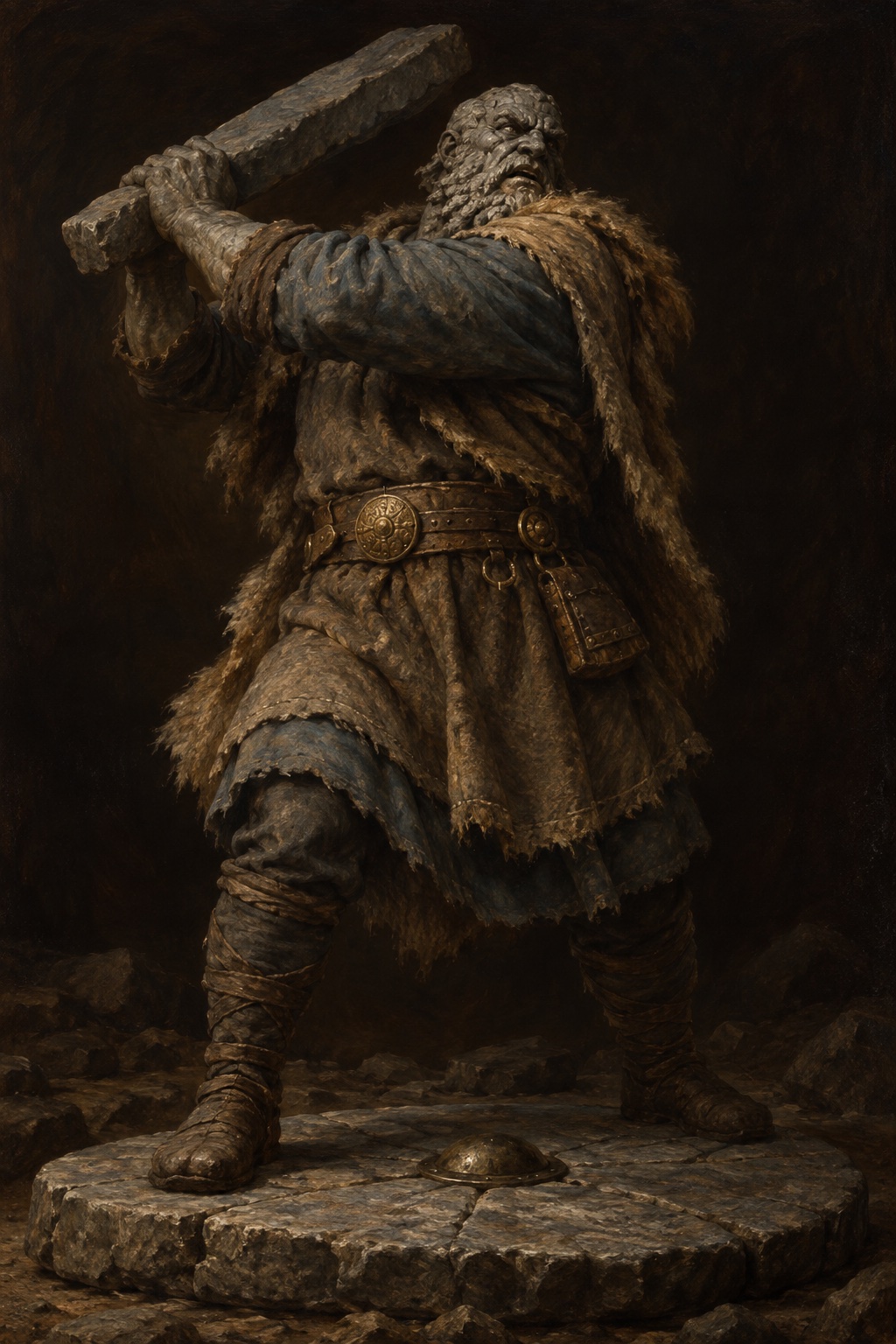
The ride into Ásgard
Most of what the sources tell about Hrungnir is in one long chapter of Snorri’s Skáldskaparmál. In Snorri’s frame it is a story that Bragi tells Ægir, one of the tales behind the poets’ kennings. It does not start with the giant. Thor has gone east to kill trolls, and Odin rides Sleipnir into Jötunheim and visits a giant named Hrungnir. Hrungnir asks who the man in the golden helmet is, who rides through air and water, and he says that the stranger has a very good horse. The golden helmet is Odin’s, not Hrungnir’s. Odin answers that he will wager his head that no horse in Jötunheim is as good. Hrungnir says that it is a good horse, but that his own horse is much better paced, in Brodeur’s words. Its name is Gullfaxi, which Brodeur translates as Gold-Mane.
The wager is Odin’s head, not Hrungnir’s, and the text never settles it. Hrungnir becomes angry, jumps onto his horse and rides after Odin, to pay him back for his boast. Odin rides so hard that he is over the next hill first. Hrungnir is in such a giant’s fury, jötunmóð, that he notices nothing until he has ridden in through the gates of Ásgard. At the hall door the Æsir invite him to drink. He goes in and asks for drink, and they bring him the cups that Thor usually drinks from. He empties each of them in turn.
En er hann gerðist drukkinn, þá skorti eigi stór orð. Hann lézt skyldu taka upp Valhöll ok færa í Jötunheima, en sökkva Ásgarði, en drepa goð öll, nema Freyju ok Sif vill hann heim hafa með sér, en Freyja ein þorir þá at skenkja honum, ok drekka lézt hann mundu allt ásaöl. En er ásum leiddust ofryrði hans, þá nefna þeir Þór. Því næst kom Þórr í höllina ok hafði á lofti hamarinn ok var allreiðr ok spyrr, hverr því ræðr, er jötnar hundvísir skulu þar drekka, eða hverr seldi Hrungni grið at vera í Valhöll eða hví Freyja skal skenkja honum sem at gildi ása. Þá svarar Hrungnir ok sér ekki vinaraugum til Þórs, sagði, at Óðinn bauð honum til drykkju ok hann var á hans griðum. Þá mælti Þórr, at þess boðs skal Hrungnir iðrast, áðr hann komi út. Hrungnir segir, at Ása-Þór er þat lítill frami at drepa hann vápnlausan. Hitt er meiri hugraun, ef hann þorir at berjast við hann at landamæri á Grjóttúnagörðum, - “ok hefir þat verit mikit fólskuverk,” sagði hann, “er ek lét eftir heima skjöld minn ok hein. En ef ek hefða hér vápn mín, þá skyldum vit nú reyna hólmgönguna, en at öðrum kosti legg ek þér við níðingsskap, ef þú vill drepa mik vápnlausan.” Þórr vill fyrir engan mun bila at koma til einvígis, er honum var hólmr skoraðr, því at engi hafði honum þat fyrr veitt.
“But when he had become drunken, then big words were not wanting: he boasted that he would lift up Valhall and carry it to Jötunheim, and sink Ásgard and kill all the gods, save that he would take Freyja and Sif home with him. Freyja alone dared pour for him; and he vowed that he would drink all the ale of the Æsir. But when his overbearing insolence became tiresome to the Æsir, they called on the name of Thor. “Straightway Thor came into the hall, brandishing his hammer, and he was very wroth, and asked who had advised that these dogs of giants be permitted to drink there, or who had granted Hrungnir safe-conduct to be in Valhall, or why Freyja should pour for him as at a feast of the Æsir. Then Hrungnir answered, looking at Thor with no friendly eyes, and said that Odin had invited him to drink, and he was under his safe-conduct. Thor declared that Hrungnir should repent of that invitation before he got away. Hrungnir answered that Ása-Thor would have scant renown for killing him, weaponless as he was: it were a greater trial of his courage if he dared fight with Hrungnir on the border at Grjótúnagard. ‘And it was a great folly,’ said he, ‘when I left my shield and hone behind at home; if I had my weapons here, then we should try single-combat. But as matters stand, I declare thee a coward if thou wilt slay me, a weaponless man.’ Thor was by no means anxious to avoid the fight when challenged to the field, for no one had ever offered him single-combat before. — Snorri Sturluson, Skáldskaparmál 24 (Brodeur numbers it XVII), tr. A. G. Brodeur
The boast has three parts. He will lift up Valhöll, carry it to Jötunheim and sink Ásgard. He will kill all the gods, except Freyja and Sif, whom he will take home with him. And he will drink all the ale of the Æsir. Freyja is the only one who dares to pour for him. The threat is against the whole of Ásgard, and it is made from inside its main hall, over Thor’s own cups.
When the Æsir grow tired of him they say Thor’s name, and Thor is in the hall at once with the hammer raised. His three questions are about the rules of the hall, not about the insult. Who allowed giants to drink here? Who gave Hrungnir safe-conduct, grið, in Valhöll? Why does Freyja pour for him as if at a feast of the Æsir? Hrungnir’s answer is also about the rules. Odin invited him to drink, and he is under Odin’s safe-conduct. The god whose wager began the ride is now the god whose protection keeps the giant alive.
Then Hrungnir sets the terms of his own death. He has no weapons with him. Killing an unarmed man would bring Thor little fame, he says, and it would be a greater test of courage to fight him on the border, at Grjótúnagarðar. It was great folly, he says, to leave his shield and his whetstone, hein, at home. If Thor kills him unarmed, he will declare Thor a coward, which is Brodeur’s word for níðingsskap. Thor accepts, and Snorri gives the reason. Nobody had ever challenged him to single combat before, and the first one to offer Thor a duel is this drunk giant.
Stone at Grjótúnagarðar
Hrungnir rides home to Jötunheim as fast as he can. The news of the meeting spreads among the giants, and they feel that much depends on who wins. If Hrungnir dies, they expect trouble from Thor, because Hrungnir is the strongest of them all. So they build him a second.
Þá gerðu jötnar mann á Grjóttúnagörðum af leiri, ok var hann níu rasta hár, en þriggja breiðr undir hönd, en ekki fengu þeir hjarta svá mikit, at honum sómði, fyrr en þeir tóku úr meri nökkurri, ok varð honum þar eigi stöðugt, þá er Þórr kom. Hrungnir átti hjarta þat, er frægt er, af hörðum steini ok tindótt með þrimr hornum, svá sem síðan er gert ristubragð þar, er Hrungnishjarta heitir. Af steini var ok höfuð hans. Skjöldr hans var ok steinn, víðr ok þjokkr, ok hafði hann skjöldinn fyrir sér, er hann stóð á Grjóttatúnagörðum ok beið Þórs, en hein hafði hann fyrir vápn ok reiddi of öxl ok var ekki dælligr. Á aðra hlið honum stóð leirjötunninn, er nefndr er Mökkurkálfi, ok var hann allhræddr. Svá er sagt, at hann meig, er hann sá Þór. Þórr fór til hólmstefnu ok með honum Þjálfi. Þá rann Þjálfi fram at, þar er Hrungnir stóð, ok mælti til hans: “Þú stendr óvarliga, jötunn, hefir skjöldinn fyrir þér, en Þórr hefir sét þik, ok ferr hann it neðra í jörðu, ok mun hann koma neðan at þér.” Þá skaut Hrungnir skildinum undir fætr sér ok stóð á, en tvíhendi heinina. Því næst sá hann eldingar ok heyrði þrumur stórar. Sá hann þá Þór í ásmóði. Fór hann ákafliga ok reiddi hamarinn ok kastaði um langa leið at Hrungni. Hrungnir færir upp heinina báðum höndum ok kastar í mót. Mætir hon hamrinum á flugi, ok brotnar sundr heinin. Fellr annarr hlutr á jörð, ok eru þar af orðin öll heinberg. Annarr hlutr brast í höfði Þór, svá at hann fell fram á jörð. En hamarrinn Mjöllnir kom í mitt höfuð Hrungni ok lamði hausinn í smán mola, ok fell hann fram yfir Þór, svá at fótr hans lá of háls Þór.
“Then the giants made a man of clay at Grjótúnagard: he was nine miles high and three broad under the arm-pits; but they could get no heart big enough to fit him, until they took one from a mare. Even that was not steadfast within him, when Thor came. Hrungnir had the heart which is notorious, of hard stone and spiked with three corners, even as the written character is since formed, which men call Hrungnir’s Heart. His head also was of stone; his shield too was stone, wide and thick, and he had the shield before him when he stood at Grjótúnagard and waited for Thor. Moreover he had a hone for a weapon, and brandished it over his shoulders, and he was not a pretty sight. At one side of him stood the clay giant, which was called Mökkurkálfi: he was sore afraid, and it is said that he wet himself when he saw Thor. “Thor went to the meeting-place, and Thjálfi with him. Then Thjálfi ran forward to the spot where Hrungnir stood and said to him: ‘Thou standest unwarily, Giant, having the shield before thee: for Thor has seen thee, and comes hither down below the earth, and will come at thee from beneath.’ Then Hrungnir thrust the shield under his feet and stood upon it, wielding the hone with both hands. Then speedily he saw lightnings and heard great claps of thunder; then he saw Thor in God-like anger, who came forward furiously and swung the hammer and cast it at Hrungnir from afar off. Hrungnir lifted up the hone in both hands and cast it against him; it struck the hammer in flight, and the hone burst in sunder: one part fell to the earth, and thence are come all the flint-rocks; the other burst on Thor’s head, so that he fell forward to the earth. But the hammer Mjöllnir struck Hrungnir in the middle of the head, and smashed his skull into small crumbs, and he fell forward upon Thor, so that his foot lay over Thor’s neck. — Snorri Sturluson, Skáldskaparmál 24 (Brodeur numbers it XVII), tr. A. G. Brodeur
The two giants at Grjótúnagarðar are opposites. Mökkurkálfi is made of clay and is enormous, nine miles high and three broad under the arms in Brodeur’s translation, but the giants cannot find a heart big enough for him. They give him a mare’s heart, and it fails him when Thor comes. He is terrified, and he wets himself at the sight of Thor. Hrungnir is made of stone where it matters. His heart is of hard stone, spiked, with three corners. Snorri compares its shape to a carved sign, ristubragð, that people have made since then, and says that the sign is called Hrungnishjarta, Hrungnir’s heart. Brodeur calls the sign a written character. Snorri says nothing more about it. The giant’s head is also stone, and so is his shield, wide and thick. His weapon is a whetstone, which he swings over his shoulder, and Snorri adds that he was not a pleasant sight.
Before the fight starts, a lie takes his shield away from him. Thor’s servant Þjálfi runs ahead and warns him that he is standing carelessly with the shield in front of him, because Thor has seen him and will come at him from under the ground. Hrungnir puts the shield under his feet, stands on it and takes the whetstone in both hands. So the giant who set the terms of the duel meets Thor with no shield in front of him. Then come lightning and loud thunder, and he sees Thor í ásmóði, in the fury of a god. It is the same kind of word as the jötunmóð, the giant’s fury, that carried Hrungnir through the gates of Ásgard.
Thor swings the hammer and throws it from far away. Hrungnir lifts the whetstone in both hands and throws it against the hammer, and the two meet in the air. The whetstone breaks in two. One piece falls to the earth, and all the whetstone rocks, heinberg, come from it. Brodeur calls them the flint-rocks. The other piece strikes Thor’s head, and Thor falls forward. The hammer hits Hrungnir in the middle of the head and breaks his stone skull into small pieces. He falls forward over Thor, and his foot lies across Thor’s neck. The giant is dead, but a piece of his weapon is in the god’s head, and his body holds the god down on the ground.
The whetstone in Thor’s head
The rest of the chapter is about what Hrungnir leaves behind. Þjálfi strikes at Mökkurkálfi, and the clay giant falls with little glory. Then Þjálfi tries to lift Hrungnir’s foot off Thor and does not have the strength. All the Æsir come when they hear that Thor has fallen, and they cannot move the foot either. The one who lifts it is Magni, Thor’s son, three nights old, and that scene belongs to his entry. Thor rewards him with Gullfaxi, the horse that Hrungnir owned. Odin objects that Thor should have given the good horse to his own father, not to the son of a giantess, and Snorri gives the complaint no answer. The horse that Hrungnir praised at the start of the chapter, against Sleipnir, now belongs to Thor’s son.
Thor goes home to Þrúðvangar with the whetstone still stuck in his head. A wise woman called Gróa, the wife of Aurvandill, comes and sings her spells over him until the whetstone becomes loose. Thor wants to reward her and make her glad, so he tells her some news. He has waded from the north over the Icy Stream, as Brodeur calls it, and has carried Aurvandill out of Jötunheim in a basket on his back. One of Aurvandill’s toes stuck out of the basket and froze, so Thor broke it off and threw it into the sky, and made from it the star called Aurvandill’s Toe. Aurvandill will soon be home. Gróa is so glad that she forgets her spells. The whetstone does not come loose, and it is still in Thor’s head. That is why, Snorri says, it is forbidden to throw a whetstone across the floor, because then the whetstone moves in Thor’s head.
So the fight leaves three things in the world. One half of the whetstone becomes the whetstone rocks of the earth. The other half stays in the god, and it is the reason for a rule about whetstones in the house. And the giant’s heart gives its name to a carved sign. Hrungnir is dead after one blow, but pieces of the stone giant stay in the ground, in the god and in the sign.
Snorri also names a poem on this story. Þjóðólfr of Hvin, he says, composed on it in Haustlöng. Then the frame closes. Ægir says that Hrungnir seems to him to have been very mighty, and he asks whether Thor ever did a greater deed against trolls. Bragi answers with the story of Thor’s journey to Geirröðr. Hrungnir has become the measure of Thor’s other fights.
In the poets’ words
The poems use him as a measure too. In Hárbarðsljóð, Thor and a ferryman who calls himself Hárbarðr trade boasts and insults across a sound. In stanza 14 the ferryman says that he will stand there and wait for Thor, and that Thor has not met a fiercer man since Hrungnir died. Thor answers at once.
Hins viltu nú geta, er vit Hrungnir deildum, sá inn stórúðgi jötunn, er ór steini var höfuðit á; þó lét ek hann falla ok fyrir hníga. Hvat vanntu þá meðan, Hárbarðr?
“Fain art thou to tell how with Hrungnir I fought, / The haughty giant, whose head of stone was made; / And yet I felled him, and stretched him before me. / What, Harbarth, didst thou the while?” — Hárbarðsljóð 15, tr. H. A. Bellows
The ferryman measures himself against Hrungnir, and Thor answers with the fight itself. His answer keeps one detail of Snorri’s giant, the head of stone, ór steini var höfuðit á. It calls him stórúðgi, which Bellows translates as haughty. The stanza has no horse, no feast, no Þjálfi and no whetstone. In Thor’s own telling there is only the fight and the fall, and then the question he throws back across the water: what was Hárbarðr doing at the time?
The kennings keep the giant’s name alive in a different way. Snorri’s list of ways to name Thor, in Skáldskaparmál 11, includes vegandi Hrungnis, the slayer of Hrungnir, which Brodeur translates as Smiter of Hrungnir. It stands beside two other names, Geirröðr and Þrívaldi. Among the verses that Snorri gives after the list, Bragi calls Thor the Skull-Splitter of Hrungnir, haussprengi Hrungnis. In both kennings Hrungnir is named only as the one whom Thor killed.
Þjálfi’s trick became a kenning as well. Later in the same book, Snorri says that a shield can be named after Hrungnir’s feet, because Hrungnir stood on his shield. His heading is ilja blað Hrungnis, which Brodeur translates as Blade of Hrungnir’s Foot-Soles, and the example he gives is a verse by Bragi. The verse does not use Hrungnir’s name. In Brodeur’s words, the shield is the Sole-Blade of Thrúdr’s thief, and Snorri’s heading shows that the thief is Hrungnir. Þrúðr is Thor’s daughter: the same list of Thor-kennings calls Thor her father. The Hrungnir chapter tells no story in which he takes Þrúðr, and none of the passages on this page explains the name.
His strength is remembered among giants too. In Grottasöngr, which Brodeur’s translation of Skáldskaparmál includes, the two giant women whom Fróði bought to grind at the mill Grótti tell him that he did not ask about their kin when he bought them. Then they name strong giants. Hrungnir was hardy, they say, and his father too, but Þjazi was mightier than both. The passage does not name his father.
The domains on this page follow this small record. Monsters is how this wiki files him, as it files the other giants. Horses is for Gullfaxi and the ride that brought him into Ásgard, and chaos is for the boast that he would sink it. No source gives Hrungnir an office. He is known for one ride, one boast and one duel, and for the pieces of stone that stayed in the world after it.