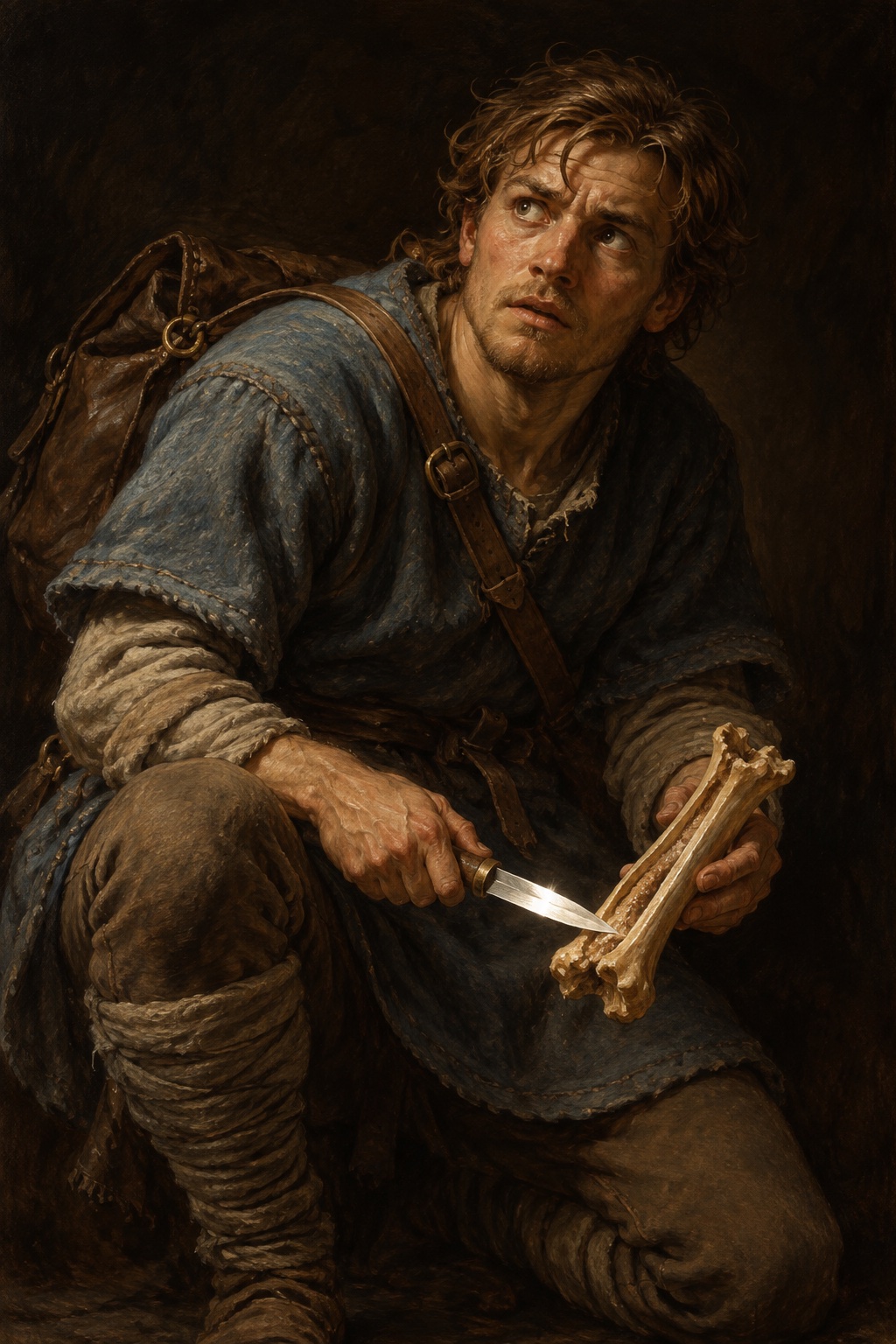
The thigh-bone
Þjálfi comes into the myths at a farmer’s supper table. In Gylfaginning 44 Thor is out with his he-goats and his chariot, and Loki is with him. At evening they come to a farmer’s house and get a night’s lodging there. Thor slaughters both of his goats, and they are flayed and put in the cauldron. When the meat is cooked, Thor asks the farmer, the farmer’s wife and their children to eat with him. Here Snorri names the children for the first time: the son is Þjálfi, and the daughter is Röskva.
At the meal Thor gives one order, and Þjálfi is the one person whom the story shows doing something else.
Þá lagði Þórr hafrstökurnar útar frá eldinum ok mælti, at búandi ok heimamenn hans skyldu kasta á hafrstökurnar beinunum. Þjálfi, sonr búanda, hélt á lærlegg hafrsins ok spretti á knífi sínum ok braut til mergjar.
“Then Thor laid the goat-hides farther away from the fire, and said that the husbandman and his servants should cast the bones on the goat-hides. Thjálfi, the husbandman’s son, was holding a thigh-bone of the goat, and split it with his knife and broke it for the marrow.” — Snorri Sturluson, Gylfaginning 44, tr. A. G. Brodeur
The order is about where the bones go: on the hides. Thor does not say why, and he does not forbid anyone to break a bone. Þjálfi holds a thigh-bone, lærlegg hafrsins, opens it with his knife, spretti á knífi sínum, and breaks it to get at the marrow, braut til mergjar. The text gives him no motive. It does not say that he was hungry, that he heard the order, or that anyone told him to do it. It names one bone and one person, and it moves on.
Thor stays the night. Before day he gets up, takes the hammer Mjöllnir, raises it and hallows the goat-hides. The goats stand up, and one of them is lame in a hind leg. Thor sees it and says that the farmer or his household cannot have dealt wisely with the bones; he knows that the thigh-bone, lærleggrinn, was broken. He does not name Þjálfi, and nothing in the chapter says that he ever learns who broke it. The fault falls on the whole house. The farmer sees Thor let his brows sink down over his eyes, and he thinks that he will fall down at the sight of those eyes alone. Thor grips the hammer-shaft until his knuckles whiten. The farmer and all his household cry out, beg for peace, and offer everything they own.
Bond-servants
The text does not say that Thor takes any of it. Snorri ends the chapter with what he does take.
En er hann sá hræðslu þeira, þá gekk af honum móðrinn, ok sefaðist hann ok tók af þeim í sætt börn þeira, Þjálfa ok Röskvu, ok gerðust þau þá skyldir þjónustumenn hans, ok fylgja þau honum jafnan síðan.
“But when he saw their terror, then the fury departed from him, and he became appeased, and took of them in atonement their children, Thjálfi and Röskva, who then became his bond-servants; and they follow him ever since.” — Snorri Sturluson, Gylfaginning 44, tr. A. G. Brodeur
The price is paid í sætt, in atonement, and it is paid in children. Brodeur’s bond-servants translates skyldir þjónustumenn hans, his servants under obligation. Röskva goes with her brother, although the text gives her no part in the meal except her name and nothing to do with the bone. The last clause changes tense. The sentence is told in the past until it reaches fylgja þau honum jafnan síðan: they follow him ever since. Brodeur keeps the present tense. In Snorri’s telling the bargain is still in force at the time of the telling.
The service begins at once. Thor leaves his goats behind and sets out east toward Jötunheim, as far as the sea, and crosses it. When he comes to land, Loki, Þjálfi and Röskva go up with him. They walk through a great forest all day until dark. Here Snorri stops to say two things about Þjálfi. He was the swiftest-footed of all men, and he carried Thor’s bag, though there was no good food to be had. So the first work that the text gives him is a porter’s work, on foot, and the first quality it gives him is speed. The speed is put to the test one chapter later.
A race against thought
The travellers come at last to a stronghold, where, they are told, no one may stay who does not have some skill above other men. Loki goes first, in an eating match, and loses it. Then the master of the hall, Útgarða-Loki, turns to Þjálfi and asks what inn ungi maðr, the young man, can do. Þjálfi says that he will run a race against anyone whom Útgarða-Loki chooses. Útgarða-Loki answers that this is a good skill, and that the young man must be very fast if he is to win at it, but that he will soon put it to the test. They go out to a good course over a level plain, and Útgarða-Loki calls up a lad named Hugi, sveinstaula nökkurn, to run against him.
Þá taka þeir it fyrsta skeið, ok er Hugi því framar, at hann snýst aftr í móti honum at skeiðsenda. Þá mælti Útgarða-Loki: “Þurfa muntu, Þjálfi, at leggja þik meir fram, ef þú skalt vinna leikinn, en þó er þat satt, at ekki hafa hér komit þeir menn, er mér þykkja fóthvatari en svá.” Þá taka þeir aftr annat skeið, ok þá er Hugi er kemr til skeiðsenda ok hann snýst aftr, þá var langt kólfskot til Þjálfa. Þá mælti Útgarða-Loki: “Vel þykkir mér Þjálfi renna skeiðit, en eigi trúi ek honum nú, at hann vinni leikinn, en nú mun reyna, er þeir renna it þriðja skeiðit.” Þá taka þeir enn skeið, en er Hugi er kominn til skeiðsenda ok snýst aftr, ok er Þjálfi eigi þá kominn á mitt skeið. Þá segja allir, at reynt er um þenna leik.
“Then they held the first heat; and Hugi was so much ahead that he turned back to meet Thjálfi at the end of the course. Then said Útgarda-Loki: ‘Thou wilt need to lay thyself forward more, Thjálfi, if thou art to win the game; but it is none the less true that never have any men come hither who seemed to me fleeter of foot than this.’ Then they began another heat; and when Hugi had reached the course’s end, and was turning back, there was still a long bolt-shot to Thjálfi. Then spake Útgarda-Loki: ‘Thjálfi appears to me to run this course well, but I do not believe of him now that he will win the game. But it will be made manifest presently, when they run the third heat.’ Then they began the heat; but when Hugi had come to the end of the course and turned back, Thjálfi had not yet reached mid-course. Then all said that that game had been proven.” — Snorri Sturluson, Gylfaginning 46, tr. A. G. Brodeur
Each heat is worse than the one before. In the first, Hugi is so far ahead that he turns round at the end of the course and meets Þjálfi coming in. In the second, when Hugi turns, Þjálfi is still a long bolt-shot away, langt kólfskot. In the third, Þjálfi has not reached the middle of the course, á mitt skeið. Between the heats Útgarða-Loki gives him praise and a verdict in the same breath. No men have ever come there who seemed to him fóthvatari, fleeter of foot, and still he does not believe that Þjálfi will win. The praise agrees with what Snorri said on the road. Þjálfi really is the fastest man there is, and he loses by more each time.
The answer comes when the guests leave. Once Thor is outside the stronghold, Útgarða-Loki tells him the truth: he had worked illusions against them, and no contest was what it seemed. Loki’s opponent in the eating match was wild-fire, which burned the trough as fast as the meat. Then he comes to the race.
En er Þjálfi þreytti rásina við þann, er Hugi hét, þat var hugr minn, ok var Þjálfa eigi vænt at þreyta skjótfæri við hann.
“But when Thjálfi ran the race with him called Hugi, that was my “thought,” and it was not to be expected of Thjálfi that he should match swiftness with it.” — Snorri Sturluson, Gylfaginning 47, tr. A. G. Brodeur
The Norse sentence puts the name and the word side by side: the one er Hugi hét, who was called Hugi, was hugr minn, my thought. Brodeur marks the word with quotation marks of its own. The second half of the sentence clears Þjálfi. It was not to be expected of him that he should match his skjótfæri, his swiftness, against it. Nothing in the explanation takes back the claim that he is the swiftest of all men. He was beaten by something that was not a man, and the race was never a fair one.
The clay giant
Þjálfi appears again in Skáldskaparmál, in Snorri’s account of the duel between Thor and the giant Hrungnir. Before the fight the giants build a man of clay at Grjótúnagarðr to stand with Hrungnir. In Brodeur’s English he is nine miles high and three broad under the arms, and they can find no heart big enough for him until they take one from a mare. The duel passage calls him leirjötunninn, the clay giant, and gives his name, Mökkurkálfi. He stands at Hrungnir’s side and is badly afraid, and it is said that he wets himself when he sees Thor.
Þórr fór til hólmstefnu ok með honum Þjálfi. Þá rann Þjálfi fram at, þar er Hrungnir stóð, ok mælti til hans: “Þú stendr óvarliga, jötunn, hefir skjöldinn fyrir þér, en Þórr hefir sét þik, ok ferr hann it neðra í jörðu, ok mun hann koma neðan at þér.” Þá skaut Hrungnir skildinum undir fætr sér ok stóð á, en tvíhendi heinina.
“Thor went to the meeting-place, and Thjálfi with him. Then Thjálfi ran forward to the spot where Hrungnir stood and said to him: ‘Thou standest unwarily, Giant, having the shield before thee: for Thor has seen thee, and comes hither down below the earth, and will come at thee from beneath.’ Then Hrungnir thrust the shield under his feet and stood upon it, wielding the hone with both hands.” — Snorri Sturluson, Skáldskaparmál 24 (Brodeur numbers it XVII), tr. A. G. Brodeur
Here Þjálfi runs ahead of his master, and this time it is his words that do the work. Þú stendr óvarliga, jötunn: you stand carelessly, giant. Hrungnir believes him, puts his stone shield under his feet, and takes his whetstone in both hands. Nothing in what follows has Thor come out of the ground. Hrungnir sees lightning and hears great thunder, and then he sees Thor coming at him with the hammer raised. Hammer and whetstone meet in the air, and a piece of the whetstone strikes Thor’s head and knocks him down. Mjöllnir smashes Hrungnir’s skull, and the giant falls forward over Thor, so that his foot lies across Thor’s neck.
En Þjálfi vá at Mökkurkálfa, ok fell hann við lítinn orðstír. Þá gekk Þjálfi til Þórs ok skyldi taka fót Hrungnis af honum ok gat hvergi valdit.
“Thjálfi struck at Mökkurkálfi, and he fell with little glory. Thereupon Thjálfi went over to Thor and would have lifted Hrungnir’s foot off him, but could not find sufficient strength.” — Snorri Sturluson, Skáldskaparmál 24 (Brodeur numbers it XVII), tr. A. G. Brodeur
Snorri gives Þjálfi’s fight one clause. He vá at Mökkurkálfa, struck at Mökkurkálfi, and the clay giant fell við lítinn orðstír, with little glory; the glory that is missing is the giant’s. The verb says only that he struck and the giant fell. This page records Mökkurkálfi as the one Þjálfi slays. Then Þjálfi tries to lift Hrungnir’s foot off his master, and he cannot, gat hvergi valdit. He is not alone in that. All the Æsir come when they hear that Thor has fallen, and they cannot move the foot either. The one who lifts it is Magni, Thor’s son by Járnsaxa, three nights old.
Master of Þjálfi and Röskva
The bargain at the farmer’s house became part of Thor’s names. In Skáldskaparmál 11 Snorri lists the ways in which a poet may name Thor, and one of them names him by his two servants.
vegandi Hrungnis, Geirröðar, Þrívalda, dróttinn Þjálfa ok Rösku, dólgr Miðgarðsorms
“Smiter of Hrungnir, of Geirrödr and of Thrívaldi, Master of Thjálfi and Röskva, Foe of the Midgard Serpent” — Snorri Sturluson, Skáldskaparmál 11 (Brodeur numbers it IV), tr. A. G. Brodeur
The kenning dróttinn Þjálfa ok Rösku, Master of Thjálfi and Röskva, stands in the list between the giants Thor killed and the serpent he fights. In the lines quoted here it is the one name that comes from a household and not from a fight. Among the verses that Snorri gives after the list, one by the poet Eilífr has both master and servant in it: “Wroth stood Röskva’s Brother, And Magni’s Sire wrought bravely: With terror Thor’s staunch heart-stone Trembled not, nor Thjálfi’s.” In the verse Þjálfi is not Thor’s servant but Röskva’s Brother, named after the sister who was taken with him.
This wiki files Þjálfi with the heroes. Snorri makes him a farmer’s son, sonr búanda, and never more than a man. Travel is for the road east with Thor’s bag on his back, for the race, and for the run ahead of his master to the duel. He is quick on his feet in the race and at the duel, and in none of his stories is the last deed his: Hugi wins the race, Magni lifts the foot, and the bone he broke made him Thor’s servant for good.