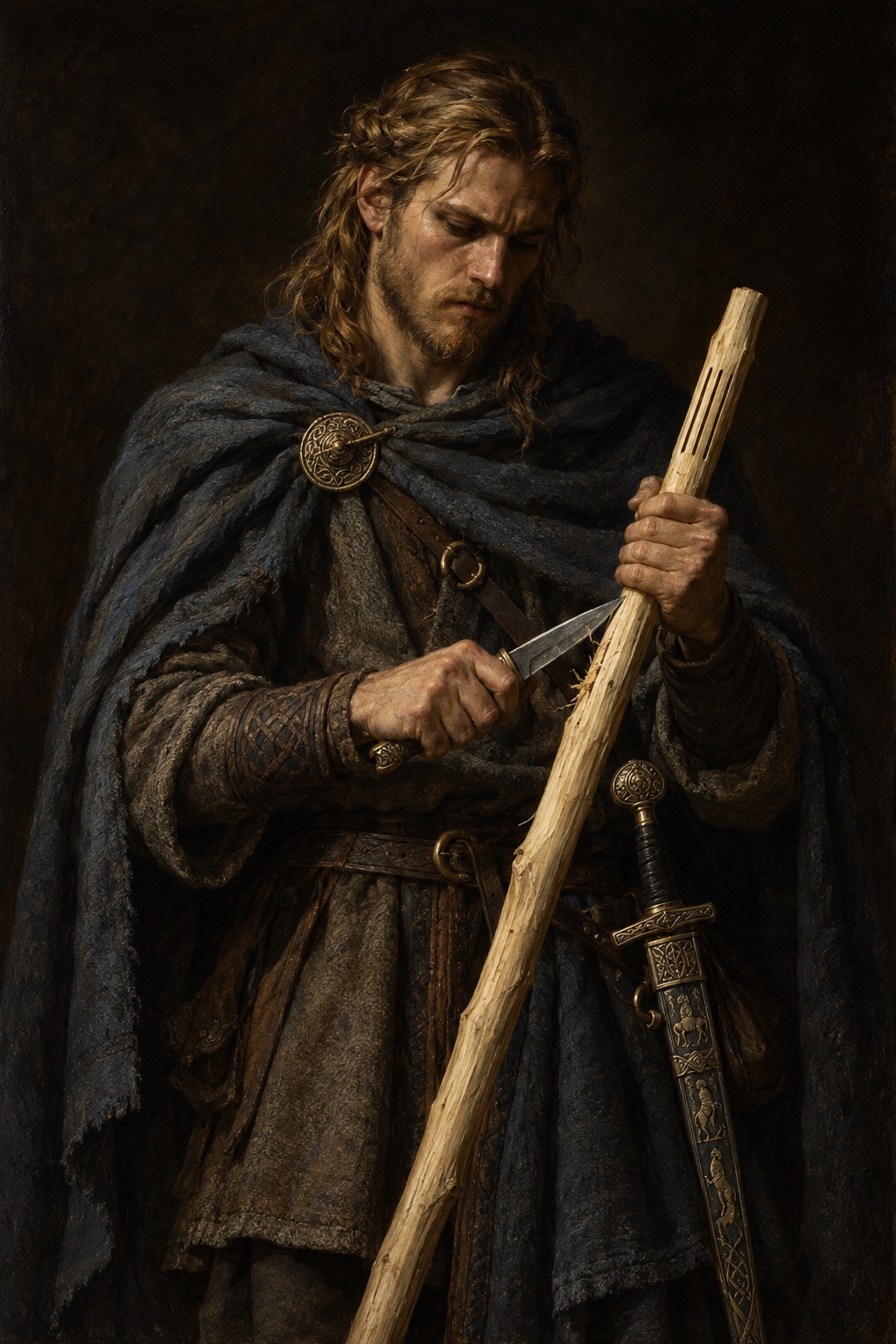
The price of one errand
Freyr has seen a woman from Hlidskjálf and stopped speaking to anyone. His father sends a servant in to find out why, and the servant goes without wanting to, saying in advance that he expects to be shouted at. Everything that happens afterwards — the ride through fire, the gifts, the threats, the curse, the nine nights at Barri — follows from a bargain struck in that one room, before the errand begins.
Þá lét Njörðr kalla til sín Skírni, skósvein Freys, ok bað hann ganga til Freys ok beiða hann orða ok spyrja, hverjum hann væri svá reiðr, at hann mælti ekki við menn. En Skírnir lézt ganga mundu ok eigi fúss ok kvað illra svara vera ván af honum. En er hann kom til Freys, þá spurði hann, hví Freyr var svá hnipinn ok mælti ekki við menn. Þá svarar Freyr ok sagði, at hann hefði sét konu fagra ok fyrir hennar sakir var hann svá harmfullr, at eigi myndi hann lengi lifa, ef hann skyldi eigi ná henni - “ok nú skaltu fara ok biðja hennar mér til handa ok hafa hana heim hingat, hvárt er faðir hennar vill eða eigi, ok skal ek þat vel launa þér.” Þá svarar Skírnir, sagði svá, at hann skal fara sendiferð, en Freyr skal fá honum sverð sitt. Þat var svá gott sverð, at sjálft vást. En Freyr lét eigi þat til skorta ok gaf honum sverðit. Þá fór Skírnir ok bað honum konunnar ok fekk heit hennar, ok níu nóttum síðar skyldi hon þar koma, er Barrey heitir, ok ganga þá at brullaupinu með Frey
“Then Njördr summoned to him Skírnir, Freyr’s foot-page, and bade him go to Freyr and beg speech of him and ask for whose sake he was so bitter that he would not speak with men. But Skírnir said he would go, albeit unwillingly; and said that evil answers were to be expected of Freyr. But when he came to Freyr, straightway he asked why Freyr was so downcast, and spake not with men. Then Freyr answered and said that he had seen a fair woman; and for her sake he was so full of grief that he would not live long if he were not to obtain her. ‘And now thou shalt go and woo her on my behalf and have her hither, whether her father will or no. I will reward thee well for it.’ Then Skírnir answered thus: he would go on his errand, but Freyr should give him his own sword—which is so good that it fights of itself;—and Freyr did not refuse, but gave him the sword. Then Skírnir went forth and wooed the woman for him, and received her promise; and nine nights later she was to come to the place called Barrey, and then go to the bridal with Freyr” — Snorri Sturluson, Gylfaginning 37, tr. A. G. Brodeur
Snorri gives him one word of standing and then one sentence of leverage. The word is skósveinn, shoe-boy, the servant who walks behind — and the sentence is a servant naming his own terms to a god who is too far gone to argue. He does not ask to be paid afterwards, which is what Freyr offers. He asks for the sword first, and the errand does not start until he has it.
Neither elf nor god nor Van
He rides north on a horse that is not his either, over mountains, through Gymir’s gate and past the bound hounds, and through a wall of fire that Bellows renders as the leaping flame. Someone inside the hall hears him coming and asks the obvious question: what is standing at the door. The answer he gives is the only self-description he ever offers, and it is entirely negative.
Emk-at ek alfa né ása sona né víssa vana; þó ek einn of komk eikinn fúr yfir yður salkynni at séa
“I am not of the elves, nor the offspring of gods, Nor of the wise Wanes; Though I came alone through the leaping flame Thus to behold thy home” — Skírnismál 18, tr. H. A. Bellows
Three categories are put to him and he refuses all three, then changes the subject to the fire he has just crossed. He does not say what he is instead, and nothing else in either Edda says it for him. The poem’s own prose has already called him Freyr’s footpage; Snorri repeats the word and adds nothing. That is the whole file on him. This wiki files him as a hero rather than a god on the strength of his own denial and that job title, and the question the maidservant asked him stays open, exactly as he left it — a figure who does everything a god’s power would be needed for and disclaims the rank in the same breath.
The wand, and the rune with three staves
The gifts fail. Eleven golden apples fail, the ring that drips eight more every ninth night fails, and Gerðr’s own entry carries her three refusals in her own words, including the one she gives to a drawn sword. What Skírnir does when the sword does not work either is the reason this entry lists magic among his domains. He strikes her with a rod.
Tamsvendi ek þik drep, en ek þik temja mun, mær, at mínum munum; þar skaltu ganga, er þik gumna synir síðan æva séi
“I strike thee, maid, with my magic staff, To tame thee to work my will; There shalt thou go where never again The sons of men shall see thee” — Skírnismál 26, tr. H. A. Bellows
Tamsvöndr is a taming-wand, the word used for breaking an animal to a bridle, and it opens ten stanzas of the most sustained cursing in the Poetic Edda: a life on an eagle’s mound facing away from the world, food more hateful to her than the serpent is to men, a three-headed giant to live with or no man at all, and below the gates of the dead a giant called Hrímgrímnir and goat’s piss to drink. Somewhere in the middle of it he goes to the woods and cuts a second implement — Til holts ek gekk ok til hrás viðar, gambantein at geta, gambantein ek gat, to the wood he went and to the wet timber, to get a gambanteinn, and a gambanteinn he got. The poem never says whether that wand and the taming-wand are the same object, and this entry does not decide it for the poem. Then he cuts the curse into something, and names the letters.
Þurs ríst ek þér ok þría stafi, ergi ok æði ok óþola; svá ek þat af ríst, sem ek þat á reist, ef gerask þarfar þess
“I write thee a charm and three runes therewith, Longing and madness and lust; But what I have writ I may yet unwrite If I find a need therefor” — Skírnismál 36 (Bellows prints it as 37), tr. H. A. Bellows
Þurs is the giant-rune, ᚦ, and the three staves are named outright: ergi ok æði ok óþola — unmanning shame, madness, and a restlessness that cannot be borne. Bellows renders the three as longing, madness and lust. The last line is the working part of the whole speech. Having carved it, he says he can also scrape it off again, should there be need. That is not mercy; it is the terms of a hostage note read aloud, and Gerðr yields in the stanza after it. Whatever he is, he is the one figure in this material who can write a curse onto wood and take it off again at will, and he does it as an employee, on someone else’s schedule.
What the sword was worth
The errand succeeds. Gerðr names Barri and the nine nights, Skírnir carries the answer home, and there the poem ends and Snorri keeps going. Freyr never gets the sword back, and Snorri is unusually direct about what that costs, twice in the same chapter. The first time is a bare clause of explanation, attached to a fight nobody remembers.
Þessi sök er til þess, er Freyr var svá vápnlauss, er hann barðist við Belja ok drap hann með hjartarhorni
“This was to blame for Freyr’s being so weaponless, when he fought with Beli, and slew him with the horn of a hart” — Snorri Sturluson, Gylfaginning 37, tr. A. G. Brodeur
The hart’s horn belongs here, to Beli, and nowhere else. It is worth saying plainly, because the two fights are easy to run together. Beli takes the antler in chapter 37; the Ragnarök fight in chapter 51, quoted in full in Surtr’s entry, has no antler in it and no weapon at all. Snorri’s narrator says so himself in the next breath, answering whether a weapon that good was wise to give away.
Lítit mark var þá at, er þeir Beli hittust. Drepa mátti Freyr hann með hendi sinni. Verða mun þat, er Frey mun þykkja verr við koma, er hann missir sverðsins, þá er Múspellssynir fara at herja
“There was small matter in that, when he and Beli met; Freyr could have killed him with his hand. It shall come to pass that Freyr will think a worse thing has come upon him, when he misses his sword on that day that the Sons of Múspell go a-harrying” — Snorri Sturluson, Gylfaginning 37, tr. A. G. Brodeur
Beli did not matter. The bill comes due at the end of the world, and Surtr’s entry carries the receipt: at Ragnarök Freyr falls to the fire-giant from the south, and Snorri’s reason for it is that he no longer has the good sword he gave to Skírnir. A servant asked for one weapon as the fare for one journey, a lovesick god handed it over without haggling, and the loss is still being paid off in the last chapter of the world. Nothing in either Edda says Skírnir knew what he was pricing. Nothing says he gave it back, either.