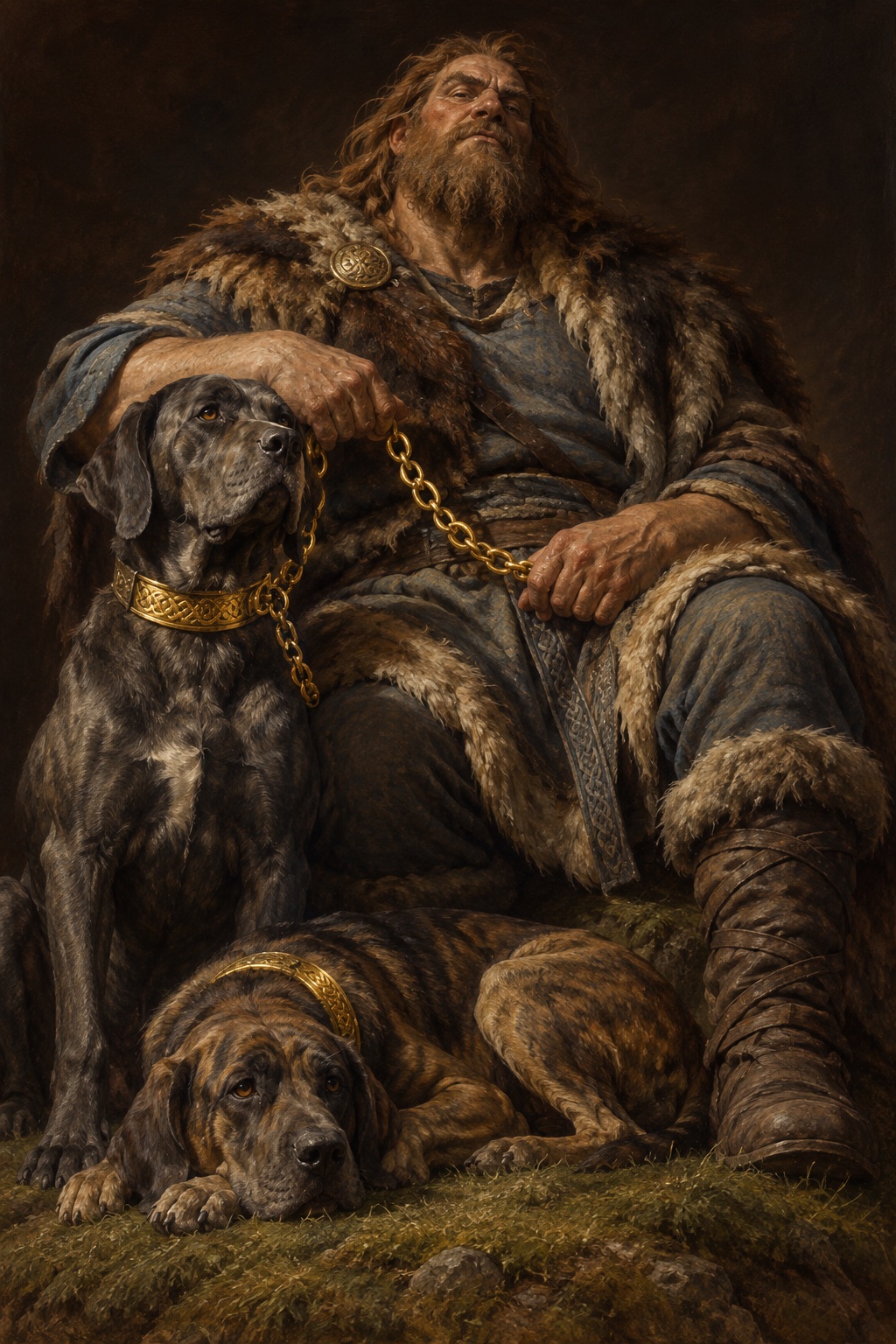
The lord on the mound
Þrymskviða opens on Thor, not on him. Thor wakes and his hammer is gone, and Loki borrows Freyja’s feather-coat and flies out of the home of the gods into the land of the giants. What he finds there is the first picture the poem gives of Þrymr, and it is a picture of leisure. The narrator names him with the title the poem will keep for him, þursa dróttinn, lord of the þursar, and shows him sitting on a mound, twisting gold into leashes for his hounds and smoothing the manes of his horses. He greets the visitor with questions: how do the gods fare, how do the elves fare, and why has Loki come alone? Loki answers that it goes badly with both, and asks him outright whether he has hidden Thor’s hammer.
Þrymr does not deny it. He says that he has hidden it, and then he says where, and on what terms.
átta röstum fyr jörð neðan; hann engi maðr aftr of heimtir, nema færi mér Freyju at kvæn
“Eight miles down deep in the earth; And back again shall no man bring it If Freyja I win not to be my wife” — Þrymskviða 8 (Bellows prints it as 7), tr. H. A. Bellows
This is not a boast. It is a ransom note, set out in order: the place, the depth, the fact that nobody can fetch it, and the one condition. The Old Norse measures the depth as átta röstum, eight leagues; Bellows makes it eight miles. The hammer has been hidden, not used, and nothing in the stanza threatens anyone. What Þrymr wants in exchange for Thor’s weapon is a wedding: nema færi mér Freyju at kvæn, unless Freyja is brought to him as his wife.
Loki carries the terms home, and in his report to Thor the giant gets his title for the second time: Þrymr has the hammer, þursa dróttinn, lord of the þursar. Freyja’s answer is fury and a refusal. The gods hold council, and it is Heimdall who proposes the solution: put the bridal veil on Thor instead, with Freyja’s great necklace, keys hanging from him and a woman’s dress down to his knees. Loki goes with him as the serving-maid. The goats are driven in and hurried into harness, the mountains split and the earth burns as the two of them ride out, and the bride who arrives at Þrymr’s hall is Thor.
The bride at the table
At the other end, Þrymr is getting ready. He tells his giants to stand up and strew straw on the benches, because now they are bringing him Freyja as his wife, Njörðr’s daughter out of Nóatún. Then he counts what he owns. Cows with golden horns walk in his yard, and oxen that are black all over, for his pleasure. He has plenty of treasure and plenty of jewels. Freyja alone, he says, is what he lacks. It is the longest speech he makes about himself, and it is an inventory.
The feast begins early in the evening, and the ale is carried out for the giants. The bride eats a whole ox, eight salmon and all the delicacies set out for the women, and Sif’s husband drinks three casks of mead. Þrymr’s reaction is astonishment, not suspicion. He has never seen a bride bite more keenly, he says, or a maiden drink more mead. The serving-maid sits close by and has an answer ready: Freyja has eaten nothing for eight nights, so eager was she to come to Jötunheim. He accepts that, and he leans in for a kiss.
Laut und línu, lysti at kyssa, en hann útan stökk endlangan sal: “Hví eru öndótt augu Freyju? Þykki mér ór augum eldr of brenna
“Thrym looked ‘neath the veil, for he longed to kiss, But back he leaped the length of the hall: “Why are so fearful the eyes of Freyja? Fire, methinks, from her eyes burns forth”” — Þrymskviða 27, tr. H. A. Bellows
This is the one moment in the poem when Þrymr sees the truth, and he sees it exactly: there is fire in the bride’s eyes. His body reacts before his judgement does. He leaps back endlangan sal, the whole length of the hall, and it is the only violent movement the poem ever gives him — away from the bride, not towards her. Then he asks the right question out loud. Hví eru öndótt augu Freyju? Why are Freyja’s eyes so fearful?
The serving-maid answers him with the same excuse in the same shape as before. Freyja has not slept for eight nights, so eager was she to come to Jötunheim. For the second time he accepts it. The poem does not say whether he believes her. It shows a man who has noticed that something is wrong and who wants the wedding more than he wants the answer.
The hammer in the bride’s lap
The last demand at the feast is not his. The giants’ sister, whom the poem later calls old, comes in and asks the bride for a bridal fee: the red-gold rings from her hands, if she wants the sister’s goodwill. Þrymr answers with the ceremony. He calls for the hammer to be carried in to hallow the bride, for it to be laid on the maiden’s knees, and for the two of them to be hallowed together by the hand of Vár. This is the only time the Old Norse poem calls the hammer by its name, Mjöllnir, and the name is in his mouth. The episode began with his admission that he had hidden the hammer, and it ends with his order to bring it back into the room.
Hló Hlórriða hugr í brjósti, er harðhugaðr hamar of þekkði; Þrym drap hann fyrstan, þursa dróttin, ok ætt jötuns alla lamði
“The heart in the breast of Hlorrithi laughed When the hard-souled one his hammer beheld; First Thrym, the king of the giants, he killed, Then all the folk of the giants he felled” — Þrymskviða 31, tr. H. A. Bellows
Thor is Hlórriði in this stanza, and his heart laughs when he knows the hammer again. Þrym drap hann fyrstan: Þrymr dies first, and the poem gives him his full title at the moment it kills him, þursa dróttin, which Bellows renders “the king of the giants”. The Old Norse then has the giant in the singular, ætt jötuns alla: after Þrymr, the rest of his kin goes down with him. The next stanza adds the old sister, who asked for rings and got a blow from the hammer instead, and the poem closes on Odin’s son with his hammer back in his hands.
Seen from his side, the bargain was kept. He said that no one would get the hammer back unless Freyja came as his wife. When the bride came, he brought the hammer out to bless the marriage. Every lie told at his wedding feast is told to him.
One poem, no hall
Þrymskviða is the whole of Þrymr. Snorri does not tell the story in either Gylfaginning or Skáldskaparmál, so the poem is the only witness on both sides of this page, the Old Norse and the English. What the poem gives him is a title and some property. The title comes six times: þursa dróttinn in stanzas 6, 11, 22, 25 and 30, and þursa dróttin in stanza 31, where he dies. Bellows changes the English from stanza to stanza, but the Old Norse keeps the same two words each time. That title is the ground for this page’s kingship domain and for its one rules relation: he rules the þursar, not a place.
The poem gives no name to his hall. It has benches to strew with straw, a yard where his cattle walk, and a length he can leap back along, endlangan sal, but it has no name. Þrymheimr, a name that looks as if it should be his, belongs to Þjazi in Snorri’s account, and after Þjazi to Skaði; Þrymskviða never uses the word.
Nor does the poem describe him. It gives him no face, no size, no clothes and no weapon. The gold in his story goes on his dogs’ leashes and on the horns of his cattle, never on his own body. The poem shows him in three poses: sitting on the mound at his ease, bending under the veil to kiss the bride, and leaping backwards the length of his own hall.
Þjazi’s entry calls his bargain the only place in the corpus where a giant gets what he wants by bargaining rather than by force. Þrymr’s is the same kind of bargain, struck with the same god, Loki, over the same kind of price, a goddess. Þjazi collects Iðunn, if only for a while. Þrymr names Freyja and receives Thor. Ravana, another monstrous king who wants a woman he cannot have, takes Sita by force. Þrymr never takes Freyja at all. He asks for her, and he waits for her, and both of the questions he asks at the feast are answered with a lie.