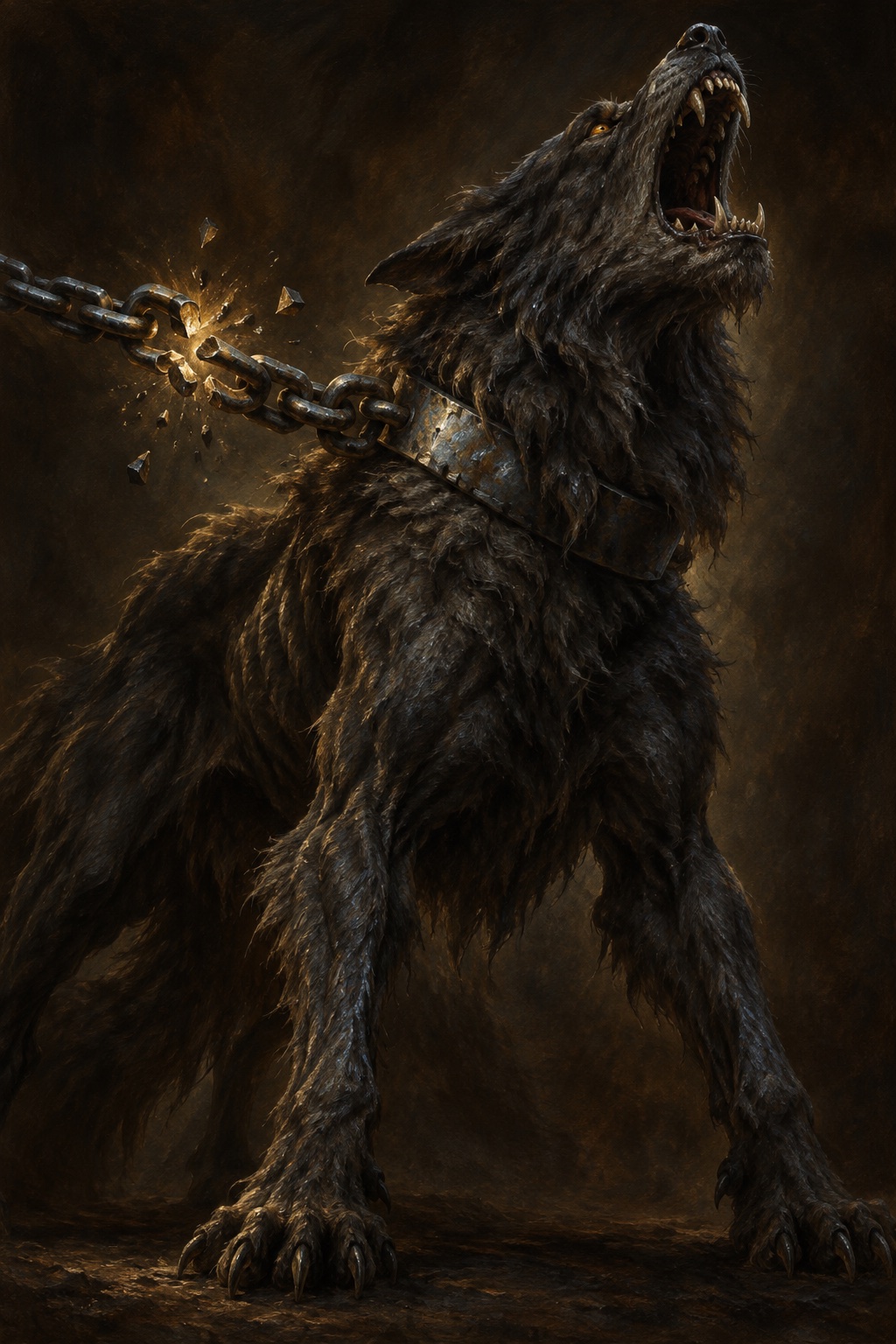
The greatest monster
Garmr has one scene in Gylfaginning, and it comes at the end of the world. In Gylfaginning 51, Snorri tells the last battle as a series of single fights. Freyr falls before Surtr, because he gave his good sword away to Skírnir. Garmr’s sentence comes next, and after it Thor kills Jörmungandr and then dies of the serpent’s venom.
Þá er ok lauss orðinn hundrinn Garmr, er bundinn er fyrir Gnipahelli. Hann er it mesta forað. Hann á víg móti Tý, ok verðr hvárr öðrum at bana
“Then shall the dog Garmr be loosed, which is bound before Gnipa’s Cave: he is the greatest monster; he shall do battle with Týr, and each become the other’s slayer” — Snorri Sturluson, Gylfaginning 51, tr. A. G. Brodeur
Snorri calls him hundrinn, the dog, and the sentence gives him two states. Until the end he is bundinn, bound, before Gnipahellir. At the end he is lauss orðinn, loose. The text does not say who bound him, or when, or why. Snorri names the place of the binding and nothing more.
The next sentence is the only description that Garmr gets: Hann er it mesta forað, he is the greatest monster, in Brodeur’s English. Snorri gives him no size, no colour and no shape beyond the word for a dog. A reader who pictures a giant beast, or a beast with more than one head, takes that picture from somewhere other than this sentence.
Hann á víg móti Tý: his fight is with Týr, and it has no winner. The sentence ends hvárr öðrum at bana, each becomes the other’s slayer, so Garmr and Týr die together. The Týr page tells this fight from the god’s side. Snorri gives no reason for the pairing, and he does not connect Garmr with Týr’s lost hand or with Fenrir.
Howling before Gnipahellir
The other witness is Völuspá, and there Garmr is not one fight in a list. He is a sound. The stanza opens with it, Geyr nú Garmr, now Garmr howls, and he howls before the same cave that Snorri names.
Geyr nú Garmr mjök fyr Gnipahelli, festr mun slitna, en freki renna; fjölð veit ek fræða, fram sé ek lengra um ragna rök römm sigtíva
“Now Garm howls loud before Gnipahellir, The fetters will burst, and the wolf run free; Much do I know, and more can see Of the fate of the gods, the mighty in fight” — Völuspá 44, tr. H. A. Bellows
The first half of the stanza puts three things side by side: the howl, a fetter that will break, festr mun slitna, and a wolf that will run, en freki renna. It does not say whose fetter breaks or which wolf runs. Bellows, in his note on the stanza, takes the wolf to be Fenrir. The stanza itself never makes Garmr the one who is bound. That comes from Snorri, whose prose puts Garmr in bonds before Gnipahellir. Völuspá gives the name, the place and the howl. The binding, the superlative and the fight with Týr are in Snorri alone, and Völuspá does not name Týr anywhere.
The second half of the stanza belongs to the voice that speaks the poem: much do I know, and I see further, um ragna rök, of the fate of the gods. The stanza is a refrain. The poem comes back to the same lines as stanza 49 and stanza 58 in Bellows’s translation, and the Old Norse edition prints them once more, as stanza 54. Each time, the howl sounds again while the account of the end goes on around it.
Snorri knew this part of the poem. Earlier in the same account of Ragnarök he quotes Völuspá 45, the stanza that follows the refrain, about brothers who fight and kill each other. The refrain itself he does not quote, and the name Garmr comes only twice in the whole of Gylfaginning. Garmr enters Snorri’s account in Snorri’s own prose, and the howl stays in the poem.
A hound with no history
Three texts name Garmr: Gylfaginning, Völuspá and Grímnismál. None of them gives him a father, a mother or a master, and none says where he came from or whose hound he is. Fenrir is bound as well, and the likeness makes the two easy to merge, but nothing in these texts makes Garmr kin to the wolf or the same animal.
Two of Bellows’s notes go further than the poems do. In his note on Völuspá 44 he makes Garmr the watchdog at the entrance to Hel’s realm, and he explains Gnipahellir as the mouth of the land of the dead. Neither Völuspá nor Snorri says this, and it is the translator’s gloss. The nearest the poem comes is the stanza just before the refrain, which ends with a red cock crowing below the earth at the halls of Hel. The poem does not put Garmr there. The same note also points to Baldrs draumar, where Odin rides down toward Niflhel and meets a hound with blood on its breast. That poem never names the hound. Bellows’s note on Baldrs draumar calls it Garm, and the identification is his, not the poem’s.
This wiki files Garmr with the monsters for Snorri’s superlative, it mesta forað. Fate is for the refrain, which the poem ties to ragna rök, the fate of the gods. War is for his one deed in Snorri’s account, the fight in which he and Týr each become the other’s slayer.