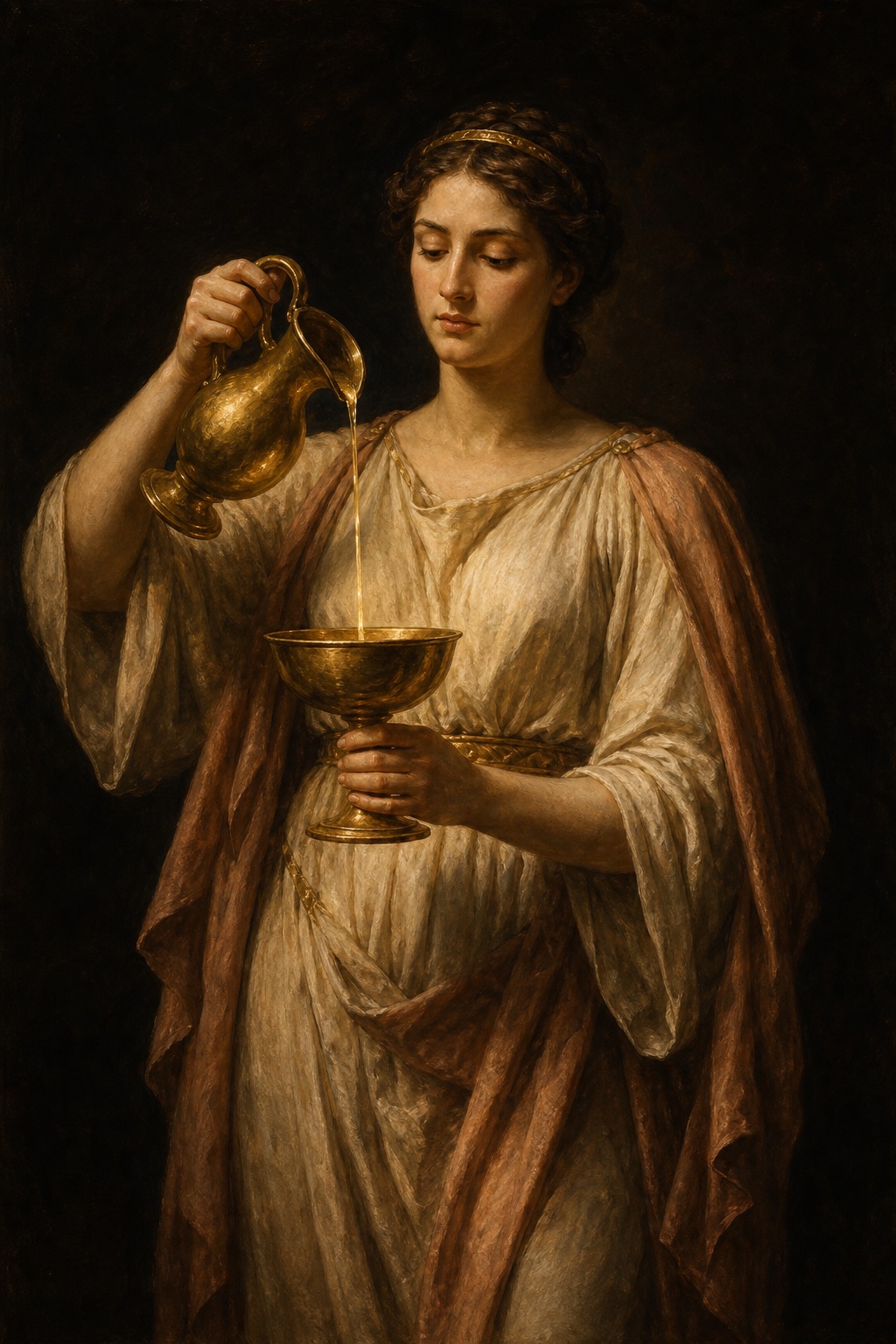
Hebe is the Greek word for the prime of youth — the age at which a boy becomes liable for military service — turned into a person. She is Zeus and Hera’s daughter, and the only legitimate one to hold an office on Olympus. Her office is pouring the drink.
Homer opens Book 4 of the Iliad with her doing it, and the placement matters: the gods are about to decide whether Troy falls, and the scene is set with a girl filling cups.
Οἳ δὲ θεοὶ πὰρ Ζηνὶ καθήμενοι ἠγορόωντο χρυσέῳ ἐν δαπέδῳ, μετὰ δέ σφισι πότνια Ἥβη νέκταρ ἐοινοχόει
“Now the gods, seated by the side of Zeus, were holding assembly on the golden floor, and in their midst the queenly Hebe poured them nectar.” — Homer, Iliad 4.1–3, tr. A. T. Murray
It is easy to read that as decorative, and it is not. Nectar is what makes the gods deathless; the cupbearer is the one who administers immortality, daily, by hand. Hebe is not serving a drink so much as operating the mechanism the whole pantheon depends on. Later she is replaced in the role by Ganymede, a Trojan boy Zeus abducts — a substitution nobody in the sources explains, and which reads uncomfortably like a demotion.
Her second function is to be the prize. When Heracles finishes his labours and is burned out of his mortal body, he arrives on Olympus and is married to Hebe. Hesiod reports it in the language of an accounting: he finished his great works, and now lives untroubled and unaging. She is what “unaging” looks like when it is given a face and a wedding. The marriage also settles the pantheon’s longest feud — Hera spent Heracles’ entire life trying to kill him, and the peace treaty is her own daughter.
That combination makes her stranger than she first appears. Youth, in Greek thought, is precisely the thing that does not last; deifying it produces a goddess whose entire content is a condition everyone else is losing. Compare the Chinese arrangement, where the same anxiety is handled as pharmacology rather than personification: Xiwangmu keeps the peaches of immortality, Chang’e swallows the elixir, and the substance is the story. Greece made it a girl with a jug, and then married her off to the one mortal who earned a share.