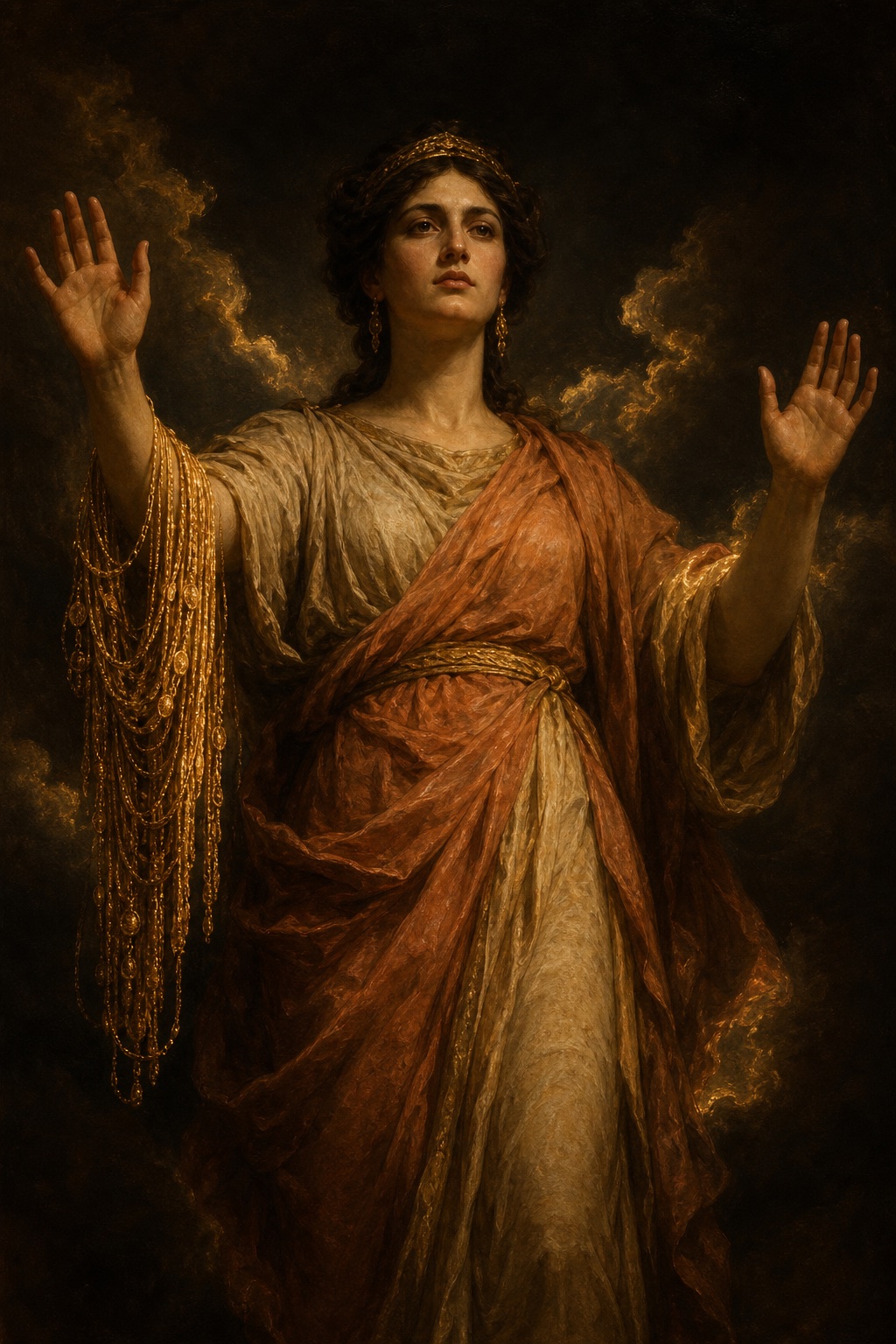
The one who was not told
Leto has been in labour on Delos for nine days and nine nights. Every goddess of consequence is standing around her — Dione, Rhea, Themis, Amphitrite — and the birth will not come, because the one who has to be there is missing and has not even been informed.
μούνη δ’ οὐκ ἐπέπυστο μογοστόκος Εἰλείθυια ἧστο γὰρ ἄκρῳ Ὀλύμπῳ ὑπὸ χρυσέοισι νέφεσσιν Ἥρης φραδμοσύνης λευκωλένου, ἥ μιν ἔρυκε ζηλοσύνῃ, ὅτ’ ἄρ’ υἱὸν ἀμύμονά τε κρατερόν τε Λητὼ τέξεσθαι καλλιπλόκαμος τότ’ ἔμελλεν
“Only Eilithyia, goddess of sore travail, had not heard of Leto’s trouble, for she sat on the top of Olympus beneath golden clouds by white-armed Hera’s contriving, who kept her close through envy, because Leto with the lovely tresses was soon to bear a son faultless and strong.” — Homeric Hymn 3, To Apollo 97–101, tr. Evelyn-White
The epithet that travels with her everywhere is μογοστόκος, which Evelyn-White renders “of sore travail” — literally she who brings the birth-pang, built from the word for toil and the word for bearing. It is a two-sided name. She does not merely relieve labour; she is the one who starts it, and the pain is her instrument rather than the thing she is called in to remove.
What the passage establishes is that the mechanism is absolute. A goddess in labour with a god cannot deliver while Eileithyia sits on Olympus not knowing about it, and Hera does not need to lay a hand on Leto to keep Apollo unborn — she only has to keep one daughter under a golden cloud and out of earshot.
The necklace, and the crossing to Delos
The other goddesses solve it by bribery. They send Iris off the island to fetch her, promising a great necklace strung with golden threads, nine cubits long, and they instruct Iris to call her aside quietly, out of Hera’s hearing, in case Hera should talk her out of coming after all. Iris runs the whole distance to Olympus, calls Eileithyia out of the hall to the door, and the two go back together like shy wild doves.
The result is instantaneous, and the hymn is careful about the sequence: as soon as Eileithyia set foot on Delos, the pangs seized Leto, and she cast her arms about a palm tree and knelt on the soft meadow, and the earth laughed beneath her. Nine days of nothing, and then a birth in the time it takes a goddess to step ashore. Nowhere in the hymn does Eileithyia do anything — no touch, no word, no ritual act. Her arrival is the whole of her function.
Zeus swears, and Hera counts the months
The Iliad turns the same lever the other way. Zeus, on the day Heracles is due to be born, makes a boast in front of the assembled gods, and phrases it as a prophecy about what Eileithyia is going to do that afternoon.
σήμερον ἄνδρα φόως δὲ μογοστόκος Εἰλείθυια ἐκφανεῖ, ὃς πάντεσσι περικτιόνεσσιν ἀνάξει, τῶν ἀνδρῶν γενεῆς οἵ θ’ αἵματος ἐξ ἐμεῦ εἰσί
“This day shall Eileithyia, the goddess of childbirth, bring to the light a man that shall be the lord of all them that dwell round about, even one of the race of those men who are of me by blood.” — Homer, Iliad 19.103–105, tr. Murray
Hera makes him swear to it as a binding oath, then leaves Olympus for Argos, brings on the seven-months child of the wife of Sthenelus ahead of his time, and stays Alcmene’s bearing by holding back the Eileithyiae. Eurystheus is born first; Heracles is born second; the oath binds, and the greatest hero of the Greek world spends his life labouring for a lesser man because of a difference of a few hours in a delivery room.
Zeus’s own oath is what traps him, but the instrument in both stories is the same, and it is not strength. Twice, in the two oldest sources that mention her, a goddess of childbirth is detained or dispatched by somebody else in order to decide who gets born and when — and both times it works.
One goddess or many
Homer will not settle whether she is singular. In Zeus’s boast she is one goddess with a name; sixteen lines later Hera holds back “the Eileithyiae”, plural. In Book 11 they are plural again and given a parentage — the piercing dart that strikes a woman in labour is sent by “the Eilithyiae, the goddesses of childbirth, even the daughters of Hera that have in their keeping bitter pangs”, where the spelling of the name has drifted between one book and the next even in Murray’s translation. The hymn, by contrast, is unambiguous: one goddess, seated under a cloud, who has not heard the news.
The plural is probably the older idea — a class of birth-spirits attached to the moment rather than a personality — and the singular Eileithyia of the hymn is what happens when such a class acquires a mother, a place on Olympus, and an enemy with a reason to keep her away.