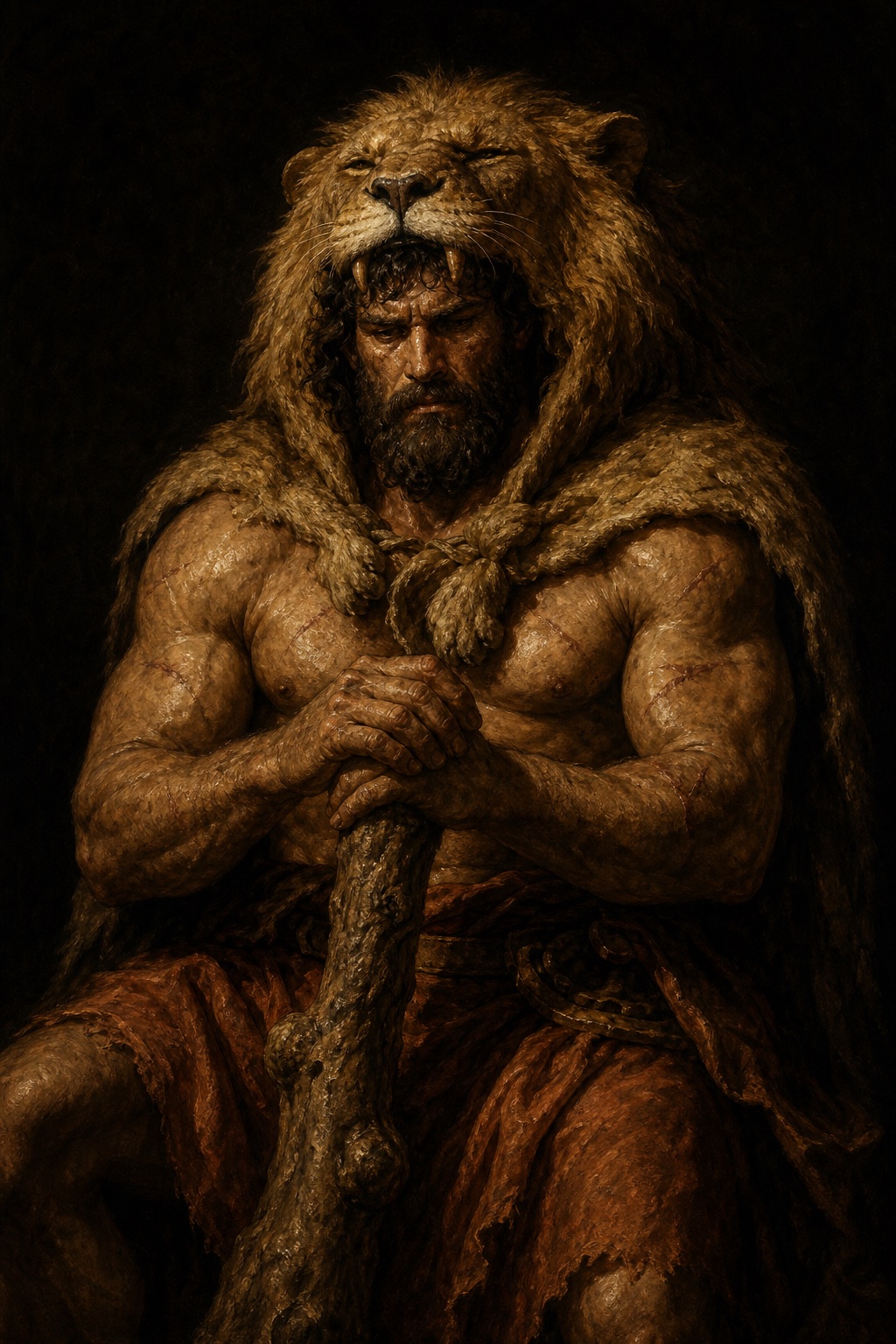
Heracles is the son of Zeus by the mortal Alcmene, and Hera’s hostility to him begins before he can walk — she sends two serpents into his cradle, and he strangles them. The hostility is the engine of his whole career: it is Hera who drives him mad, and in that madness he kills his own wife and children, and it is to expiate that killing that he is bound over to serve his lesser cousin Eurystheus and perform the labours.
Ἡρακλέα Διὸς υἱὸν ἀείσομαι, ὃν μέγ’ ἄριστον γείνατ’ ἐπιχθονίων Θήβῃς ἔνι καλλιχόροισιν Ἀλκμήνη μιχθεῖσα κελαινεφέϊ Κρονίωνι
“I will sing of Heracles, the son of Zeus and much the mightiest of men on earth. Alcmena bare him in Thebes, the city of lovely dances, when the dark-clouded Son of Cronos had lain with her.” — Homeric Hymn 15, tr. Evelyn-White
The labours run from the local to the impossible and end underground. He strangles the Nemean lion and wears its hide thereafter; cuts off the Hydra’s heads while Iolaus sears the necks; drives off the Erymanthian boar, the Cretan bull and the mares of Diomedes; cleans Augeas’s stables by rerouting two rivers; fetches the girdle of the Amazon queen, the cattle of Geryon and the apples of the Hesperides; and last goes down to bring up Cerberus, which he does bare-handed, on the condition that he use no weapon, and returns the dog afterwards.
His death is domestic and undeserved. The centaur Nessus, dying of one of Heracles’ arrows, persuades Deianeira to keep his blood as a love-charm; years later she soaks a robe in it to win her husband back, and the Hydra’s venom in the blood burns him past bearing. He builds his own pyre on Mount Oeta and has it lit. What burns is the mortal part: the Greeks alone among his inheritors let their greatest hero end as a god on Olympus, reconciled at last with Hera and married to her daughter Hebe.