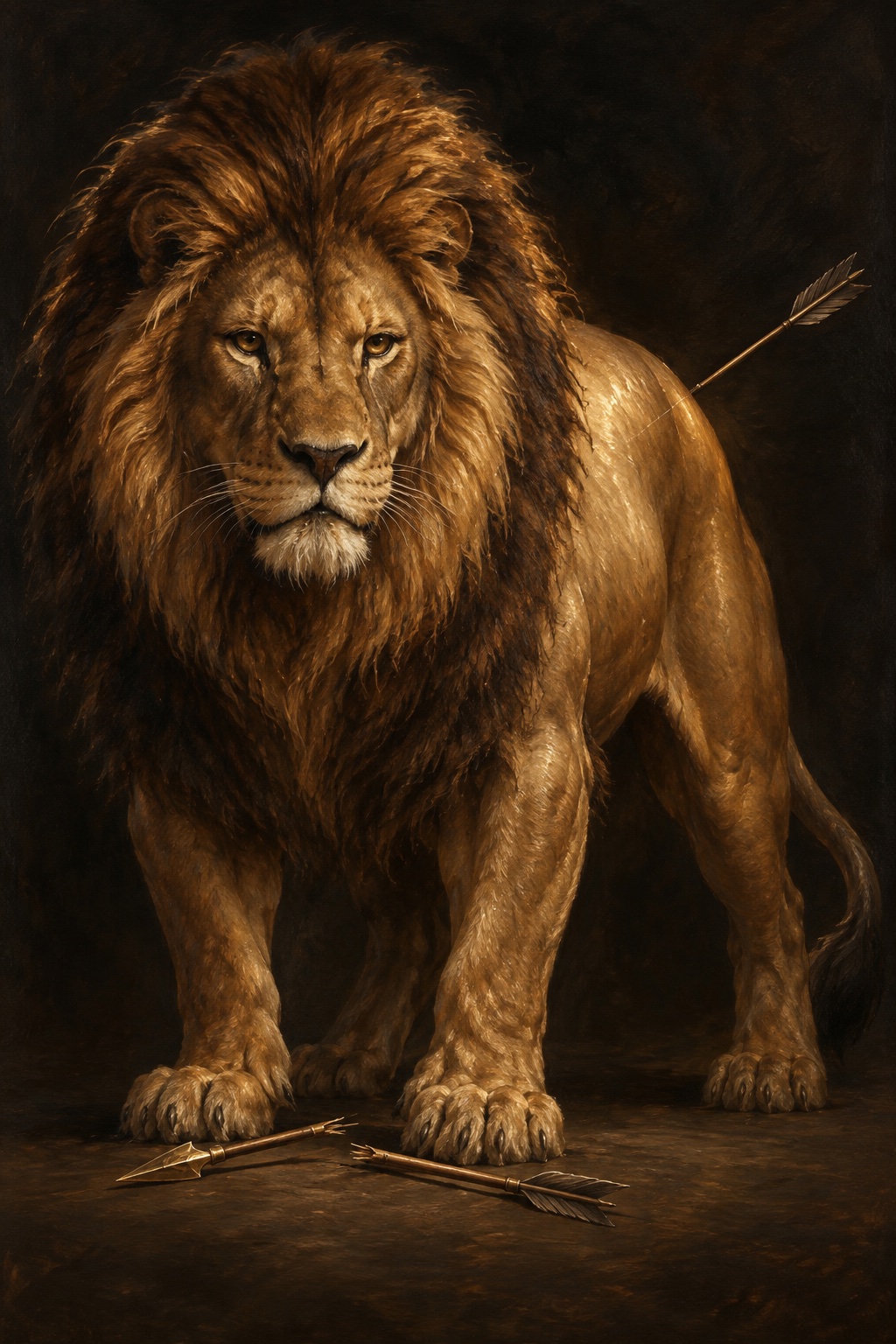
Hesiod’s lion
Hesiod gives the Nemean lion seven lines of the Theogony. They come in his catalogue of monsters, directly after the lines on the Chimera, and in those seven lines the lion is born, reared, settled in its country and overcome.
ἣ δ᾽ ἄρα Φῖκ᾽ ὀλοὴν τέκε Καδμείοισιν ὄλεθρον Ὅρθῳ ὑποδμηθεῖσα Νεμειαῖόν τε λέοντα, τόν ῥ᾽ Ἥρη θρέψασα Διὸς κυδρὴ παράκοιτις γουνοῖσιν κατένασσε Νεμείης, πῆμ᾽ ἀνθρώποις. ἔνθ᾽ ἄρ᾽ ὃ οἰκείων ἐλεφαίρετο φῦλ᾽ ἀνθρώπων, κοιρανέων Τρητοῖο Νεμείης ἠδ᾽ Ἀπέσαντος· ἀλλά ἑ ἲς ἐδάμασσε βίης Ἡρακληείης
“Echidna was subject in love to Orthus and brought forth the deadly Sphinx which destroyed the Cadmeans, and the Nemean lion, which Hera, the good wife of Zeus, brought up and made to haunt the hills of Nemea, a plague to men. There he preyed upon the tribes of her own people and had power over Tretus of Nemea and Apesas: yet the strength of stout Heracles overcame him” — Hesiod, Theogony 326–332, tr. Evelyn-White
The first words are the difficulty. The Greek opens with ἣ δ᾽ ἄρα, and she, and it never says who she is. The name Echidna is Evelyn-White’s, not Hesiod’s. The same open pronoun begins the Chimera’s lines at 319, and it leaves the same question. The mother in this passage may be Echidna, whose children the catalogue has been listing, or she may be the Chimera, whose lines come directly before. This wiki’s Echidna entry reads Echidna, as Evelyn-White does, and this entry’s relations follow it, but the line itself does not decide.
The father is named. Ὅρθῳ ὑποδμηθεῖσα, subject in love to Orthus: the mother conceives by Orthus, the hound of Geryon, whom Hesiod had named earlier in the same catalogue as a child of Echidna and Typhon. If the mother is Echidna, she conceives by her own son. Two children come of it. The first is Φῖκ᾽ ὀλοὴν, the deadly Phix, which Evelyn-White renders the deadly Sphinx, and Hesiod gives her one purpose, Καδμείοισιν ὄλεθρον, a destruction for the Cadmeans. The second is Νεμειαῖόν τε λέοντα, the Nemean lion. Hesiod gives it no feature of its own. He tells nothing of its size, its hide or its strength, and it is named only for its place.
The next clause gives it a keeper. τόν ῥ᾽ Ἥρη θρέψασα Διὸς κυδρὴ παράκοιτις: Hera, the good wife of Zeus, brought it up. γουνοῖσιν κατένασσε Νεμείης: she settled it in the hills of Nemea, which Evelyn-White renders made to haunt the hills of Nemea, as πῆμ᾽ ἀνθρώποις, a plague to men. Hesiod’s Hera rears the Hydra too, a few lines earlier, and there he gives a reason: ἄπλητον κοτέουσα βίῃ Ἡρακληείῃ, being angry beyond measure with the mighty Heracles. Here Hesiod gives Hera no reason. The lion is reared to be a plague to men, and Heracles comes into the passage only at its end.
Then the lion acts. ἔνθ᾽ ἄρ᾽ ὃ οἰκείων ἐλεφαίρετο φῦλ᾽ ἀνθρώπων: there it preyed upon the tribes of her own people, in Evelyn-White’s words. κοιρανέων Τρητοῖο Νεμείης ἠδ᾽ Ἀπέσαντος: it had power over Tretus of Nemea and Apesas, the only places the passage names apart from Nemea itself. The last line ends it. ἀλλά ἑ ἲς ἐδάμασσε βίης Ἡρακληείης: yet the strength of stout Heracles overcame him. βίη Ἡρακληείη, the might of Heracles, is the epic way of naming the hero himself, and here Hesiod puts ἲς, strength, in front of it. That one line is the whole of the lion’s death in Hesiod. He does not say where Heracles overcame it, how, or on whose orders. The labour, the cave and the strangling are in Apollodorus.
The first labour
Apollodorus makes the lion the first of the labours that Eurystheus set Heracles. πρῶτον μὲν οὖν ἐπέταξεν αὐτῷ τοῦ Νεμέου λέοντος τὴν δορὰν κομίζειν: First, Eurystheus ordered him to bring the skin of the Nemean lion. He describes the beast in one word, ἄτρωτον, invulnerable, and gives it a father, Typhon, who is not Hesiod’s. He says nothing else about its body. Before the hunt he tells of a host. On the road Heracles comes to Cleonae and lodges with a day-labourer, ἀνδρὶ χερνήτῃ Μολόρχῳ, Molorchus. Molorchus wants to offer a victim in sacrifice, and Heracles tells him to wait thirty days. If Heracles comes back safe from the hunt, Molorchus is to sacrifice to Saviour Zeus, Διὶ σωτῆρι. If he dies, Molorchus is to make offerings to him as to a hero, ὡς ἥρωι ἐναγίζειν. Then Heracles goes on to Nemea.
εἰς δὲ τὴν Νεμέαν ἀφικόμενος καὶ τὸν λέοντα μαστεύσας ἐτόξευσε τὸ πρῶτον· ὡς δὲ ἔμαθεν ἄτρωτον ὄντα, ἀνατεινάμενος τὸ ῥόπαλον ἐδίωκε. συμφυγόντος δὲ εἰς ἀμφίστομον σπήλαιον αὐτοῦ τὴν ἑτέραν ἐνῳκοδόμησεν εἴσοδον, διὰ δὲ τῆς ἑτέρας ἐπεισῆλθε τῷ θηρίῳ, καὶ περιθεὶς τὴν χεῖρα τῷ τραχήλῳ κατέσχεν ἄγχων ἕως ἔπνιξε, καὶ θέμενος ἐπὶ τῶν ὤμων ἐκόμιζεν εἰς Κλεωνάς
“And having come to Nemea and tracked the lion, he first shot an arrow at him, but when he perceived that the beast was invulnerable, he heaved up his club and made after him. And when the lion took refuge in a cave with two mouths, Hercules built up the one entrance and came in upon the beast through the other, and putting his arm round its neck held it tight till he had choked it; so laying it on his shoulders he carried it to Cleonae” — Apollodorus, Bibliotheke 2.5.1, tr. J. G. Frazer
Heracles’s weapons do not kill the lion. He tracks the lion, μαστεύσας, and shoots first, ἐτόξευσε τὸ πρῶτον. The arrow shows him what Apollodorus told the reader at the start: ὡς δὲ ἔμαθεν ἄτρωτον ὄντα, when he perceived that the beast was invulnerable. The word ἄτρωτον comes twice, once as Apollodorus’s description and once as Heracles’s discovery. Then he lifts his club, ἀνατεινάμενος τὸ ῥόπαλον, and ἐδίωκε, made after him. The Greek does not say that the club strikes. Heracles lifts it, and the lion runs.
It runs into a cave, εἰς ἀμφίστομον σπήλαιον, a cave with two mouths. Heracles walls up one entrance, τὴν ἑτέραν ἐνῳκοδόμησεν εἴσοδον, and comes in upon the beast through the other. The killing is done by hand. περιθεὶς τὴν χεῖρα τῷ τραχήλῳ κατέσχεν ἄγχων ἕως ἔπνιξε: he put his arm round its neck and held it, throttling, until it choked. The arrow fails, the club never lands, and the arm ends the labour. Heracles then lays the dead lion on his shoulders, θέμενος ἐπὶ τῶν ὤμων, and carries it back to Cleonae.
He comes back on the last of the days, ἐν τῇ τελευταίᾳ τῶν ἡμερῶν, and finds Molorchus about to make the offering to him ὡς νεκρῷ, as to a dead man. The host has kept the count, and the offering that Heracles asked for in case of his death is almost made. Heracles sacrifices to Saviour Zeus instead, σωτῆρι θύσας Διὶ, and ἦγεν εἰς Μυκήνας τὸν λέοντα, brought the lion to Mycenae.
At Mycenae the labour frightens the man who set it. Εὐρυσθεὺς δὲ καταπλαγεὶς αὐτοῦ τὴν ἀνδρείαν: Amazed at his manhood, Eurystheus forbade him thenceforth to enter the city, and ordered him to show the fruits of his labours before the gates. Apollodorus adds a report with φασὶ δὲ, They say. In his fear Eurystheus had a bronze jar made for himself, πίθον ἑαυτῷ χαλκοῦν, to hide in under the earth, and he sent his commands for the labours through a herald, Copreus. In that report, the man who set the first labour hides under the earth from the man who did it.
The skin
Eurystheus’s order and Heracles’s delivery do not name the same thing. The order was for τὴν δορὰν, the skin. What Heracles brings to Mycenae is τὸν λέοντα, the lion, and he has carried it to Cleonae on his shoulders, whole. Apollodorus never tells how the lion was skinned, and in the first labour Heracles never puts the skin on.
The lion whose skin Apollodorus does give Heracles to wear is another animal. Before the labours, while Heracles was with the herds and in his eighteenth year, he killed the lion of Cithaeron, which came down from Cithaeron and harried the cattle of Amphitryon and of Thespius (2.4.9). He hunted it from the house of Thespius, king of Thespiae, who entertained him for fifty days, and when the lion was dead he dressed himself in the skin and wore the scalp as a helmet (2.4.10). That is the only place where Apollodorus has Heracles put on a lion’s skin, and the lion there is not the Nemean one.
After that the skin is simply there. At the last labour Heracles goes to fetch Cerberus, and he may take the hound only if he masters it without the weapons he carries. He finds it at the gates of Acheron, cased in his cuirass and covered by the lion’s skin, and flung his arms round the head of the brute (2.5.12). Apollodorus does not say which lion the skin came from. In the first labour and in the last, Heracles masters a beast with his arms, but Apollodorus does not say that the skin he wears at the last is the one he was sent for at the first. Hesiod does not mention a skin at all. In these two authors, the skin of the Nemean lion appears only in Eurystheus’s order to bring it.
Where the accounts differ
Hesiod and Apollodorus agree on the lion’s country, Nemea, and on its killer, Heracles. Almost everything else is in one of them only. Hesiod has Hera rear the lion and settle it in the hills of Nemea as a plague to men, and he names Tretus and Apesas. In the first labour Apollodorus names neither Hera nor those places, and he tells the story between Cleonae, Nemea and Mycenae. Apollodorus has the labour, Eurystheus, Molorchus, the arrow, the club, the cave and the strangling. Hesiod has one line, in which the strength of Heracles overcomes the lion. Only Apollodorus calls the lion invulnerable.
They also give it different fathers.