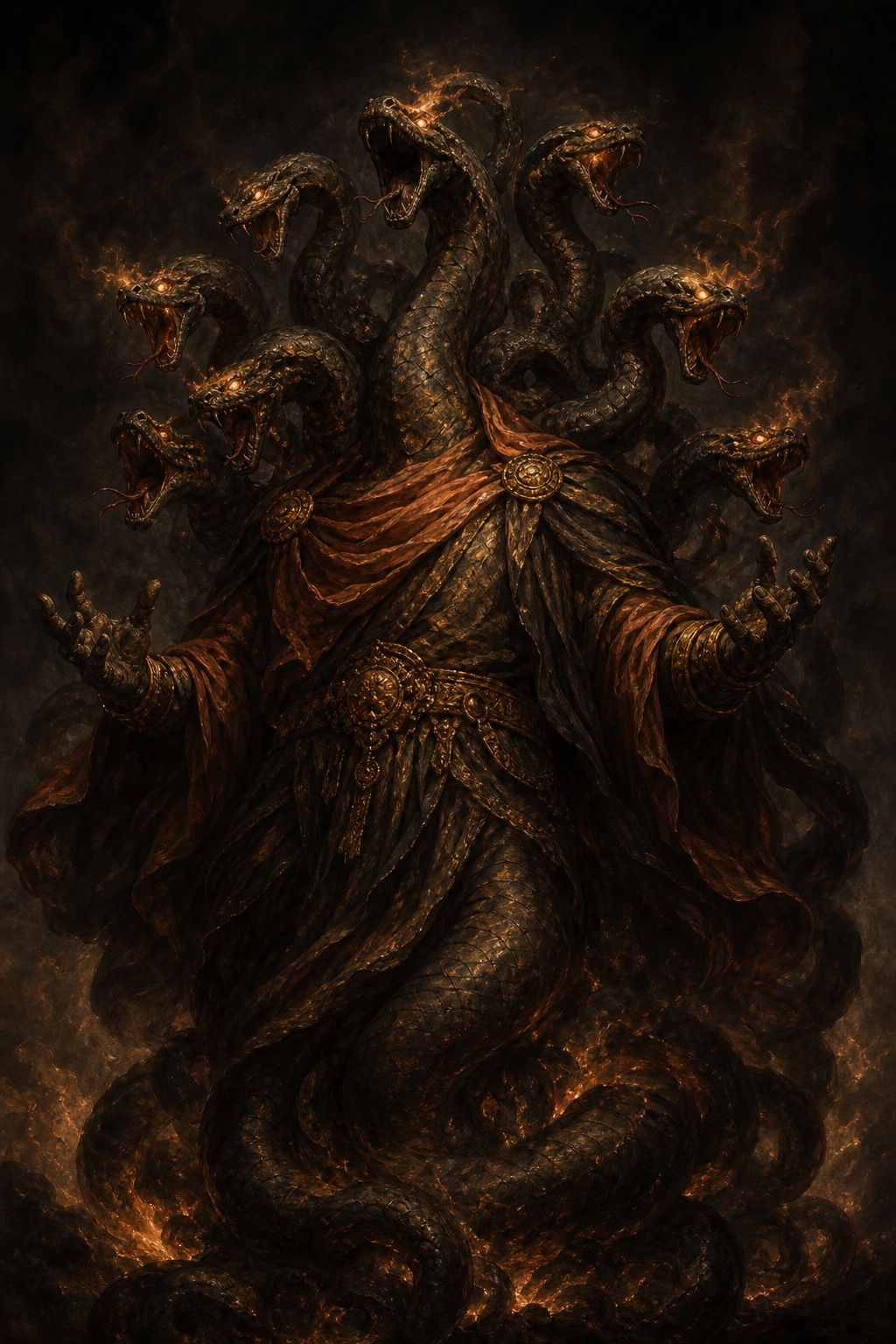
Gaia’s last child
By the time Typhon is born, the war for the sky is already over. Zeus has driven the Titans from heaven and stands as the newly settled king of gods and mortals — and it is precisely then, not before, that Gaia bears her last and most dangerous child, fathered by Tartarus, the abyss beneath the earth itself.
Αὐτὰρ ἐπεὶ Τιτῆνας ἀπ᾽ οὐρανοῦ ἐξέλασεν Ζεύς, ὁπλότατον τέκε παῖδα Τυφωέα Γαῖα πελώρη Ταρτάρου ἐν φιλότητι διὰ χρυσέην Ἀφροδίτην· οὗ χεῖρες μὲν ἔασιν ἐπ᾽ ἰσχύι, ἔργματ᾽ ἔχουσαι, καὶ πόδες ἀκάματοι κρατεροῦ θεοῦ· ἐκ δέ οἱ ὤμων ἣν ἑκατὸν κεφαλαὶ ὄφιος, δεινοῖο δράκοντος, γλώσσῃσιν δνοφερῇσι λελιχμότες, ἐκ δέ οἱ ὄσσων θεσπεσίῃς κεφαλῇσιν ὑπ᾽ ὀφρύσι πῦρ ἀμάρυσσεν· [πασέων δ᾽ ἐκ κεφαλέων πῦρ καίετο δερκομένοιο·] φωναὶ δ᾽ ἐν πάσῃσιν ἔσαν δεινῇς κεφαλῇσι παντοίην ὄπ᾽ ἰεῖσαι ἀθέσφατον· ἄλλοτε μὲν γὰρ φθέγγονθ᾽ ὥστε θεοῖσι συνιέμεν, ἄλλοτε δ᾽ αὖτε ταύρου ἐριβρύχεω, μένος ἀσχέτου, ὄσσαν ἀγαύρου, ἄλλοτε δ᾽ αὖτε λέοντος ἀναιδέα θυμὸν ἔχοντος, ἄλλοτε δ᾽ αὖ σκυλάκεσσιν ἐοικότα, θαύματ᾽ ἀκοῦσαι, ἄλλοτε δ᾽ αὖ ῥοίζεσχ᾽, ὑπὸ δ᾽ ἤχεεν οὔρεα μακρά
“But when Zeus had driven the Titans from heaven, huge Earth bare her youngest child Typhoeus of the love of Tartarus, by the aid of golden Aphrodite. Strength was with his hands in all that he did and the feet of the strong god were untiring. From his shoulders grew an hundred heads of a snake, a fearful dragon, with dark, flickering tongues, and from under the brows of his eyes in his marvellous heads flashed fire, and fire burned from his heads as he glared. And there were voices in all his dreadful heads which uttered every kind of sound unspeakable; for at one time they made sounds such that the gods understood, but at another, the noise of a bull bellowing aloud in proud ungovernable fury; and at another, the sound of a lion, relentless of heart; and at anothers, sounds like whelps, wonderful to hear; and again, at another, he would hiss, so that the high mountains re-echoed” — Hesiod, Theogony 820–835, tr. Evelyn-White
Hesiod’s own Greek calls him Typhoeus throughout this passage; “Typhon” is the byname later Greek and English usage settled on for the same figure, and the one this entry uses. He also names Aphrodite in the same breath as the birth, but not as a second mother — the line credits her only with presiding over the union between Gaia and Tartarus, the way she is elsewhere the power behind any act of desire. Every name he then gives the child himself describes an overload rather than a single beast: a hundred serpent heads sprouting from his shoulders, fire flashing from a hundred pairs of eyes, and a chorus of voices that can sound, breath to breath, like a god, a bull, a lion, a pack of whelps, or a hiss loud enough to make the high mountains answer back. He is less one monster than every threatening sound at once, wearing a single body.
The shaking of the world
Hesiod does not treat the outcome as settled in advance. For one dreadful moment, he says, Typhon comes within reach of ruling over gods and mortals both, and is stopped only because Zeus, father of gods and men, is quick enough to notice in time. What follows reads less like a duel than the entire ordered cosmos reacting to the threat against it: Zeus’s own thunder sets the earth, the wide sky above, the sea, the streams of Ocean and the nether parts of the earth all resounding together; Olympus reels beneath his feet as he rises to fight, and the ground groans under him. Far below, Hades trembles where he rules the dead, and the Titans whom Zeus has shut up under Tartarus with Cronus feel the same endless shaking through the earth that holds them.
Struck down in the mountain glens
The battle itself is short. Zeus gathers his weapons — thunder, lightning, the smoking bolt — and comes down from Olympus at a leap.
Ζεὺς δ᾽ ἐπεὶ οὖν κόρθυνεν ἑὸν μένος, εἵλετο δ᾽ ὅπλα, βροντήν τε στεροπήν τε καὶ αἰθαλόεντα κεραυνόν, πλῆξεν ἀπ᾽ Οὐλύμποιο ἐπάλμενος· ἀμφὶ δὲ πάσας ἔπρεσε θεσπεσίας κεφαλὰς δεινοῖο πελώρου. αὐτὰρ ἐπεὶ δή μιν δάμασεν πληγῇσιν ἱμάσσας, ἤριπε γυιωθείς, στενάχιζε δὲ γαῖα πελώρη. φλὸξ δὲ κεραυνωθέντος ἀπέσσυτο τοῖο ἄνακτος οὔρεος ἐν βήσσῃσιν Ἀίτνης παιπαλοέσσῃς, πληγέντος. Πολλὴ δὲ πελώρη καίετο γαῖα ἀτμῇ θεσπεσίῃ καὶ ἐτήκετο κασσίτερος ὣς τέχνῃ ὕπ᾽ αἰζηῶν ἐν ἐυτρήτοις χοάνοισι θαλφθείς, ἠὲ σίδηρος, ὅ περ κρατερώτατός ἐστιν, οὔρεος ἐν βήσσῃσι δαμαζόμενος πυρὶ κηλέῳ τήκεται ἐν χθονὶ δίῃ ὑφ᾽ Ἡφαιστου παλάμῃσιν. ὣς ἄρα τήκετο γαῖα σέλαι πυρὸς αἰθομένοιο. ῥῖψε δέ μιν θυμῷ ἀκαχὼν ἐς Τάρταρον εὐρύν
“So when Zeus had raised up his might and seized his arms, thunder and lightning and lurid thunderbolt, he leaped form Olympus and struck him, and burned all the marvellous heads of the monster about him. But when Zeus had conquered him and lashed him with strokes, Typhoeus was hurled down, a maimed wreck, so that the huge earth groaned. And flame shot forth from the thunder- stricken lord in the dim rugged glens of the mount, when he was smitten. A great part of huge earth was scorched by the terrible vapour and melted as tin melts when heated by men’s art in channelled crucibles; or as iron, which is hardest of all things, is softened by glowing fire in mountain glens and melts in the divine earth through the strength of Hephaestus. Even so, then, the earth melted in the glow of the blazing fire. And in the bitterness of his anger Zeus cast him into wide Tartarus” — Hesiod, Theogony 852–868, tr. Evelyn-White
Whichever mountain it is, the earth itself is casualty enough: a great stretch of it melts under Zeus’s fire the way tin melts in a smith’s crucible, or the way even iron gives way once it is worked with the strength of Hephaestus. Beaten and scarred, Typhon is thrown down into wide Tartarus — the same abyss Hesiod names as his father.
Father of storms
Defeat does not erase Typhon; Hesiod repurposes him. From the broken monster comes the origin of every ill-tempered wind that harries sailors and farmers, with only three exceptions spared his parentage.
Ἐκ δὲ Τυφωέος ἔστ᾽ ἀνέμων μένος ὑγρὸν ἀέντων, νόσφι Νότου Βορέωτε καὶ ἀργέστεω Ζεφύροιο· οἵ γε μὲν ἐκ θεόφιν γενεή, θνητοῖς μέγ᾽ ὄνειαρ· οἱ δ᾽ ἄλλοι μαψαῦραι ἐπιπνείουσι θάλασσαν· αἳ δή τοι πίπτουσαι ἐς ἠεροειδέα πόντον, πῆμα μέγα θνητοῖσι, κακῇ θυίουσιν ἀέλλῃ· ἄλλοτε δ᾽ ἄλλαι ἄεισι διασκιδνᾶσί τε νῆας ναύτας τε φθείρουσι· κακοῦ δ᾽ οὐ γίγνεται ἀλκὴ ἀνδράσιν, οἳ κείνῃσι συνάντωνται κατὰ πόντον· αἳ δ᾽ αὖ καὶ κατὰ γαῖαν ἀπείριτον ἀνθεμόεσσαν ἔργ᾽ ἐρατὰ φθείρουσι χαμαιγενέων ἀνθρώπων πιμπλεῖσαι κόνιός τε καὶ ἀργαλέου κολοσυρτοῦ
“And from Typhoeus come boisterous winds which blow damply, except Notus and Boreas and clear Zephyr. These are a god-sent kind, and a great blessing to men; but the others blow fitfully upon the seas. Some rush upon the misty sea and work great havoc among men with their evil, raging blasts; for varying with the season they blow, scattering ships and destroying sailors. And men who meet these upon the sea have no help against the mischief. Others again over the boundless, flowering earth spoil the fair fields of men who dwell below, filling them with dust and cruel uproar” — Hesiod, Theogony 869–880, tr. Evelyn-White
Three winds keep their good name — Notus, Boreas, clear Zephyr — precisely because Hesiod excuses them from Typhon’s fatherhood; every gust that scatters a fleet or buries a farmer’s field in dust traces back to him instead. It is a fitting afterlife for a monster whose other offspring are just as elemental: with Echidna, Typhon also fathered Cerberus, the hound now posted at the gate of the underworld, guarding the very border between the living and the dead that Typhon himself once tried to overrun.