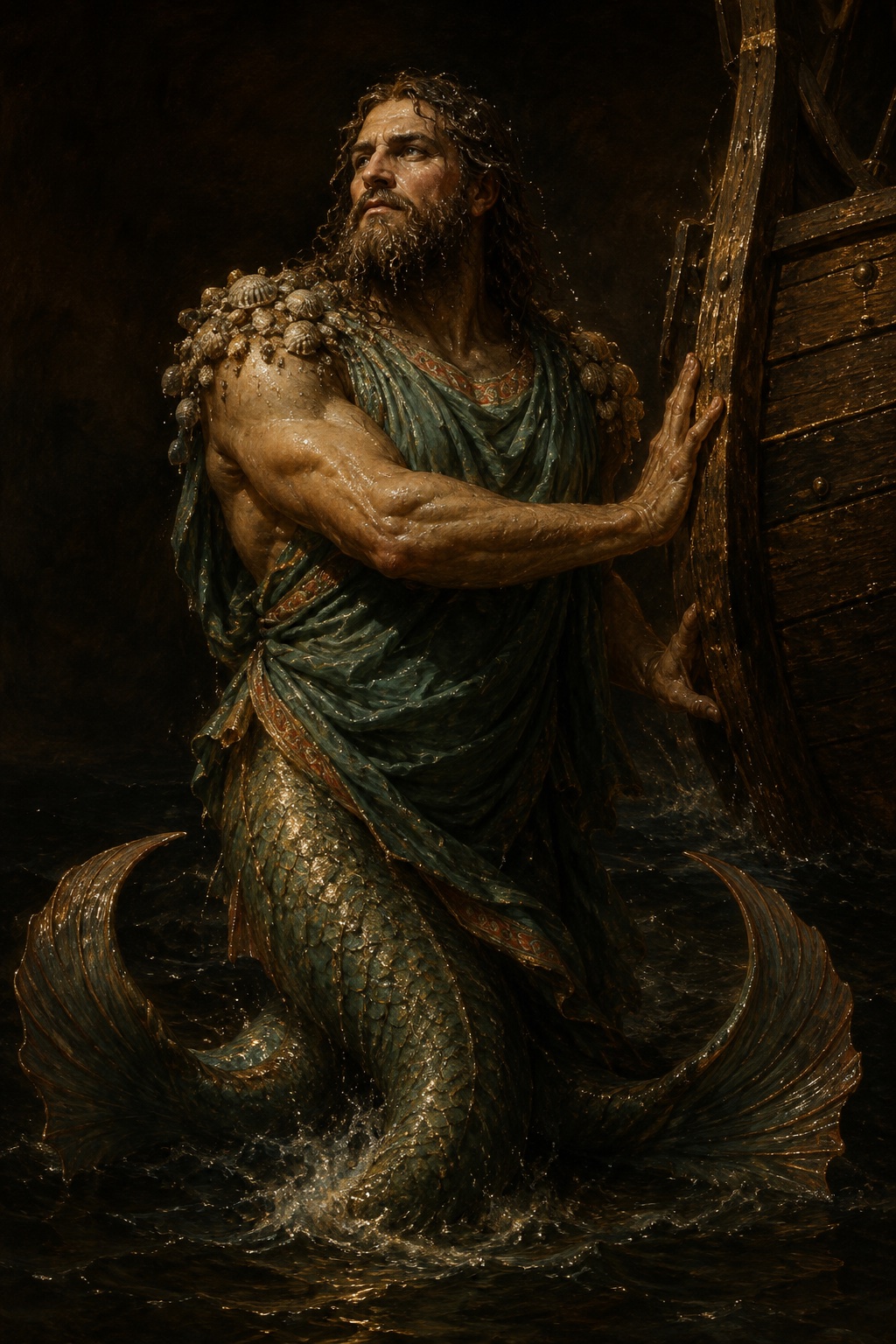
The young man with a handful of earth
Hesiod gives him four lines near the end of the Theogony and no story to go with them. Amphitrite and the loud-roaring Earth-Shaker have a great son; he owns the depths of the sea; he lives down there with his dear mother and his lordly father in a golden house; he is a fearsome god. That is a parentage and an address, not a life. For a scene in which he does something, the Greek corpus has one place, and it is late — the fourth book of Apollonius’ Argonautica, where a ship is stuck in Libya and cannot get out.
The Argonauts have carried the Argo on their shoulders across the desert and set her down in Lake Tritonis, which turns out to have no visible way to the sea. They row about the water looking for one. Orpheus tells them to bring Apollo’s great tripod out of the ship and set it on the shore as a propitiation to the gods of the country. They do it, and a young man is standing in front of them.
ἀνὰ βῶλον ἀείρας ξείνι’ ἀριστήεσσι προΐσχετο, φώνησέν τε· «Δέχθε, φίλοι· ἐπεὶ οὐ περιώσιον ἐγγυαλίξαι ἐνθάδε νῦν πάρ’ ἐμοὶ ξεινήιον ἀντομένοισιν. εἰ δέ τι τῆσδε πόρους μαίεσθ’ ἁλός, οἷά τε πολλὰ ἄνθρωποι χατέουσιν ἐπ’ ἀλλοδαπῇ περόωντες, ἐξερέω. δὴ γάρ με πατὴρ ἐπιίστορα πόντου θῆκε Ποσειδάων τοῦδ’ ἔμμεναι
“he lifted a clod from the earth and offered it as a stranger’s gift, and thus spake: ‘Take it, friends, for no stranger’s gift of great worth have I here by me now to place in the hands of those who beseech me. But if ye are searching for a passage through this sea, as often is the need of men passing through a strange land, I will declare it. For my sire Poseidon has made me to be well versed in this sea’” — Apollonius Rhodius, Argonautica 4.1552–1559, tr. R. C. Seaton
He is not a young man, and the poem says so before the speech begins. The Argonauts are not told. The speech gives them a father’s name and no name of its own, and it undersells its own present: the clod goes into the hands of Euphemus, and near the end of the book he throws that handful of Libya into the sea, an island rises out of it called Calliste, and a later settler renames the island Thera. Then the stranger stretches out his arm, shows them the dark mouth of the lake and the narrow water between the breakers, and tells them which way to hold once they are through.
Triton, or Phorcys, or Nereus
They go aboard and take up the oars. Behind them the young man picks up the great tripod they had set out on the shore and walks into the lake with it on his shoulder, and after that nobody can say how he vanished. It is enough to cheer them, since one of the blessed has plainly met them in friendly guise, and they tell Jason to offer the best of the sheep and to chant over it. He kills the animal above the stern and prays. This is the only line in the whole episode where the name is said aloud, and it is said as a guess.
Δαῖμον, ὅτις λίμνης ἐπὶ πείρασι τῆσδ’ ἐφαάνθης, εἴτε σέγε Τρίτων’, ἅλιον τέρας, εἴτε σε Φόρκυν, ἢ Νηρῆα θύγατρες ἐπικλείουσ’ ἁλοσύδναι, ἵλαθι, καὶ νόστοιο τέλος θυμηδὲς ὄπαζε
“Thou god, who hast manifested thyself on the borders of this land, whether the daughters born of the sea call thee Triton, the great sea-marvel, or Phorcys, or Nereus, be gracious, and grant the return home dear to our hearts” — Apollonius Rhodius, Argonautica 4.1597–1600, tr. R. C. Seaton
Three names, and the prayer declines to pick one. Phorcys and Nereus are other old powers of salt water, and the sentence puts all three side by side and hands the problem to the sea’s own daughters, who presumably know which is right. The Argonauts have taken a gift from him, a way out of the lake and a course to steer down the coast, and they still cannot say whom they are thanking. What the prayer is sure of is the category rather than the name: something huge and marine, which showed itself at the edge of this water and might be persuaded to send them home.
In form such as he really was
Everything so far has happened to a courteous young man on a beach. The sacrifice changes the terms.
ἧκε κατὰ πρύμνης· ὁ δὲ βένθεος ἐξεφαάνθη τοῖος ἐών, οἷός περ ἐτήτυμος ἦεν ἰδέσθαι. ὡς δ’ ὅτ’ ἀνὴρ θοὸν ἵππον ἐς εὐρέα κύκλον ἀγῶνος στέλλῃ, ὀρεξάμενος λασίης εὐπειθέα χαίτης, εἶθαρ ἐπιτροχάων, ὁ δ’ ἐπ’ αὐχένι γαῦρος ἀερθεὶς ἕσπεται, ἀργινόεντα δ’ ἐνὶ στομάτεσσι χαλινὰ ἀμφὶς ὀδακτάζοντι παραβλήδην κροτέονται· ὧς ὅγ’ ἐπισχόμενος γλαφυρῆς ὁλκήιον Ἀργοῦς ἦγ’ ἅλαδε προτέρωσε
“cast it from the stern. And the god rose up from the depths in form such as he really was. And as when a man trains a swift steed for the broad race-course, and runs along, grasping the bushy mane, while the steed follows obeying his master, and rears his neck aloft in his pride, and the gleaming bit rings loud as he champs it in his jaws from side to side; so the god, seizing hollow Argo’s keel, guided her onward to the sea” — Apollonius Rhodius, Argonautica 4.1602–1610, tr. R. C. Seaton
The simile is the surprising part. He does not tow the ship, or lift her, or carry her on his back; he takes hold of the keel and walks her out, and Apollonius spends five lines on a man breaking in a race-horse — running at its shoulder with a fist in the mane, the horse’s neck up in pride, the bright bit rattling as it works the metal from side to side. The Argo is the animal in that picture, spirited and obedient at once, and the god is the one on foot beside her doing the work.
Only now, with the ship already moving, does the poem look at him.
δέμας δέ οἱ ἐξ ὑπάτοιο κράατος, ἀμφί τε νῶτα καὶ ἰξύας ἔστ’ ἐπὶ νηδὺν ἀντικρὺ μακάρεσσι φυὴν ἔκπαγλον ἔικτο· αὐτὰρ ὑπαὶ λαγόνων δίκραιρά οἱ ἔνθα καὶ ἔνθα κήτεος ὁλκαίη μηκύνετο· κόπτε δ’ ἀκάνθαις ἄκρον ὕδωρ, αἵ τε σκολιοῖς ἐπινειόθι κέντροις μήνης ὡς κεράεσσιν ἐειδόμεναι διχόωντο
“And his body, from the crown of his head, round his back and waist as far as the belly, was wondrously like that of the blessed ones in form; but below his sides the tail of a sea monster lengthened far, forking to this side and that; and he smote the surface of the waves with the spines, which below parted into curving fins, like the horns of the new moon” — Apollonius Rhodius, Argonautica 4.1610–1616, tr. R. C. Seaton
Down to the belly he is one of the blessed ones; below that a sea-beast, and the tail forks, so the body is twin-tailed rather than the single curl of later pictures. He beats the surface with the spines along it, and where they end they open into curved fins that Apollonius measures against the horns of the new moon. The sequence is the point. The gift, the directions and the tripod all went to a youth on the sand; the body arrives only after the sheep is killed, and it arrives with the ship already under his hands. He pushes the Argo out into open water, dives into the depths, and the crew shout at the sight. Apollonius leaves the shore with a harbour on it and two altars standing there, one to Poseidon and one to Triton.
The conch
In none of that does Apollonius give him an instrument. The shell every later reader knows him by comes from a Latin poem, and in it he is not a host but a subordinate. Ovid’s flood has drowned the world and is being called back; the ruler of the sea — Poseidon under his Roman name, and his father, though Ovid does not say so here — lays down his three-pronged spear and calls up the one who can finish the work.
Nec maris ira manet, positoque tricuspide telo mulcet aquas rector pelagi supraque profundum exstantem atque umeros innato murice tectum caeruleum Tritona vocat conchaeque sonanti inspirare iubet fluctusque et flumina signo iam revocare dato. Cava bucina sumitur illi, tortilis, in latum quae turbine crescit ab imo, bucina, quae medio concepit ubi aera ponto, litora voce replet sub utroque iacentia Phoebo. Tunc quoque, ut ora dei madida rorantia barba contigit et cecinit iussos inflata receptus, omnibus audita est telluris et aequoris undis, et quibus est undis audita, coercuit omnes
“Then too the anger of the sea subsides, when the sea’s great ruler lays by his three-pronged spear and calms the waves; and, calling sea-hued Triton, showing forth above the deep, his shoulders thick o’ergrown with shell-fish, he bids him blow into his loud-resounding conch, and by that signal to recall the floods and streams. He lifts his hollow, twisted shell, which grows from the least and lowest to a broad-swelling whorl—the shell which, when in mid-sea it has received the Triton’s breath, fills with its notes the shores that lie beneath the rising and the setting sun. So then, when it had touched the sea-god’s lips wet with his dripping beard, and sounded forth the retreat which had been ordered, ‘twas heard by all the waters both of land and sea; and all the waters by which ‘twas heard it held in check” — Ovid, Metamorphoses 1.330–342, tr. F. J. Miller
The trident belongs to the sea’s ruler here and is put down before the son is called, which is worth saying, because pictures hand it to Triton constantly and no text in this entry does. What he is given instead is a shell: hollow, twisted, widening from a narrow base into a broad whorl, and sounded not as music but as an order. The note is a signal to recall the water, and every wave that hears it stops where it is. Ovid also gives him the colour and the encrustation the Greek poem never mentions — sea-hued, shoulders thick with shellfish, the beard wet and dripping where the shell touches his lips — and the verb attached to him is iubet: he is bidden, summoned by a greater god and told what to blow.
That is the whole distance between the two poems. Apollonius’ Triton comes unasked, hands out presents, claims a coast and needs a sacrifice before he will show his face; Ovid’s is called and obeys. They are recognisably one figure at two different ranks, and the office is identical in both. Water has gone wrong — a lake with no outlet, a flood with no end — and he is the god who gives it back its way out.