The old man who does not lie
Hesiod brings Nereus into the Theogony where the poem turns to the children of the sea. His father is Pontus, the Sea. Nereus is the first child that Hesiod names, and before he names any other, he gives four lines to the kind of god that Nereus is.
Νηρέα δ᾽ ἀψευδέα καὶ ἀληθέα γείνατο Πόντος, πρεσβύτατον παίδων· αὐτὰρ καλέουσι γέροντα, οὕνεκα νημερτής τε καὶ ἤπιος, οὐδὲ θεμιστέων λήθεται, ἀλλὰ δίκαια καὶ ἤπια δήνεα οἶδεν
“And Sea begat Nereus, the eldest of his children, who is true and lies not: and men call him the Old Man because he is trusty and gentle and does not forget the laws of righteousness, but thinks just and kindly thoughts” — Hesiod, Theogony 233–236, tr. Evelyn-White
The first words about Nereus are a pair. ἀψευδέα καὶ ἀληθέα: he is without lies, and he is true. Hesiod says the same thing twice, once as a denial and once as a statement, and Evelyn-White keeps both: who is true and lies not. Only then comes the father. γείνατο Πόντος: Pontus begot him. πρεσβύτατον παίδων: he is the eldest of his children.
Then comes the name that people give him. αὐτὰρ καλέουσι γέροντα: men call him the Old Man. Hesiod gives the reason at once, with οὕνεκα, because, and the reason is not his years. It is his character. νημερτής τε καὶ ἤπιος: he is trusty and gentle. The first word, νημερτής, is another word for truth. Evelyn-White renders it trusty, and Murray renders the same word unerring when Homer uses it in the Odyssey. So the title of Old Man is a title of respect. It names the honest, kind elder whom people trust.
The last clause gives him a mind. οὐδὲ θεμιστέων λήθεται: he does not forget the laws of righteousness. ἀλλὰ δίκαια καὶ ἤπια δήνεα οἶδεν: he knows just and gentle counsels, which Evelyn-White renders thinks just and kindly thoughts. The word for gentle, ἤπιος, comes back here as ἤπια, so gentleness is said twice in four lines, as truth was. Apart from the name of his father, nothing in the passage is about the sea. There are no waves, no fish and no changes of shape. Hesiod’s Nereus is a portrait of a wise and truthful old god, and that is why this entry gives him wisdom as well as the sea.
Doris and the fifty daughters
Hesiod’s next lines go from the father to the children. Nereus has a wife, Doris, and Evelyn-White calls her rich-haired Doris, daughter of Ocean the perfect river, so she is a daughter of Oceanus. Their children are all daughters. Hesiod names them in a long list, and at the end of it he counts them: These fifty daughters sprang from blameless Nereus. Apollodorus also says that the Nereids were born to Nereus and Doris, and he gives a list of names of his own.
Amphitrite is one of the fifty. Hesiod names her twice in the list. The second time, she is with Cymodoce, who with Cymatolege and Amphitrite easily calms the waves upon the misty sea and the blasts of raging winds. Later in the Theogony, Amphitrite is the mother of Triton by Poseidon, so Triton is a grandson of Nereus.
The last daughter in the list is Nemertes, who has the nature of her deathless father. In Hesiod’s Greek her name is the word νημερτής, the word that Hesiod used for Nereus himself when he explained the title of Old Man. So the list of the daughters ends where the portrait of the father began, with truth. One daughter carries it in her name.
Three members of this family stand side by side in a prayer in the Argonautica of Apollonius of Rhodes. At the Tritonian lake, a god in the form of a youth has shown the Argonauts the outlet to the sea and the course to steer beyond it. The poem has already told the reader that he is Triton. The Argonauts know only that one of the blessed had met them in friendly guise, so Jason prays to him with a choice of names.
Δαῖμον, ὅτις λίμνης ἐπὶ πείρασι τῆσδ’ ἐφαάνθης, εἴτε σέγε Τρίτων’, ἅλιον τέρας, εἴτε σε Φόρκυν, ἢ Νηρῆα θύγατρες ἐπικλείουσ’ ἁλοσύδναι, ἵλαθι, καὶ νόστοιο τέλος θυμηδὲς ὄπαζε
“Thou god, who hast manifested thyself on the borders of this land, whether the daughters born of the sea call thee Triton, the great sea-marvel, or Phorcys, or Nereus, be gracious, and grant the return home dear to our hearts” — Apollonius Rhodius, Argonautica 4.1597–1600, tr. R. C. Seaton
The three names are Triton, Φόρκυν and Νηρῆα: Triton, Phorcys and Nereus. By Hesiod’s family tree, Phorcys is the brother of Nereus and Triton is his grandson. The prayer does not choose between them. It leaves the name to the daughters born of the sea. For the length of the prayer, Nereus is one of the powers that could have shown the way to strangers who were lost.
Seized asleep
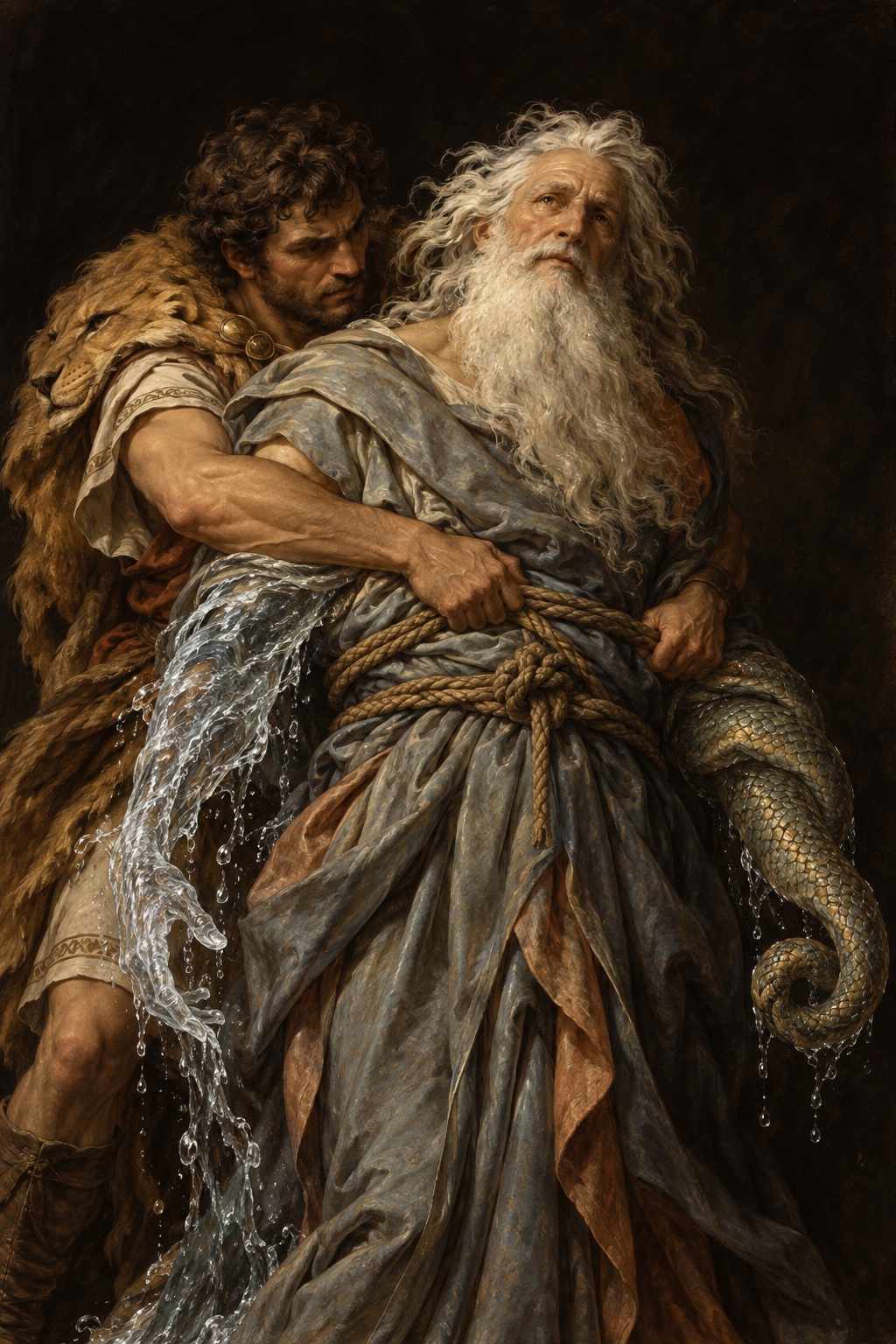
The story that the Library tells about Nereus comes in the labours of Heracles. As an eleventh labour, Eurystheus orders Heracles to fetch golden apples from the Hesperides. Apollodorus says that the apples were not in Libya, as some have said, but among the Hyperboreans. An immortal dragon with a hundred heads, the offspring of Typhon and Echidna, guards them, and the Hesperides guard them with it. Heracles does not know the way. He goes on foot through Illyria to the river Eridanus, and there he comes to the nymphs who are the daughters of Zeus and Themis.
αὗται μηνύουσιν αὐτῷ Νηρέα. συλλαβὼν δὲ αὐτὸν κοιμώμενον καὶ παντοίας ἐναλλάσσοντα μορφὰς ἔδησε, καὶ οὐκ ἔλυσε πρὶν ἢ μαθεῖν παρ᾽ αὐτοῦ ποῦ τυγχάνοιεν τὰ μῆλα καὶ αἱ Ἑσπερίδες
“They revealed Nereus to him, and Hercules seized him while he slept, and though the god turned himself into all kinds of shapes, the hero bound him and did not release him till he had learned from him where were the apples and the Hesperides” — Apollodorus, Bibliotheke 2.5.11, tr. J. G. Frazer
The nymphs do not tell Heracles the way. αὗται μηνύουσιν αὐτῷ Νηρέα: they revealed Nereus to him. The verb μηνύουσιν means to point out or to inform, so what the nymphs give Heracles is not the road but the one who knows the road. The rest of the story is one Greek sentence. συλλαβὼν δὲ αὐτὸν κοιμώμενον: Heracles seizes him while he slept. Heracles does not ask the god and wait for an answer. He takes him by surprise.
Then the god fights back in the only way the text gives him. παντοίας ἐναλλάσσοντα μορφὰς: he changes into all kinds of shapes. Apollodorus does not name a single one of them. ἔδησε: Heracles binds him. καὶ οὐκ ἔλυσε: and he does not let him go until he learns ποῦ τυγχάνοιεν τὰ μῆλα καὶ αἱ Ἑσπερίδες, where were the apples and the Hesperides. The next sentence moves on without a pause: Being informed, he traversed Libya. Apollodorus records no trick in the answer.
The Odyssey tells the same kind of capture about another old god of the sea. In the fourth book, Menelaus is held back by the gods on the island of Pharos, off Egypt. The goddess Eidothea tells him of her father, the unerring old man of the sea, immortal Proteus of Egypt, who knows the depths of every sea, and is the servant of Poseidon, in Murray’s translation. The Greek word for unerring is νημερτής, the word that Hesiod uses for Nereus. The old man comes out of the sea at midday and lies down to sleep in the hollow caves. If Menelaus catches him, he will assume all manner of shapes of all things that move upon the earth, and of water, and of wondrous blazing fire. Menelaus must hold him until he speaks again in the shape in which he lay down to sleep, and then the old man will tell him the way home. The pattern in the two texts is the same: a truthful old god of the sea, taken asleep, changes shape, is held fast, and tells the traveller the way. In Homer the god is Proteus. In Apollodorus he is Nereus.
The Theogony and the Library do not comment on each other, but they fit together. Hesiod’s Nereus does not lie and does not forget what is right. Apollodorus’s Nereus will not give his knowledge freely, and he must be caught and bound before he speaks. A god who cannot lie is worth that trouble, because the answer that he gives when he is held will be true.