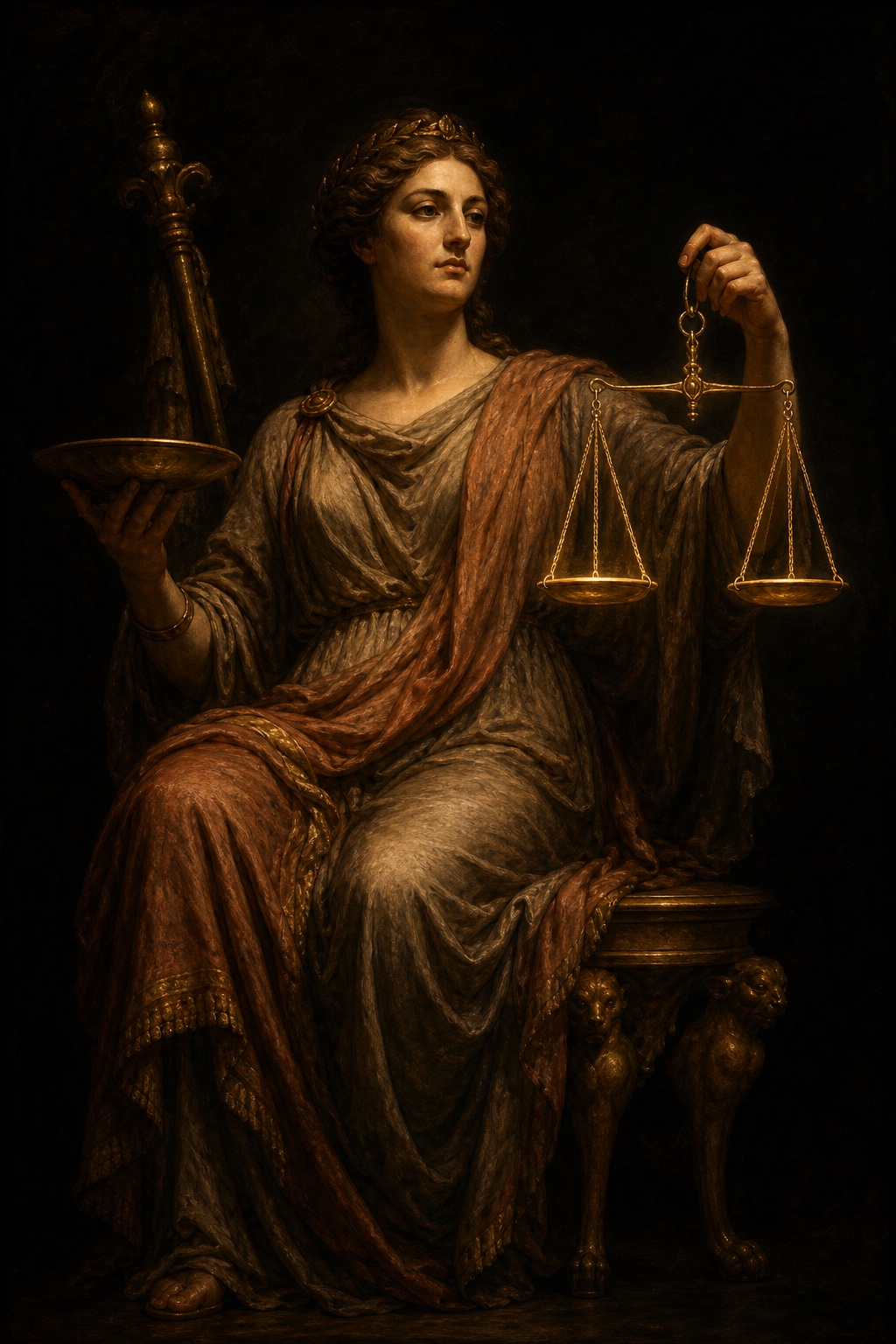
Before she is a goddess, themis is an ordinary word: the way a thing is properly done, custom so settled that it needs no enactment. It sits underneath the later vocabulary of law — nomos is a statute somebody passed, dike is a judgement somebody handed down, but themis is what was already there. The Titaness is that noun given a face, which is why she behaves less like a deity with a portfolio than like the procedure of Olympus itself.
Homer shows her at work in the least glamorous way imaginable: convening a meeting.
Ζεὺς δὲ Θέμιστα κέλευσε θεοὺς ἀγορὴν δὲ καλέσσαι κρατὸς ἀπ’ Οὐλύμποιο πολυπτύχου· ἡ δ’ ἄρα πάντῃ φοιτήσασα κέλευσε Διὸς πρὸς δῶμα νέεσθαι
“But Zeus bade Themis summon the gods to the place of gathering from the brow of many-ribbed Olympus; and she sped everywhither, and bade them come to the house of Zeus.” — Homer, Iliad 20.4–6, tr. A. T. Murray
That is her characteristic act. She calls the assembly and she keeps the house running: when Hera comes down from Olympus distraught and the gods rise to greet her, it is Themis who runs first to meet her, and from Themis’s hand that Hera takes the cup. Zeus commands; Themis is how commanding is made to look orderly. A sovereignty that had to be seized by castration and swallowed children needs to look like something other than force, and she is the apparatus by which it does.
Hesiod makes the political logic explicit in a single sequence. Zeus’s first wife is Metis, cunning, whom he swallows so that no one can use her against him. His second is Themis, whom he marries — and she bears the Horae, Eunomia and Dike and Eirene, Good Order and Justice and Peace, who “mind the works of mortal men”, and then the Moirai, Clotho and Lachesis and Atropos, to whom Hesiod says Zeus gave the greatest honour of all. The succession myth ends with the new king absorbing intelligence and marrying legitimacy, and the children of that marriage are the civil service.
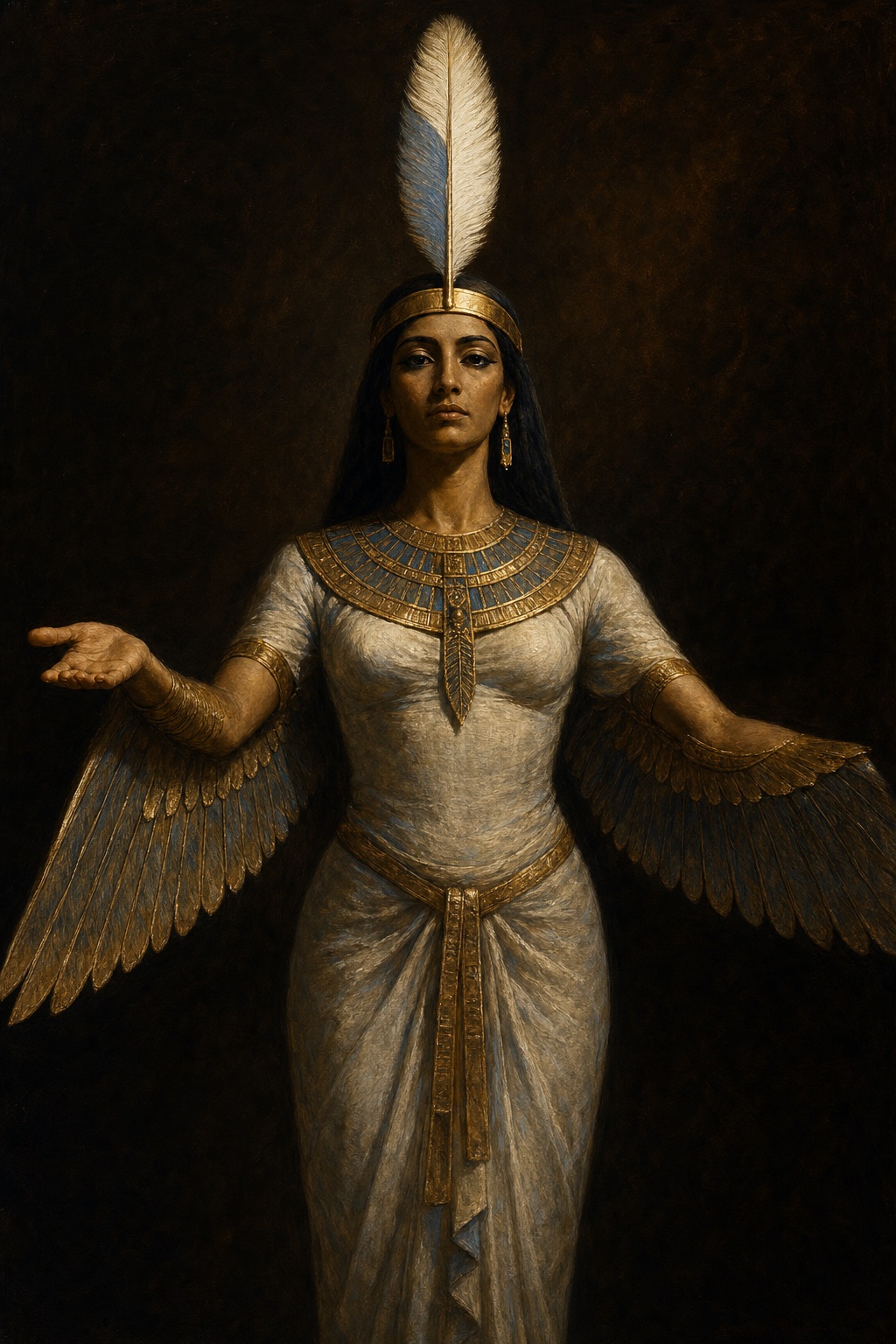
She also once owned the most important real estate in Greece. Aeschylus opens the Eumenides with the Pythia reciting the descent of the Delphic oracle: Earth first, Themis second on her mother’s seat, then Phoebe, and only then Apollo, who takes the throne as a birthday gift. Every stage is a voluntary handover, and the whole point of the recital is that Apollo’s authority is inherited rather than seized — a claim that needs Themis in the middle of it to work. Egypt personified the same idea as Ma’at and kept her at arm’s length from the throne: the pharaoh upholds Ma’at, offers her, is weighed against her, and can fail. Greece married the principle to the king and had it bear his officials, which settles the question of whether the sovereign can be judged by the standard rather more conveniently.