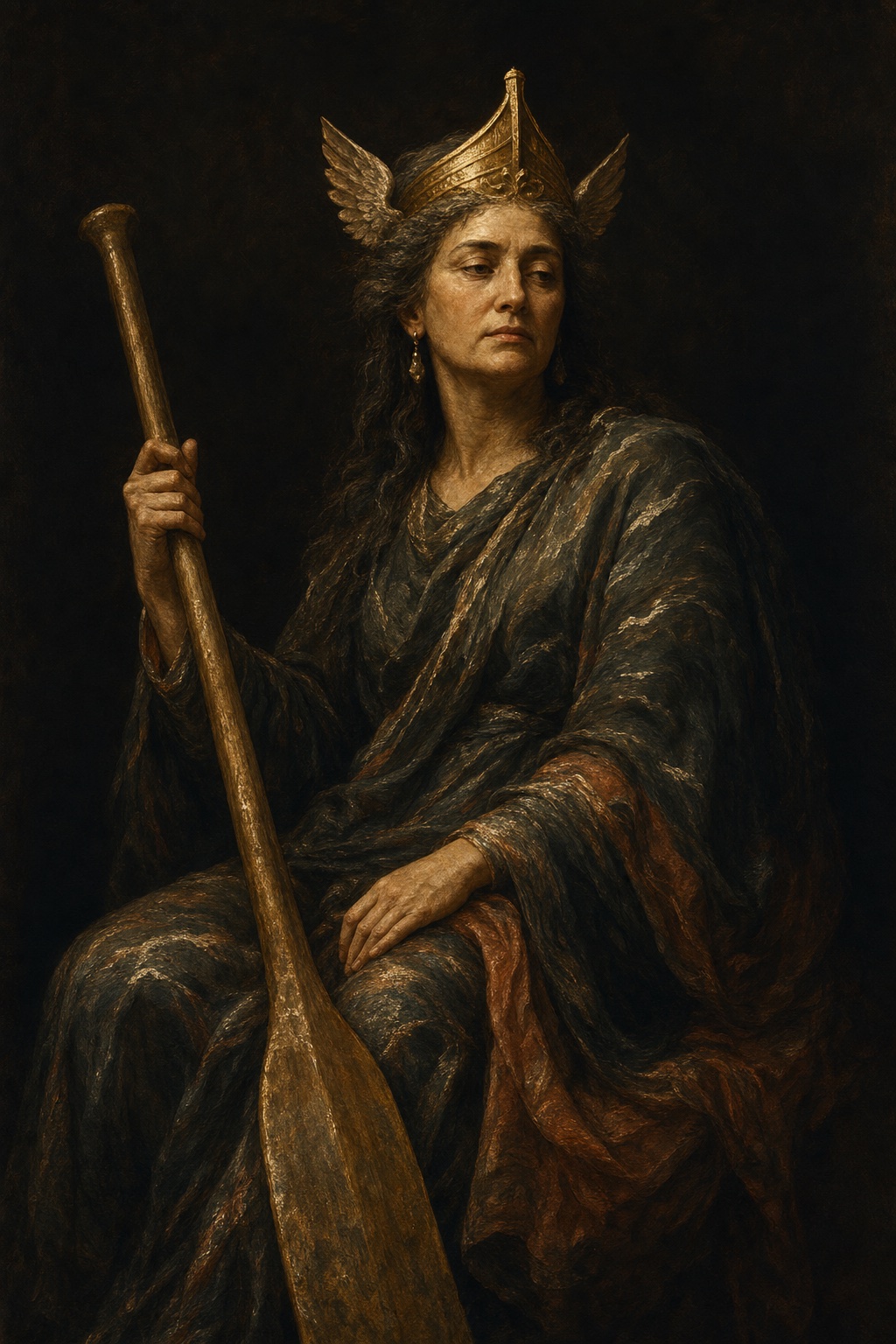
The nurse who reared Hera
Hera has a plan, and the story she is telling is not it. She wants Zeus off the battlefield below Troy long enough for the Greeks to break the Trojan line unwatched, and to borrow Aphrodite’s girdle of persuasion without explaining why, she needs an errand that sounds ordinary. The one she invents is a visit to Oceanus and Tethys.
εἶμι γὰρ ὀψομένη πολυφόρβου πείρατα γαίης, Ὠκεανόν τε θεῶν γένεσιν καὶ μητέρα Τηθύν, οἵ μ’ ἐν σφοῖσι δόμοισιν ἐῢ τρέφον ἠδ’ ἀτίταλλον, δεξάμενοι Ῥείας, ὅτε τε Κρόνον εὐρύοπα Ζεὺς γαίης νέρθε καθεῖσε καὶ ἀτρυγέτοιο θαλάσσης· τοὺς εἶμ’ ὀψομένη, καί σφ’ ἄκριτα νείκεα λύσω· ἤδη γὰρ δηρὸν χρόνον ἀλλήλων ἀπέχονται εὐνῆς καὶ φιλότητος, ἐπεὶ χόλος ἔμπεσε θυμῷ
“For I am faring to visit the limits of the all-nurturing earth, and Oceanus, from whom the gods are sprung, and mother Tethys, even them that lovingly nursed and cherished me in their halls, when they had taken me from Rhea, what time Zeus, whose voice is borne afar, thrust Cronos down to dwell beneath earth and the unresting sea. Them am I faring to visit, and will loose for them their endless strife, since now for a long time’s space they hold aloof one from the other from the marriage-bed and from love, for that wrath hath come upon their hearts.” — Homer, Iliad 14.200–207, tr. A. T. Murray
The detail is specific enough to sound sincere. It was Rhea who gave the infant Hera up, during the war against the Titans, and it was Oceanus and Tethys who received her in their own halls and raised her — nursed and cherished, in Murray’s wording, the ordinary vocabulary of rearing a child rather than anything grander. It is the only description of Tethys that survives in any Greek source: not an epithet, not a scene of her own, but one act of care, long past, that produced the future queen of the gods.
A marriage that has stopped speaking
The second half of Hera’s story is grievance rather than memory. Tethys and Oceanus, she says, have held apart from one another, from the marriage-bed and from love, for a long time now, because wrath fell upon their hearts. Homer gives no cause and takes no side. The quarrel is old enough that Hera can mention it as settled fact needing no explanation, and current enough that she can offer, plausibly, to go and end it.
It is the only characterization their marriage receives anywhere in the surviving poems, and everything it establishes is a withholding. Two Titans credited elsewhere with three thousand rivers and three thousand daughters between them have, on this single account, stopped sharing a bed over some unnamed offense that neither Hera nor Homer troubles to name.
The visit that is never paid
A hundred lines later Hera tells the same story again, to Sleep, whose cooperation she also needs before the night is out. The wording is close enough to the first telling that it reads as a set piece she already has ready: a journey to Oceanus and Tethys, to end their long estrangement. She repeats it because it worked once.
What she never does, in this book or any other, is make the journey. The Iliad moves straight from the seduction of Zeus to the fighting on the plain below, and nothing in it shows Hera reaching Oceanus’s halls, addressing Tethys, or resolving anything between them. The reconciliation exists only as a sentence Hera finds useful twice — which is also the whole of what the tradition preserves of Tethys doing anything at all: an old kindness reported at second hand, and a promised errand that is never kept.