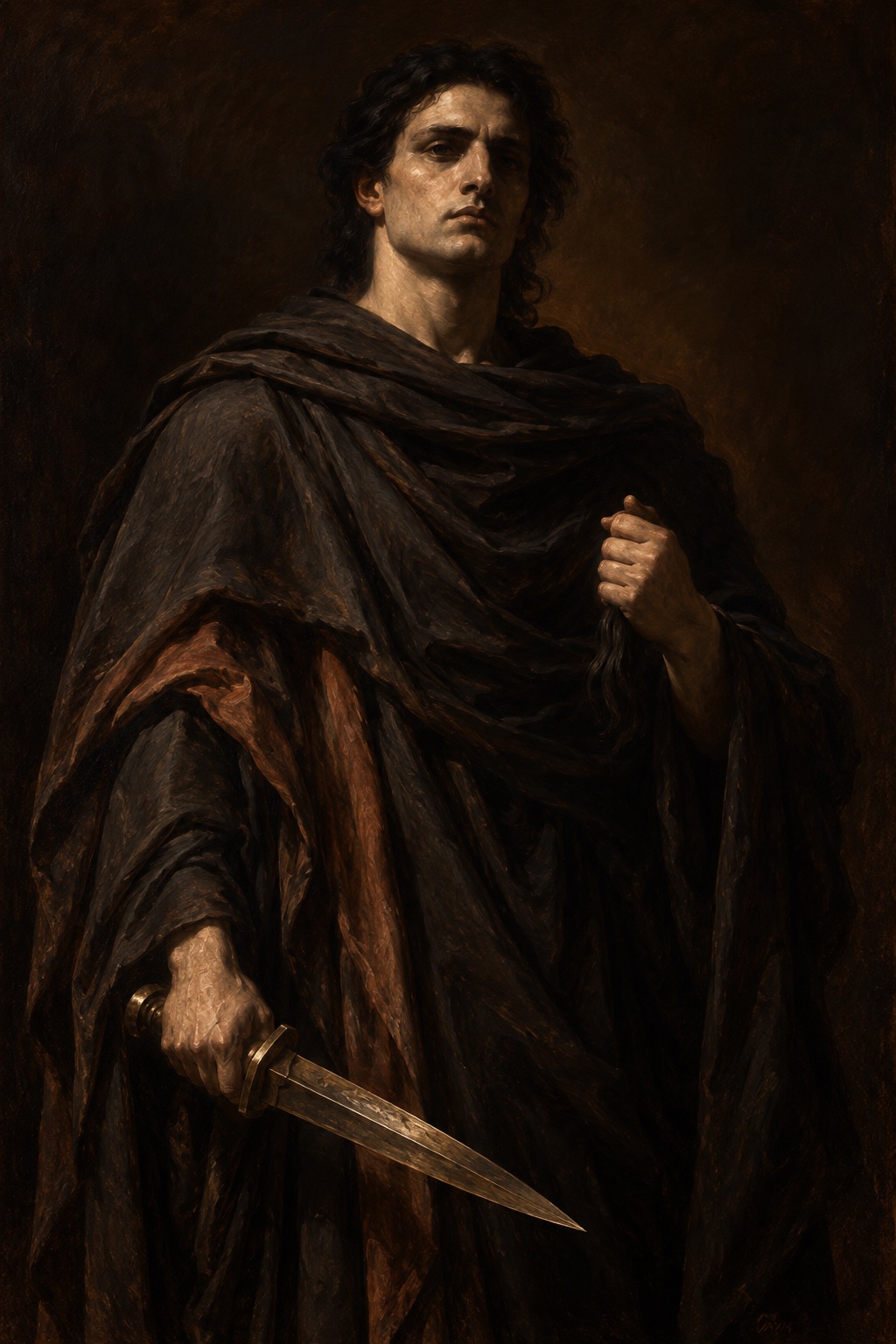
At the door of Admetus
Of the texts this page stands on, only one lets Thanatos act and speak for himself: the prologue of Euripides’ Alcestis. The play opens with Apollo taking leave of the house of Admetus, where he has lived as a servant. Zeus had killed Apollo’s son Asclepius with a thunderbolt; Apollo, in his anger, killed the Cyclopes who forged the heavenly fire; and Zeus punished him by making him a slave in a mortal’s home. Apollo found his master as holy a man as himself, and he saved him from death by cheating Destiny: the goddesses of fate promised him that Admetus would escape the death that was due to him, if he could find someone to go to the powers below in his place. Admetus tried every friend he had, and his father, and the old mother who bore him. No one would do it except his wife, Alcestis, who is dying inside the house as Apollo speaks.
Apollo leaves so that the pollution of a death will not touch him, because he can already see Thanatos close at hand. In the Greek of line 25 he calls him ἱερέα θανόντων, which is this page’s epithet, and Coleridge renders it “the priest of souls departed.” Thanatos is coming to lead her to the halls of Hades, exactly on time, on the day that is set for her. He sees Apollo at the door, and the first words he speaks are an accusation.
ἆ ἆ· τί σὺ πρὸς μελάθροις; τί σὺ τῇδε πολεῖς, Φοῖβ’; ἀδικεῖς αὖ τιμὰς ἐνέρων ἀφοριζόμενος καὶ καταπαύων; οὐκ ἤρκεσέ σοι μόρον Ἀδμήτου διακωλῦσαι, Μοίρας δολίῳ σφήλαντι τέχνῃ; νῦν δ’ ἐπὶ τῇδ’ αὖ χέρα τοξήρη φρουρεῖς ὁπλίσας, ἣ τόδ’ ὑπέστη, πόσιν ἐκλύσασ’ αὐτὴ προθανεῖν Πελίου παῖς
“Ha! What dost thou at this house? why is it thou art ranging here, Phœbus? Once again thou wrongest me, circumscribing and limiting the honours of the nether world. Wert thou not content to hinder the death of Admetus, by thy knavish cunning baulking Destiny? but now again hast thou armed thee with thy bow and art keeping guard o’er her, this daughter of Pelias, who undertook, of her free will, to die for her lord and set him free.” — Euripides, Alcestis 28–37, tr. E. P. Coleridge
The complaint is about his rights. What Apollo is doing wrong, Thanatos says, is fencing off and cutting short the honours of those below — τιμὰς ἐνέρων, the dues of the dead — and he is doing it for the second time. He has already stopped the death of Admetus by a trick played on the Fates, Μοίρας in the Greek, whom Coleridge turns into Destiny. Now he stands guard with his bow over the woman who agreed to die in her husband’s place. Thanatos does not dispute that she agreed. His case is that she is now his, and that the god at the door has no business keeping her from him.
The sword and the lock of hair
What follows is an argument in single lines, and Thanatos conducts it like a claimant at law. Apollo says he has justice and fair pleas on his side; Thanatos asks what the bow is for, then. He asks whether Apollo means to rob him of a second corpse as well. Apollo answers that he took nothing by force: Admetus lives because he gave his wife instead, and she is the one Thanatos has come to fetch. Then Apollo tries to bargain. He asks whether Alcestis might be allowed to reach old age. Thanatos says that is not possible. He too takes pleasure in his rights, and when the young die, the honour he wins is greater. Apollo points out that if she died old she would have a rich funeral. Thanatos answers that such a rule would favour the rich, because people with money would buy the chance to die old. Apollo calls his customs hateful to men and to the gods. Thanatos refuses the favour anyway.
Apollo gives up the argument and makes a prophecy instead. A man will come to this house, sent by Eurystheus to fetch a team of horses from the wintry land of Thrace. He will stay in the house of Admetus as a guest, and he will take the woman from Thanatos by force. So Thanatos will lose her all the same, Apollo says, and win no thanks from him, and earn his hatred as well. The reply is the last thing Thanatos says in the play.
πόλλ’ ἂν σὺ λέξας οὐδὲν ἂν πλέον λάβοις· ἡ δ’ οὖν γυνὴ κάτεισιν εἰς Ἅιδου δόμους. στείχω δ’ ἐπ’ αὐτήν ὡς κατάρξωμαι ξίφει· ἱερὸς γὰρ οὗτος τῶν κατὰ χθονὸς θεῶν ὅτου τόδ’ ἔγχος κρατὸς ἁγνίσῃ τρίχα
“Thou wilt not gain thy purpose any the more for all thy many words; that woman shall to Hades’ halls go down, I tell thee. Lo! I am going for her, that with the sword I may begin my rites, for he whose hair this sword doth hallow is sacred to the gods below.” — Euripides, Alcestis 72–76, tr. E. P. Coleridge
He will not argue any more, and he does not need to. The woman will go down to the house of Hades; he says it as a fact, not as a threat. Then he says how. He will go in to her and begin the rite with his sword, because whoever has had a lock of hair hallowed by this sword belongs to the gods beneath the earth. The Greek names the weapon twice in three lines, ξίφει and then ἔγχος, and Coleridge translates both as sword. It is the one object any of these texts puts in his hand, and in this passage it does not wound anyone. It cuts hair. The dying woman is to be consecrated to the gods below before she dies, and the one who consecrates her is Thanatos himself.
Apollo’s prophecy comes true, and the man is Heracles. Later in the play, a guest in the house of Admetus, Heracles resolves to bring Alcestis back. He will watch for Thanatos beside the tomb, where he expects to find him drinking the blood-offerings, rush on him from ambush and hold him in his arms until he gives the woman up (Alc. 843–849). If Thanatos does not come to the blood, Heracles will go down to the sunless home beneath the earth and ask Persephone and her king for her instead. It does not come to that. At the end of the play he brings Alcestis back to her husband and tells him how he got her: he fought the god who had her in his power, springing from ambush just by the tomb and catching him in his grip (Alc. 1140–1142). The fight itself is only reported, in a few lines of dialogue.
Heracles leaves one condition behind him. Admetus may not hear his wife speak until she has been purified from the gods below and the third day has come. The condition answers the words Thanatos spoke in the prologue. Whoever his sword hallows is sacred to the gods below, and even after Heracles has wrestled her back, it takes a purification and three days to undo it.
The twin brethren
The Iliad gives Thanatos no speech at all. He appears in the sixteenth book beside his twin, Hypnos, and the two of them are working for Zeus. Sarpedon, in Zeus’s own words the dearest of men to him, is fated to be slain by Patroclus, and Zeus wonders whether to snatch him up alive and set him down in Lycia, far from the war. Hera tells him not to. Sarpedon is a mortal, doomed long since by fate; if Zeus saves him, some other god will want to send his own dear son away from the fighting, and not all the gods will approve. Let him die, she says, and when his soul and life have left him, send Thanatos and Hypnos to carry him home to Lycia, where his brothers and his kinsfolk will bury him with mound and pillar. Zeus lets his son die. Then he gives the order to Apollo.
καὶ τότ’ Ἀπόλλωνα προσέφη νεφεληγερέτα Ζεύς· «εἰ δ’ ἄγε νῦν, φίλε Φοῖβε, κελαινεφὲς αἷμα κάθηρον ἐλθὼν ἐκ βελέων Σαρπηδόνα, καί μιν ἔπειτα πολλὸν ἀποπρὸ φέρων λοῦσον ποταμοῖο ῥοῇσι χρῖσόν τ’ ἀμβροσίῃ, περὶ δ’ ἄμβροτα εἵματα ἕσσον· πέμπε δέ μιν πομποῖσιν ἅμα κραιπνοῖσι φέρεσθαι, Ὕπνῳ καὶ θανάτῳ διδυμάοσιν, οἵ ῥά μιν ὦκα θήσουσ’ ἐν Λυκίης εὐρείης πίονι δήμῳ, ἔνθά ἑ ταρχύσουσι κασίγνητοί τε ἔται τε τύμβῳ τε στήλῃ τε· τὸ γὰρ γέρας ἐστὶ θανόντων.»
“And then unto Apollo spake Zeus, the cloud-gatherer: ‘Up now, dear Phoebus, go cleanse from Sarpedon the dark blood, when thou hast taken him forth from out the range of darts, and thereafter bear thou him far away, and bathe him in the streams of the river, and anoint him with ambrosia, and clothe him about with immortal raiment, and give him to swift conveyers to bear with them, even to the twin brethren, Sleep and Death, who shall set him speedily in the rich land of wide Lycia. There shall his brethren and his kinsfolk give him burial with mound and pillar; for this is the due of the dead.’” — Homer, Iliad 16.666–675, tr. A. T. Murray
Apollo obeys, and the lines that follow repeat the order almost word for word. He washes the body in the river, anoints it with ambrosia, dresses it in immortal raiment and gives it to the same swift conveyers, the twins Hypnos and Thanatos, who set it down in Lycia (16.676–683). The Greek word both times is διδυμάοσιν, twins, and this passage is the source of this page’s sibling relation.
Read beside the Alcestis, the scene is a reversal. At Admetus’ door Apollo stands between Thanatos and a dying woman with his bow; here he washes a dead man and hands him to Thanatos himself. The difference is the one Hera spells out. Sarpedon is a mortal doomed by fate, and even Zeus does not save his own son from it. In the Alcestis Apollo has already done for Admetus what Hera warns Zeus against, and Thanatos opens that play with the complaint of a god whose dues have been cut short. In the Iliad, where the due is paid, he has no complaint and no lines. He is a bearer. What he carries is a body already washed, anointed and dressed, and he brings it to the people who will give it the due of the dead.
A heart of iron
Hesiod gives Thanatos his family. In the Theogony’s catalogue of the children of Nyx, Night bears hateful Doom and black Fate and Thanatos, and then Hypnos and the tribe of Dreams (211–212). That is the source of this page’s mother relation, and those lines name no father. Much later the poem comes back to the two brothers, and to the house where they live.
ἔνθα δὲ Νυκτὸς παῖδες ἐρεμνῆς οἰκί᾽ ἔχουσιν, Ὕπνος καὶ Θάνατος, δεινοὶ θεοί· οὐδέ ποτ᾽ αὐτοὺς Ἠέλιος φαέθων ἐπιδέρκεται ἀκτίνεσσιν οὐρανὸν εἰς ἀνιὼν οὐδ᾽ οὐρανόθεν καταβαίνων. τῶν δ᾽ ἕτερος γαῖάν τε καὶ εὐρέα νῶτα θαλάσσης ἥσυχος ἀνστρέφεται καὶ μείλιχος ἀνθρώποισι, τοῦ δὲ σιδηρέη μὲν κραδίη, χάλκεον δέ οἱ ἦτορ νηλεὲς ἐν στήθεσσιν· ἔχει δ᾽ ὃν πρῶτα λάβῃσιν ἀνθρώπων· ἐχθρὸς δὲ καὶ ἀθανάτοισι θεοῖσιν.
“And there the children of dark Night have their dwellings, Sleep and Death, awful gods. The glowing Sun never looks upon them with his beams, neither as he goes up into heaven, nor as he comes down from heaven. And the former of them roams peacefully over the earth and the sea’s broad back and is kindly to men; but the other has a heart of iron, and his spirit within him is pitiless as bronze: whomsoever of men he has once seized he holds fast: and he is hateful even to the deathless gods.” — Hesiod, Theogony 758–766, tr. Evelyn-White
Hesiod divides the pair in a few lines. Both are awful gods, δεινοὶ θεοί, and both live where the Sun never looks. Hypnos goes quietly over the earth and the sea and is kindly to men. Thanatos is the other one. His heart is iron, and the spirit in his breast is bronze and pitiless. Whoever of men he once seizes, he holds fast, and he is hateful even to the deathless gods. Each clause of that description can be seen at work in the Alcestis. He will not let Apollo buy back a woman who is already his by the Fates’ own bargain; he holds to what he has taken against every offer; and Apollo tells him to his face that his customs are hated by men and by the gods.
Directly in front of the house, Hesiod goes on, stand the echoing halls of Hades and of Persephone (767–768). Thanatos lives at the entrance of the underworld, and in the Alcestis that is where he is taking her: to the halls of Hades, to the gods beneath the earth. That gives this page its two domains, death and the underworld. It does not give him night, which belongs on this wiki to his mother Nyx and to his twin.
The symbols on this page are the ones these texts give him: the sword, the lock of hair it cuts, the blood-offerings he drinks beside the tomb, and the heart of iron. None of them is a picture of him. When Heracles plans his ambush, the texts give Thanatos a dark robe in the better-attested reading of the line. Wings belong to vase painting. No passage quoted or cited here gives him wings, and none gives his age or his face.