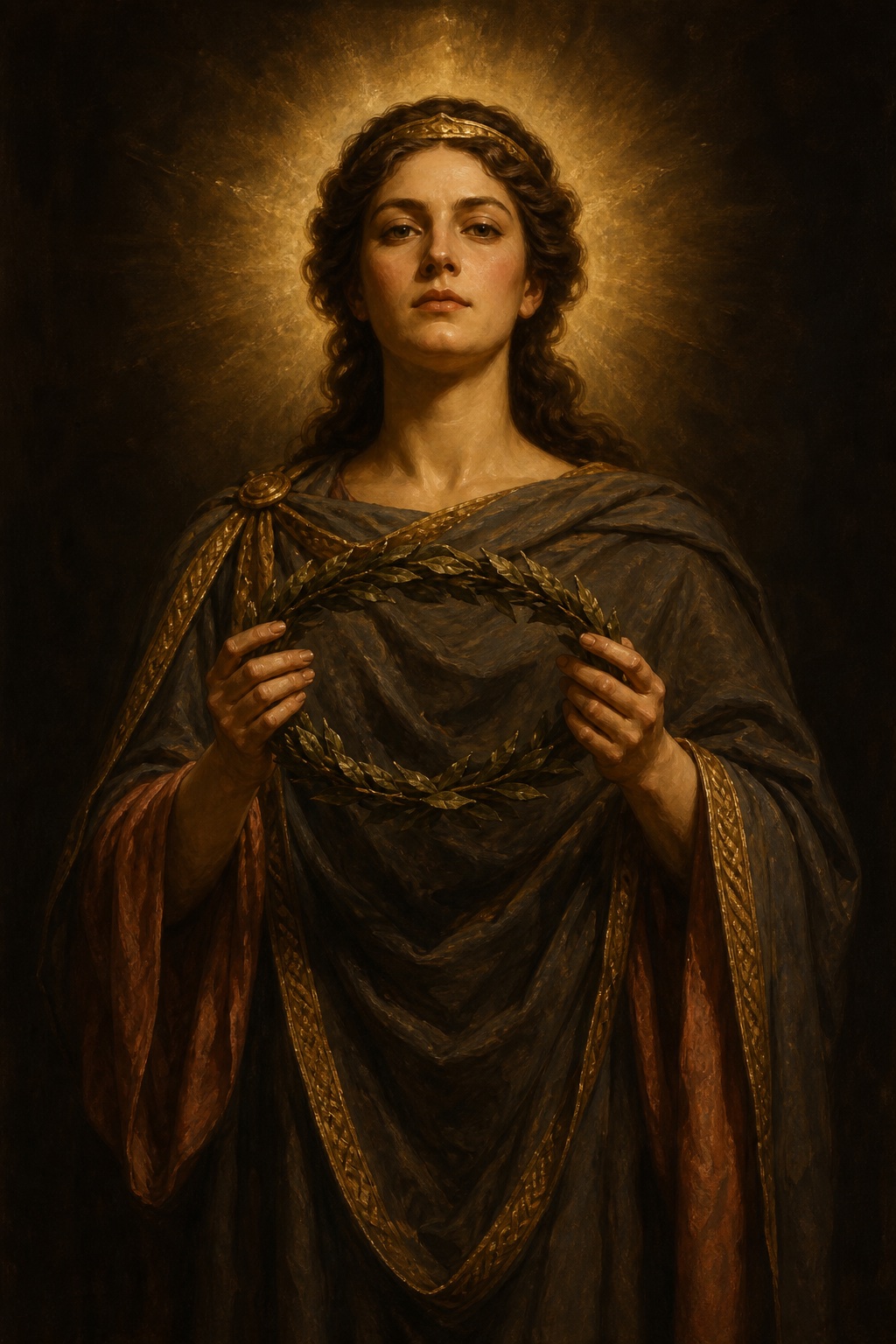
A Titaness of the first generation
Theia is one of the twelve Titans, a daughter of Uranus and Gaia born in the same generation as Cronus and Rhea, Oceanus and Tethys, Iapetus, Themis and Mnemosyne. Hesiod’s Theogony places her among that catalogue and pairs her, without further comment, with her brother Hyperion — one of several sibling matches among the Titans, and the one from which the sky’s three great lights descend. Beyond the pairing, the poem gives her no separate notice of her own: no epithet, no incident, nothing that marks her out from the list she is named in.
Mother of the Sun, the Moon, and the Dawn
What the Theogony does grant her is children, and only in Hyperion’s company. In the same four lines already devoted to him, the poem adds that Theia bore Helios, Selene, and Eos — sun, moon, and dawn, delivered in a single breath and never revisited. It is the only act attributed to her anywhere in Hesiod, and it is less an act than a fact reported about her: three of the sky’s permanent fixtures trace back to a mother who otherwise leaves no trace in the poem at all.
Known by what is owed to her
Theia’s one other appearance is different in kind, and the more revealing of the two. In the opening of his fifth Isthmian ode, Pindar turns to address her directly — not to narrate anything she does, but to name her the reason gold outweighs every other metal, and the reason ships and chariot teams strain against each other for the honor that is hers to grant:
μᾶτερ Ἁλίου πολυώνυμε Θεία , σέο ἕκατι καὶ μεγασθενῆ νόμισαν χρυσὸν ἄνθρωποι περιώσιον ἄλλων : καὶ γὰρ ἐριζόμεναι νᾶες ἐν πόντῳ καὶ ὑφ᾽ ἅρμασιν ἵπποι διὰ τεάν , ὤνασσα , τιμὰν ὠκυδινάτοις ἐν ἁμίλλαισι θαυμασταὶ πέλονται
“Mother of the Sun, Theia of many names, through thee it is that men prize gold as mighty above all things else: for ships that strive upon the sea and horses that run in chariots, for the honour that is of thee, O queen, are glorified in swiftly circling struggle.” — Pindar, Isthmian 5.1–8, tr. Myers
Nothing here is a scene. Pindar never says what Theia looks like, where she stands, or what she is doing while men value gold and race their teams for glory; the verbs are all in the general present, not the narrated past. She is invoked, called “queen,” and credited — twice over, once for gold and once for the honor contests are fought to win — with an effect on the world rather than a deed within it. It is the closest thing to a defining moment Theia has, and it defines her by what is owed to her rather than by anything she is shown to do.
A figure without a portrait
Between the two surviving passages, Theia never once receives a description. No source gives her a garment, a posture, a gesture, or an object in her hand, the way her own children are each given one — Helios his chariot, Selene her golden crown, Eos her golden throne. What she has instead is a domain by implication: the shining sky she is grouped with as a Titan, the sun her children are born from, the gold and the garland that Pindar says exist, in some sense, because of her. Theia is not a figure who does something and is remembered for it. She is a name attached to effects, owed rather than witnessed — a mother, a source, and a queen addressed by a poet who never once says what she looked like while speaking to her.