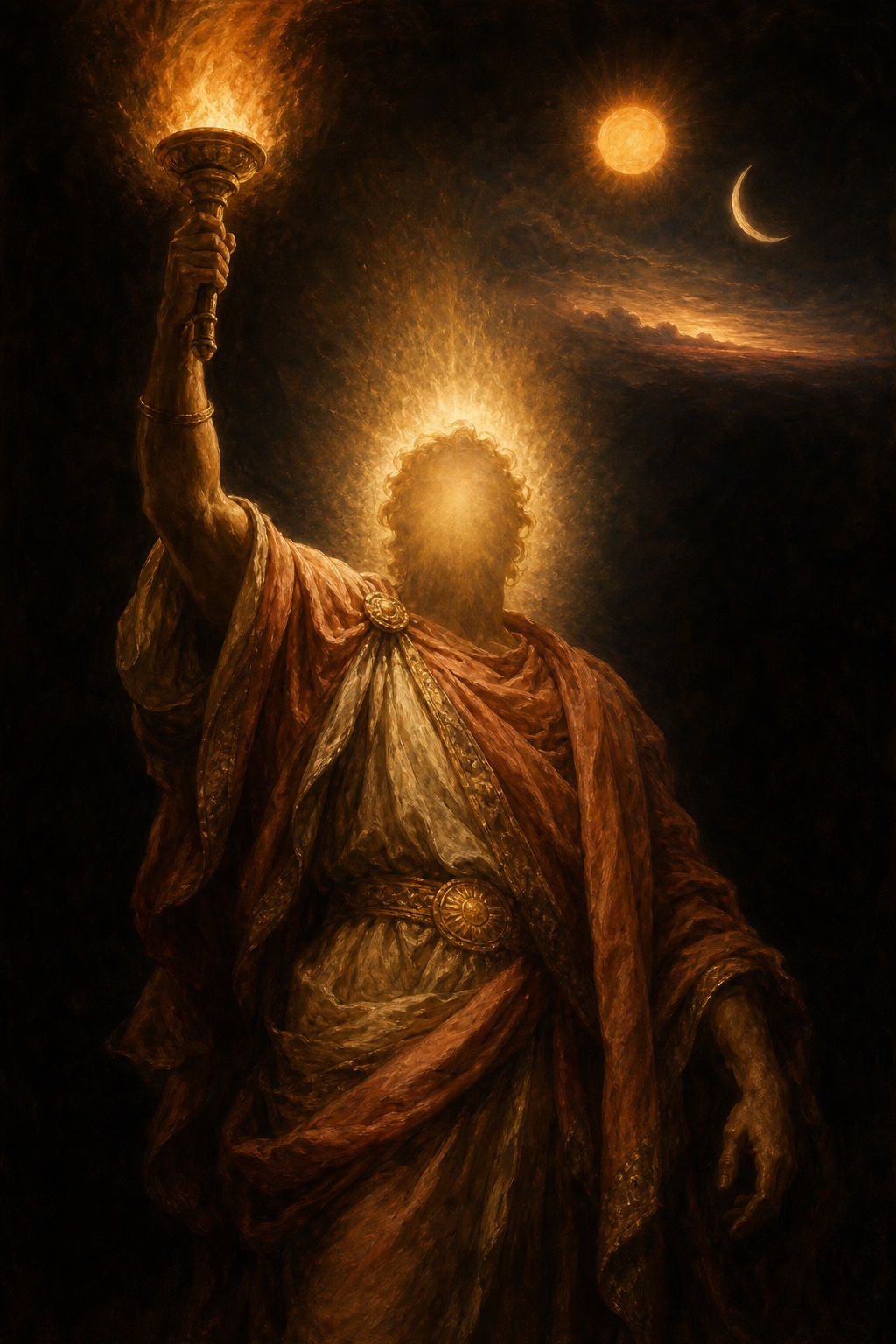
The name means something like “the one who goes above”, and that is very nearly the whole of him. Hyperion has no myth. He does not scheme, suffer, transform or get punished; he is a Titan of the first generation who exists in the record almost entirely so that three other things can be descended from him. Hesiod gives him four lines and moves on.
Θεία δ᾽ Ἠέλιόν τε μέγαν λαμπράν τε Σελήνην Ἠῶ θ᾽, ἣ πάντεσσιν ἐπιχθονίοισι φαείνει ἀθανάτοις τε θεοῖσι, τοὶ οὐρανὸν εὐρὺν ἔχουσι, γείναθ᾽ ὑποδμηθεῖσ᾽ Ὑπερίονος ἐν φιλότητι
“And Theia was subject in love to Hyperion and bare great Helius (Sun) and clear Selene (Moon) and Eos (Dawn) who shines upon all that are on earth and upon the deathless Gods who live in the wide heaven.” — Hesiod, Theogony 371–374, tr. Evelyn-White
Sun, moon and dawn, from one couple, in one sentence. It is the tidiest piece of genealogy in the poem, and it explains why Hyperion needed to exist: the three great regular lights had to come from somewhere structurally prior to the Olympians, because they were plainly older than any political arrangement on Olympus.
Then the father is absorbed by the son. Homer uses “Hyperion” as a name for the sun itself — the crew of the Odyssey are destroyed for eating the cattle of Hyperion Helios, and the Ethiopians live split between the setting and the rising of Hyperion, where no second name is offered at all. What began as a patronymic is on its way to becoming an epithet, and then just a word for the sun. It is the clearest surviving case in Greek of a god being eaten by his own descendant’s job description. He does appear once as himself in Homer, and even then obliquely: Zeus tells Hera he cares nothing for her anger, not if she went to the ends of earth and sea where Iapetus and Cronus sit, taking no pleasure in the rays of Hyperion Helios nor in the winds. Hyperion names the light that the imprisoned Titans cannot see.
The Greek arrangement is worth setting against Egypt and Japan, where the sun is the sovereign — Ra rules, Amaterasu’s descendants are the imperial line. In Greece the celestial machinery was left with the previous administration and never reclaimed. Zeus takes the thunderbolt, the sky as weather and politics, the throne; the sun keeps going round on its own, driven by a Titan’s son who is not one of the twelve and takes no part in their business. Only much later, and never in Homer or Hesiod, does Apollo start absorbing Helios and pull the sun back into the Olympian family.