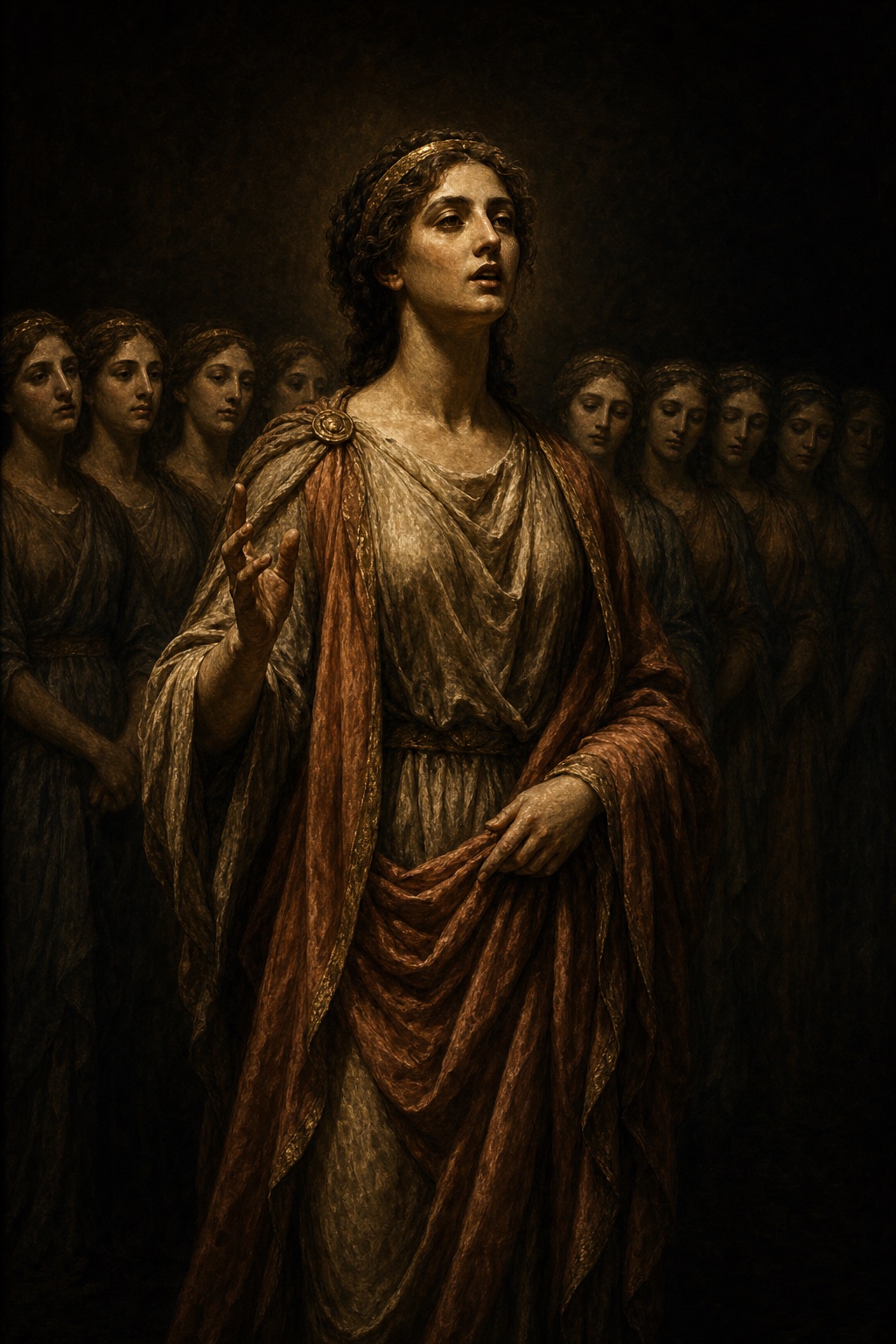
Hesiod names her in the proem, a good sixty lines before Chaos — which is to say, before the point where his cosmogony actually begins. The placement is not decorative. He is about to make a very large claim about where his information comes from, and Memory is the answer he gives.
τὰς ἐν Πιερίῃ Κρονίδῃ τέκε πατρὶ μιγεῖσα Μνημοσύνη, γουνοῖσιν Ἐλευθῆρος μεδέουσα, λησμοσύνην τε κακῶν ἄμπαυμά τε μερμηράων
“Them in Pieria did Mnemosyne (Memory), who reigns over the hills of Eleuther, bear of union with the father, the son of Cronos, a forgetting of ills and a rest from sorrow.” — Hesiod, Theogony 53–55, tr. Evelyn-White
The line turns on a piece of wordplay that only works in Greek, and it is a good one. Mnemosyne bears lesmosyne — Memory gives birth to forgetting. The two words stand at the head of consecutive lines, built on opposite roots, and the paradox is the whole point: what remembering is for is to make the rest bearable. The Muses do not preserve the past out of piety. They select it, shape it into song, and the song is a rest from sorrow.
Then the arithmetic, which is characteristically literal. Zeus lies with her for nine consecutive nights, away from the other immortals; a year later she bears nine daughters, all of one mind. Hesiod returns to her a second time in the catalogue of Zeus’s unions — placed between Demeter and Leto — and reports the same nine.
Why memory should be a Titan at all, rather than a minor personification, becomes obvious the moment a poet has to do something difficult. At the Catalogue of Ships, facing the better part of three hundred lines of names he cannot possibly hold in his head, Homer stops and applies directly to the daughters: “for ye are goddesses and are at hand and know all things, whereas we hear but a rumour and know not anything”. He is not being modest. In a world with no written archive, the archive is a woman’s daughters singing, and the poet’s own memory is a rumour by comparison. Mnemosyne is the storage medium, personified and given a genealogy old enough to outrank the gods being sung about.
The same arrangement was reached independently in India, and lasted much longer there. The Vedic hymns are śruti, “that which is heard” — a corpus transmitted by mouth with layers of redundant recitation built in specifically to make corruption detectable, and held that way for centuries after writing was available and declined. The Rigveda that this wiki quotes for Indra and Vritra was a feat of memory long before it was a manuscript. Greece put a face on the technology and married her to the king of the gods; India kept the technology and skipped the face.