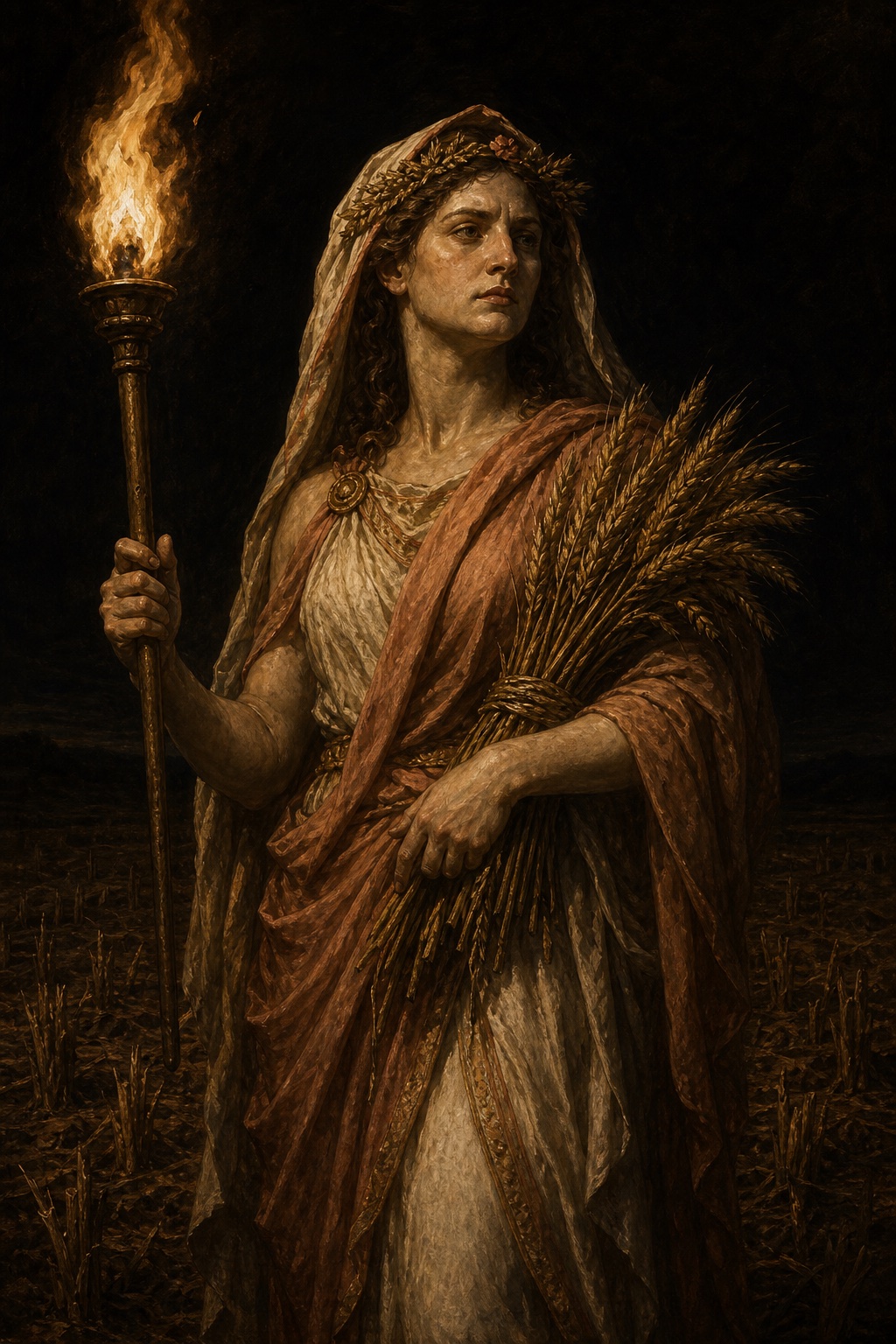
Demeter is the goddess of grain, and the long Homeric Hymn to Demeter is less a hymn than a hostage negotiation. Her daughter Persephone is taken by Hades with Zeus’s quiet consent. Demeter hears the cry, searches nine days with torches and neither eats nor washes, and learns from Helios — who sees everything — that the abductor was her brother and the arrangement had her other brother’s approval. She does not appeal. She withdraws.
Disguised as an old woman she comes to Eleusis, is taken in by the royal household, and sits in silence until a servant girl, Iambe, makes her laugh. She takes charge of the queen’s infant son and begins making him immortal by burying him in the fire each night, until his mother sees, screams, and ruins it. Demeter throws off the disguise, tells them to build her a temple, and shuts herself inside it. Then she does the thing that actually forces the issue.
αἰνότατον δ’ ἐνιαυτὸν ἐπὶ χθόνα πουλυβότειραν ποίησ’ ἀνθρώποις καὶ κύντατον, οὐδέ τι γαῖα σπέρμ’ ἀνίει· κρύπτεν γὰρ ἐυστέφανος Δημήτηρ· πολλὰ δὲ καμπύλ’ ἄροτρα μάτην βόες εἷλκον ἀρούραις, πολλὸν δὲ κρῖ λευκὸν ἐτώσιον ἔμπεσε γαίῃ
“Then she caused a most dreadful and cruel year for mankind over the all-nourishing earth: the ground would not make the seed sprout, for rich-crowned Demeter kept it hid. In the fields the oxen drew many a curved plough in vain, and much white barley was cast upon the land without avail.” — Homeric Hymn 2, To Demeter 305–309, tr. Evelyn-White
The hymn is explicit that she would have destroyed the human race entirely, and that this is what moves Zeus — not pity, but the fact that gods live on sacrifice and the dying had stopped making offerings. Iris is sent, then every god in turn with gifts; she refuses them all and states her terms: she will not let the grain grow, and she will not enter Olympus, until she sees her daughter. Zeus gives in. The famine is the only successful act of coercion against Zeus in Greek myth.
What she wins is partial, because Persephone has eaten in the house of the dead and belongs to it for a third of every year. So the arrangement encodes the agricultural year, and Demeter’s grief becomes seasonal rather than final. Before leaving Eleusis she teaches the conduct of her rites to the local kings — the Eleusinian Mysteries, which ran for something like two thousand years and which initiates were forbidden on pain of death to describe. The hymn says only that whoever has seen them is blessed, and that the uninitiated never has the same portion after death. Whatever was shown in that hall, it was the argument that grain coming back out of the ground was a statement about people too.