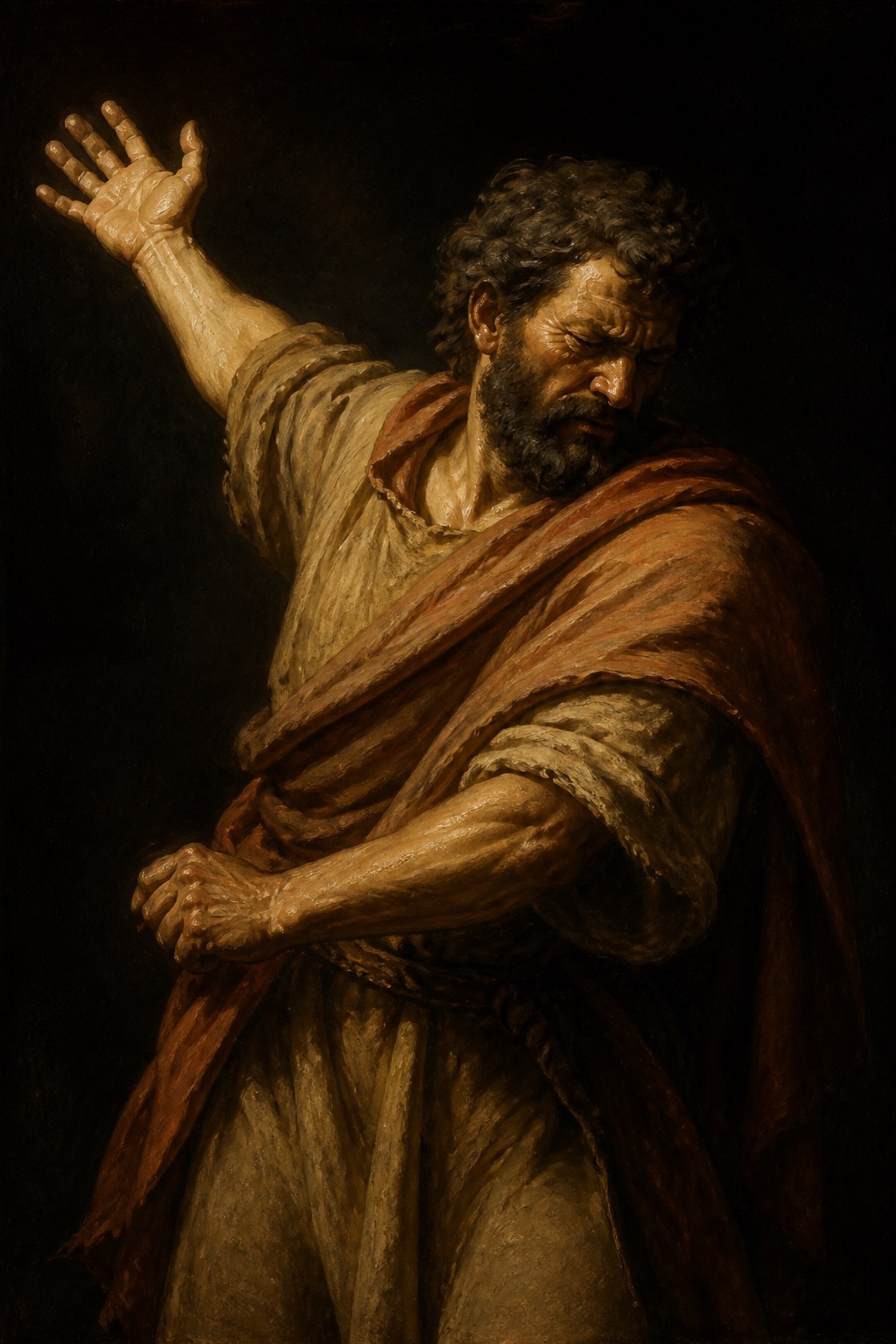
Prometheus’s son, married into the other house
Apollodorus introduces Deucalion in a single sentence that also settles who he married, and the marriage is the more remarkable half. His father is Prometheus, who stole the fire; his wife’s father is Epimetheus, who accepted the woman Zeus sent in revenge for it.
Προμηθέως δὲ παῖς Δευκαλίων ἐγένετο. οὗτος βασιλεύων τῶν περὶ τὴν Φθίαν τόπων γαμεῖ Πύρραν τὴν Ἐπιμηθέως καὶ Πανδώρας, ἣν ἔπλασαν θεοὶ πρώτην γυναῖκα
“And Prometheus had a son Deucalion. He reigning in the regions about Phthia, married Pyrrha, the daughter of Epimetheus and Pandora, the first woman fashioned by the gods” — Apollodorus, Bibliotheke 1.7.2, tr. J. G. Frazer
He is a king before he is a survivor: βασιλεύων, ruling the country about Phthia in Thessaly. Hesiod spends hundreds of lines setting the brothers Prometheus and Epimetheus against each other, the clever one and the one who thinks afterwards. One generation later their children marry, and it is that household — not either brother’s — that the flood leaves standing.
The chest
The flood is Zeus’s decision and the chest is Prometheus’s advice, and Apollodorus reports both in one clause each. Deucalion does not argue, negotiate or warn anyone; he builds.
ἐπεὶ δὲ ἀφανίσαι Ζεὺς τὸ χαλκοῦν ἠθέλησε γένος, ὑποθεμένου Προμηθέως Δευκαλίων τεκτηνάμενος λάρνακα, καὶ τὰ ἐπιτήδεια ἐνθέμενος, εἰς ταύτην μετὰ Πύρρας εἰσέβη.
“And when Zeus would destroy the men of the Bronze Age, Deucalion by the advice of Prometheus constructed a chest, and having stored it with provisions he embarked in it with Pyrrha.” — Apollodorus, Bibliotheke 1.7.2, tr. J. G. Frazer
The word is λάρναξ — a chest or coffer, the same kind of box a body or a treasure goes into, not a ship. It has no sail, no oar and no steering; the couple are stored in it along with the provisions. What destroys the Bronze Age is rain, ὑετός, poured out of the sky until most of Greece is under water and everyone drowns except a few who reach high ground.
Nine days, and a sacrifice on landing
The chest drifts for nine days and as many nights before it touches land, and where it touches is Parnassus. The first thing Deucalion does on dry ground is not to look for other survivors.
τῷ Παρνασῷ προσίσχει, κἀκεῖ τῶν ὄμβρων παῦλαν λαβόντων ἐκβὰς θύει Διὶ φυξίῳ.
“drifted to Parnassus, and there, when the rain ceased, he landed and sacrificed to Zeus, the god of Escape.” — Apollodorus, Bibliotheke 1.7.2, tr. J. G. Frazer
Διὶ φυξίῳ — Zeus of Escape, the god in his capacity as the one people get away by. The sacrifice is offered to the same god who sent the flood, under the title appropriate to having survived it. Apollodorus makes nothing of the irony; it is a cult epithet, and Deucalion uses the correct one.
The stones, thrown without looking
Zeus sends Hermes with an open offer, and Deucalion’s answer is the reason he is remembered. He does not ask for his kingdom, or for his own life to be secured. He asks for people.
Ζεὺς δὲ πέμψας Ἑρμῆν πρὸς αὐτὸν ἐπέτρεψεν αἱρεῖσθαι ὅ τι βούλεται· ὁ δὲ αἱρεῖται ἀνθρώπους αὐτῷ γενέσθαι. καὶ Διὸς εἰπόντος ὑπὲρ κεφαλῆς ἔβαλλεν αἴρων λίθους, καὶ οὓς μὲν ἔβαλε Δευκαλίων, ἄνδρες ἐγένοντο, οὓς δὲ Πύρρα, γυναῖκες
“And Zeus sent Hermes to him and allowed him to choose what he would, and he chose to get men. And at the bidding of Zeus he took up stones and threw them over his head, and the stones which Deucalion threw became men, and the stones which Pyrrha threw became women” — Apollodorus, Bibliotheke 1.7.2, tr. J. G. Frazer
The instruction is ὑπὲρ κεφαλῆς, over the head: he throws behind himself and cannot watch where any of it lands. The making of the second human race is therefore something neither of them sees happen. It is also divided by hand — his stones become men, Pyrrha’s become women — so the act only works because there are two of them doing it, which is the same reason the chest held two.