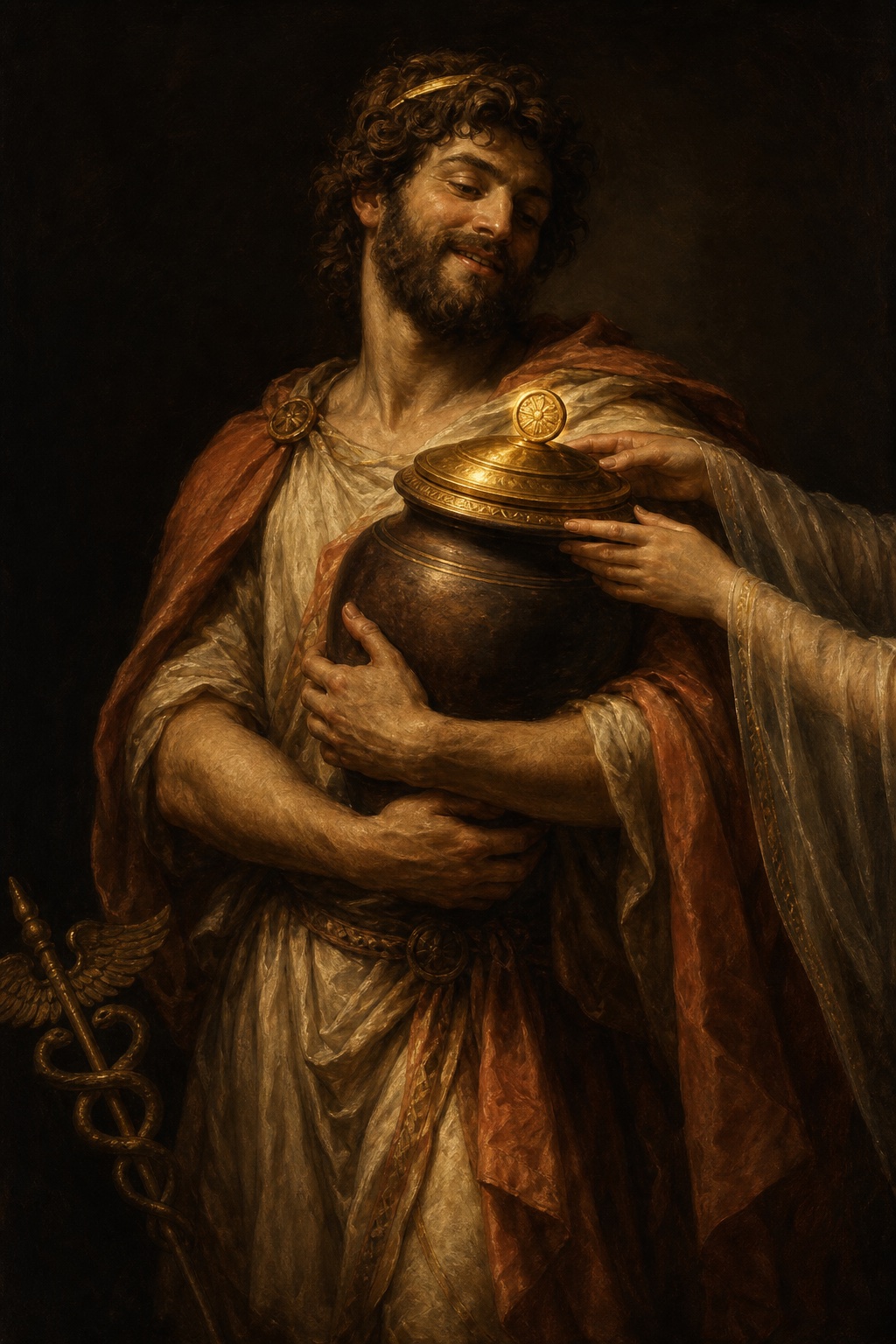
The brother who thinks afterwards
The pair of names is a joke that the whole story turns on. Prometheus is fore-thought; Epimetheus is after-thought, the one who works out what has happened once it has happened. Hesiod’s judgment on him is delivered in the Theogony’s roll-call of the sons of Iapetus, and it is not a character sketch so much as a summary of consequences.
ἁμαρτίνοόν τ᾽ Ἐπιμηθέα, ὃς κακὸν ἐξ ἀρχῆς γένετ᾽ ἀνδράσιν ἀλφηστῇσιν· πρῶτος γάρ ῥα Διὸς πλαστὴν ὑπέδεκτο γυναῖκα παρθένον
“and scatter-brained Epimetheus who from the first was a mischief to men who eat bread; for it was he who first took of Zeus the woman, the maiden whom he had formed.” — Hesiod, Theogony 511–512, tr. Evelyn-White
ἁμαρτίνοος, which Evelyn-White renders “scatter-brained”, is more exactly mistaken in mind — a mind that misses. The clause that follows is the entire indictment: he was a mischief to men from the beginning, and the reason is that he accepted a delivery. Note what the Theogony does not do here. It does not name her. She is πλαστὴν γυναῖκα, a moulded woman, an artefact of Zeus described by her manufacture rather than by any name of her own.
The gift he was warned about
The Works and Days tells the same event slowly, and the slowness is what makes it painful to read. The woman has just been finished — clothed by Athena, given a face by Aphrodite, given lies and a thievish nature by Hermes, and named Pandora because every god on Olympus contributed something to her. Then she is delivered.
εἰς Ἐπιμηθέα πέμπε πατὴρ κλυτὸν Ἀργειφόντην δῶρον ἄγοντα, θεῶν ταχὺν ἄγγελον· οὐδ᾽ Ἐπιμηθεὺς ἐφράσαθ᾽, ὥς οἱ ἔειπε Προμηθεὺς μή ποτε δῶρον δέξασθαι πὰρ Ζηνὸς Ὀλυμπίου, ἀλλ᾽ ἀποπέμπειν ἐξοπίσω, μή πού τι κακὸν θνητοῖσι γένηται. αὐτὰρ ὁ δεξάμενος, ὅτε δὴ κακὸν εἶχ᾽, ἐνόησεν
“the Father sent glorious Argus-Slayer, the swift messenger of the gods, to take it to Epimetheus as a gift. And Epimetheus did not think on what Prometheus had said to him, bidding him never take a gift of Olympian Zeus, but to send it back for fear it might prove to be something harmful to men. But he took the gift, and afterwards, when the evil thing was already his, he understood.” — Hesiod, Works and Days 84–89, tr. Evelyn-White
The warning had been given. It was specific — never accept anything from Zeus, send it straight back — and it was given by the brother whose whole distinction is seeing what comes next. Epimetheus does not argue with it or weigh it against the gift in front of him. He simply does not think of it, which is a different and more ordinary failure: the advice was not rejected, it was mislaid at the moment it was needed.
The last clause is the one that has kept the figure alive for three thousand years. ὅτε δὴ κακὸν εἶχ᾽, ἐνόησεν — when he already had the evil thing, he understood. Hesiod puts the understanding after the possession, in that order, in a single line. Epimetheus is not stupid. He comprehends the whole situation perfectly. He comprehends it second.
The jar
What Pandora does next is the part everybody remembers, and Hesiod tells it in a handful of lines: before her, the tribes of men lived on earth free from ills and hard toil and heavy sickness, until the woman took off the great lid of the jar with her hands and scattered all of them, and her thought caused sorrow and mischief to men. Only Hope stayed inside, under the rim — not saved deliberately but trapped, stopped by the lid before she could fly out, by the will of Zeus.
It is worth noticing whose house the jar is standing in. Pandora is in Epimetheus’s keeping when she opens it, which makes the disaster his in a way that Hesiod never quite states and never lets the reader forget either. The sequence he built is exact and unforgiving: Prometheus steals, Zeus retaliates by making a gift, Prometheus foresees the trap, Epimetheus takes the gift anyway, and the jar is opened under his roof. Every ill that mortals suffer arrives through the one brother who was told in advance and failed to remember it in time.