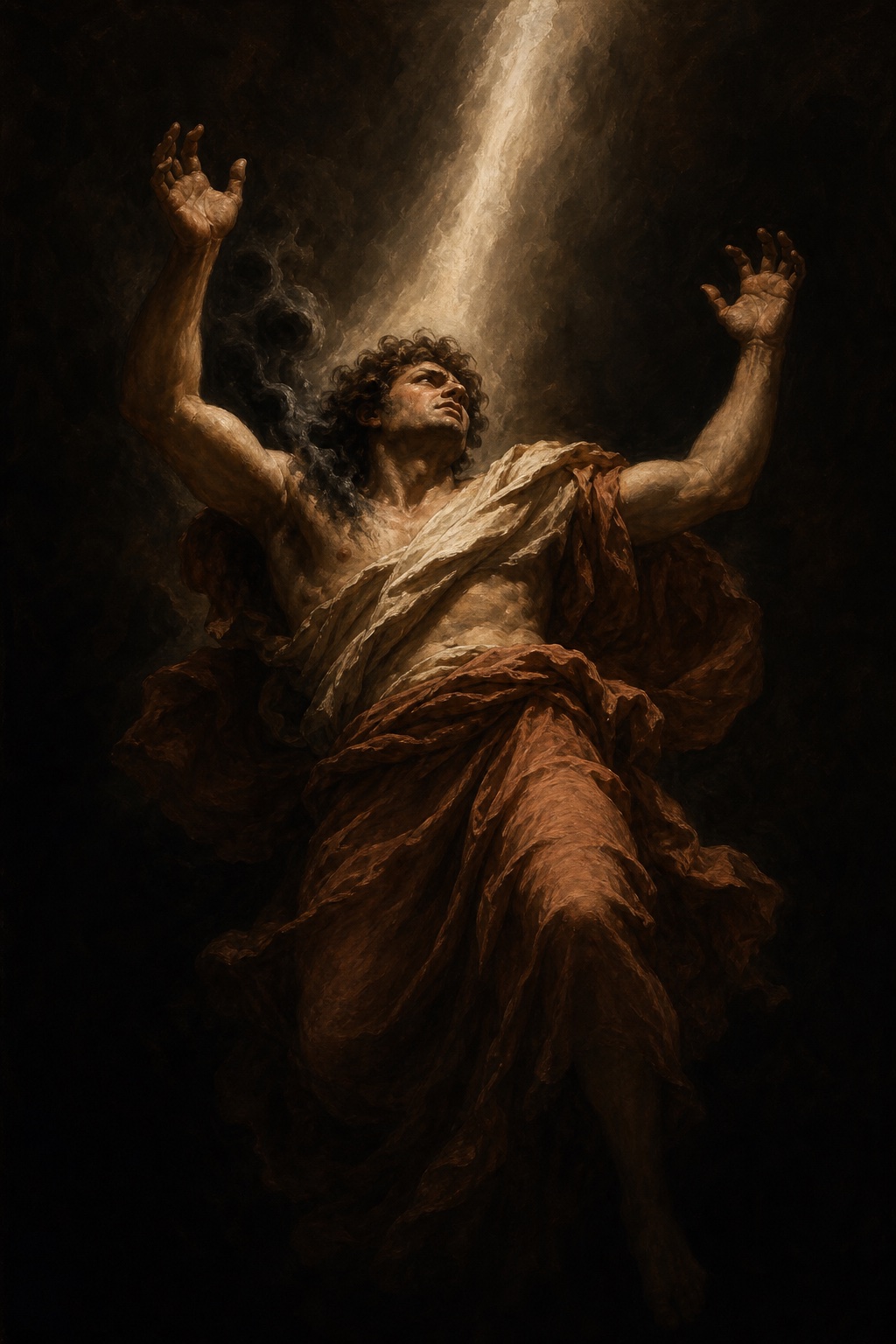
Three lines and gone
Hesiod names Menoetius twice: once in the list of Iapetus’s four sons, where he is “very glorious”, and once more to destroy him.
Ὑβριστὴν δὲ Μενοίτιον εὐρύοπα Ζεὺς εἰς Ἔρεβος κατέπεμψε βαλὼν ψολόεντι κεραυνῷ εἵνεκ᾽ ἀτασθαλίης τε καὶ ἠνορέης ὑπερόπλου
“But Menoetius was outrageous, and far-seeing Zeus struck him with a lurid thunderbolt and sent him down to Erebus because of his mad presumption and exceeding pride.” — Hesiod, Theogony 514–516, tr. Evelyn-White
That is the whole of him in the earliest source. There is no scene, no speech, no account of what he actually did — only a charge sheet and a sentence, delivered in the same sentence. The first word of the Greek is the verdict: Ὑβριστήν, the hybristic one, placed before the name so that the reader meets the crime before the criminal.
The two nouns Hesiod gives as grounds are worth separating. ἀτασθαλίη is reckless wickedness, the word the Odyssey uses for the crew who eat the cattle of the Sun and destroy themselves doing it. ἠνορέη ὑπέροπλος is manliness carried past its limit — courage that has become an offence because it has stopped recognizing anything above it. Neither is a specific act, and Hesiod plainly does not have one to report. What he has is a fourth brother who needed accounting for, and a category to file him under.
The brother the tradition forgot
Measured against his brothers, the silence is conspicuous. Prometheus steals fire and gets a play of his own centuries later. Atlas holds up the sky in a posture the whole world would eventually recognize. Epimetheus takes the gift and thereby explains, for Hesiod, the entire condition of mortal life. Menoetius gets three lines and a thunderbolt.
The likeliest explanation is that he exists to complete a set. Four sons of Iapetus map onto four ways of failing against Zeus — open defiance, sustained resistance, thoughtless acceptance, and the raw presumption that gets you annihilated before the story can start. Menoetius is the version with no craft in it, which may be exactly why nothing further was ever told about him: there was nothing to tell.
Apollodorus supplies a date
Later mythography, working to systematize what Hesiod left loose, gives the blasting a place in the war and a different destination.
Ἰαπετοῦ δὲ καὶ Ἀσίας Ἄτλας, ὃς ἔχει τοῖς ὤμοις τὸν οὐρανόν, καὶ Προμηθεὺς καὶ Ἐπιμηθεὺς καὶ Μενοίτιος, ὃν κεραυνώσας ἐν τῇ τιτανομαχία Ζεὺς κατεταρτάρωσεν
“to Iapetus and Asia was born Atlas, who has the sky on his shoulders, and Prometheus, and Epimetheus, and Menoetius, he whom Zeus in the battle with the Titans smote with a thunderbolt and hurled down to Tartarus” — Apollodorus, Bibliotheca 1.2.3, tr. Frazer
Two changes, both of them tidying. The blow is now dated: it happens in the Titanomachy, which turns an unexplained act of presumption into an ordinary casualty of the war between the generations. And the destination moves from Erebus, which in Hesiod is simply the dark, to Tartarus, the prison where the defeated Titans are already being kept — so that Menoetius ends up filed with his father’s generation rather than lying somewhere unspecified.
Apollodorus also gives the four brothers a different mother, Asia rather than Clymene. Neither change has any authority over Hesiod; they are what a systematizer does with a figure too thin to resist being tidied, and the fact that Menoetius attracted three separate corrections in one sentence says more about how little survived of him than any of the corrections do.