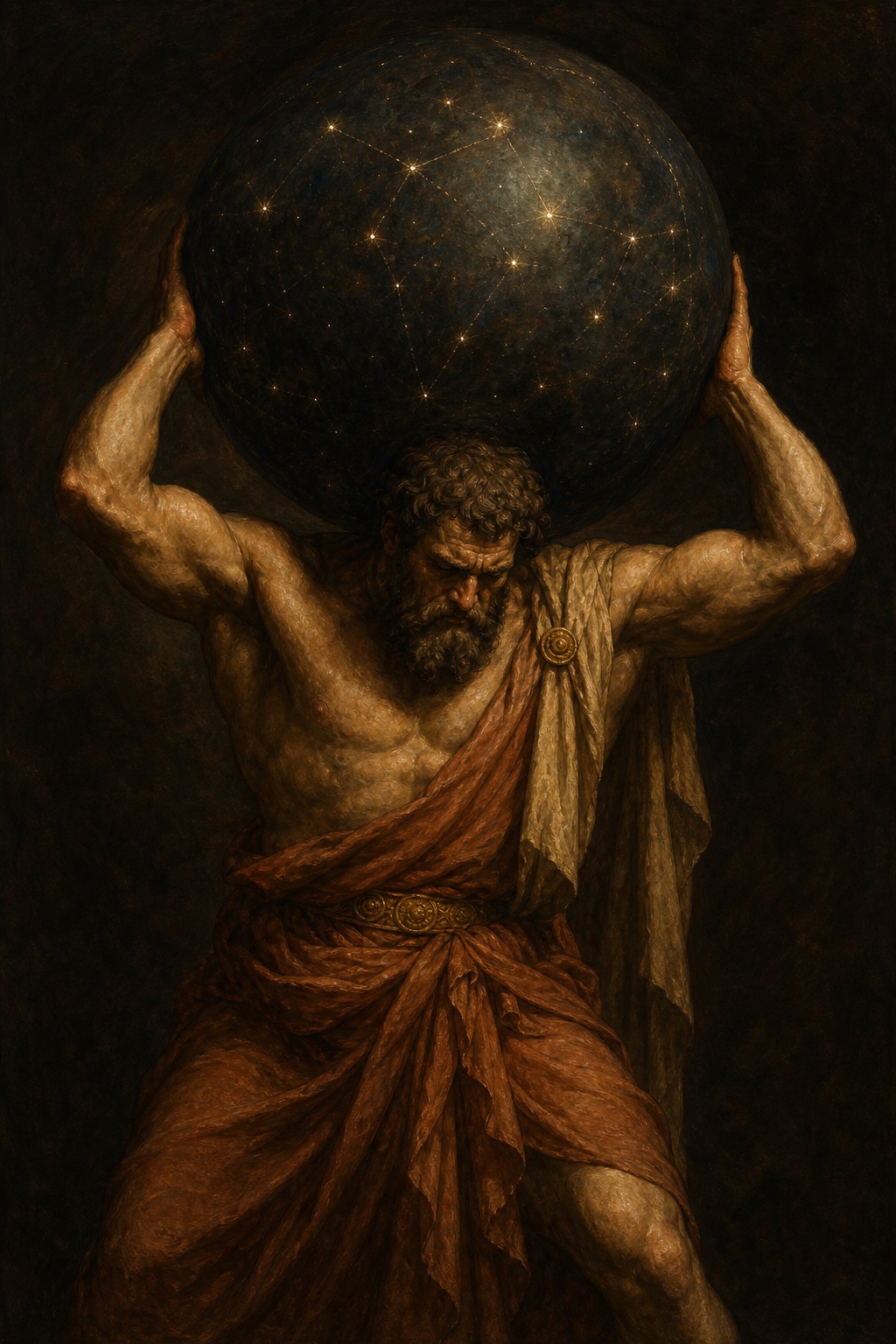
Under hard constraint
Hesiod gives Atlas four lines, and every one of them is about weight.
Ἄτλας δ᾽ οὐρανὸν εὐρὺν ἔχει κρατερῆς ὑπ᾽ ἀνάγκης πείρασιν ἐν γαίης, πρόπαρ Ἑσπερίδων λιγυφώνων, ἑστηὼς κεφαλῇ τε καὶ ἀκαμάτῃσι χέρεσσιν· ταύτην γάρ οἱ μοῖραν ἐδάσσατο μητίετα Ζεύς
“And Atlas through hard constraint upholds the wide heaven with unwearying head and arms, standing at the borders of the earth before the clear-voiced Hesperides; for this lot wise Zeus assigned to him.” — Hesiod, Theogony 517–520, tr. Evelyn-White
The phrase that decides how to read the whole figure is κρατερῆς ὑπ᾽ ἀνάγκης, under hard constraint. Atlas is not a caryatid volunteering his strength and not a cosmic principle doing what a cosmic principle does; he is a defeated god being made to stand somewhere he would leave if he could. Hesiod says so twice over, first with the compulsion and then with the last line, which reports the arrangement as an allotment — a μοῖρα handed out by Zeus in the same breath as the punishments of his brothers.
The body detail is oddly precise for a poet with four lines to spend. Not shoulders, which is how every later sculptor and every modern idiom has it, but head and arms: he is under the sky rather than beside it, taking the load on the crown of his skull with both arms braced. The adjective attached to those arms, ἀκαμάτῃσι, means untiring — and it is doing the cruellest work in the passage, because it does not describe a strong god who does not mind. It describes a god who cannot be relieved by exhaustion, held in position by the one attribute that guarantees the sentence never ends.
Homer’s pillars
Homer, describing the island where Odysseus is held, gets to Atlas from a different direction entirely — as the father of the nymph who is keeping the hero there.
Ἄτλαντος θυγάτηρ ὀλοόφρονος, ὅς τε θαλάσσης πάσης βένθεα οἶδεν, ἔχει δέ τε κίονας αὐτὸς μακράς, αἳ γαῖάν τε καὶ οὐρανὸν ἀμφὶς ἔχουσι
“daughter of Atlas of baneful mind, who knows the depths of every sea, and himself holds the tall pillars which keep earth and heaven apart” — Homer, Odyssey 1.52–54, tr. Murray
This is a different job. Homer’s Atlas does not carry the sky on his body at all — he keeps the pillars, and it is the pillars that hold earth and heaven apart. The distinction matters because it makes him an officer of the world’s structure rather than its load-bearing member, and Homer accordingly gives him something Hesiod’s Atlas has no room for: knowledge. He knows the depths of every sea, which is the sort of thing said about a sea-god or an oracle, not about a convict.
The epithet is stranger still. ὀλοόφρων, which Murray renders “of baneful mind”, is the word Homer elsewhere gives to hostile and destructive creatures, and nothing in the Odyssey explains what Atlas has done to earn it. Whatever the reason, it belongs to the same tradition Hesiod is drawing on, in which the holder of the sky is a figure the Olympians had cause to distrust.
Apollodorus, writing much later, hands the load to the shoulders at last — Atlas “has the sky on his shoulders” — and the version that became the statue and the idiom is his, not Hesiod’s.
The fourth punishment
Atlas is one of four sons of Iapetus, and the Theogony deals with all four in a single run of a dozen lines: Menoetius blasted with a thunderbolt for his presumption, Prometheus chained with the eagle at his liver, Epimetheus destroyed more quietly by accepting a gift, and Atlas set under the sky. Read together they are a catalogue of ways to lose to Zeus.
His is the punishment with no event in it. Menoetius is struck, Prometheus is bound and eventually freed when Heracles kills the bird — Hesiod says so a few lines later — and Epimetheus has at least the moment of understanding what he has taken. Atlas simply stands, and the poem moves on. There is no scene of his defeat, no speech, no reprieve: the Theogony introduces him already in position, which is the most efficient way a poem can say that this is not an episode but a condition.
At the borders of the earth
Both of the early accounts put him at the edge of the world and at the edge of the known map — Hesiod at the limits of the earth, before the clear-voiced Hesperides whose garden lies in the far west, Homer at the navel of the sea. Later mythographers place him among the Hyperboreans, and later geographers gave his name to the mountains at the western end of the Mediterranean; the collection of maps that eventually took his name did so because early printed atlases put the sky-bearer on the title page.
He is one of the few Greek gods a reader meets first as a posture rather than a story, and the posture is the point: whatever the tradition disagrees about — pillars or sky, shoulders or head, Clymene or Asia for a mother — it agrees that Atlas is what stands between everything above and everything below, permanently, because somebody more powerful decided he should.