A cow instead of a sister
Cadmus’s story begins as a search. When Europa disappears, her father Agenor sends his sons out after her and tells them not to come back until they have found her, and their mother Telephassa goes with them. The search fails, and nobody goes home: Phoenix settles in Phoenicia, Cilix near it, and Cadmus and Telephassa make their home in Thrace.
Κάδμος δὲ ἀποθανοῦσαν θάψας Τηλέφασσαν, ὑπὸ Θρακῶν ξενισθείς, ἦλθεν εἰς Δελφοὺς περὶ τῆς Εὐρώπης πυνθανόμενος. ὁ δὲ θεὸς εἶπε περὶ μὲν Εὐρώπης μὴ πολυπραγμονεῖν, χρῆσθαι δὲ καθοδηγῷ βοΐ, καὶ πόλιν κτίζειν ἔνθα ἂν αὕτη πέσῃ καμοῦσα. τοιοῦτον λαβὼν χρησμὸν διὰ Φωκέων ἐπορεύετο, εἶτα βοῒ συντυχὼν ἐν τοῖς Πελάγοντος βουκολίοις ταύτῃ κατόπισθεν εἵπετο. ἡ δὲ διεξιοῦσα Βοιωτίαν ἐκλίθη, πόλις ἔνθα νῦν εἰσι Θῆβαι
“When Telephassa died, Cadmus buried her, and after being hospitably received by the Thracians he came to Delphi to inquire about Europa. The god told him not to trouble about Europa, but to be guided by a cow, and to found a city wherever she should fall down for weariness. After receiving such an oracle he journeyed through Phocis; then falling in with a cow among the herds of Pelagon, he followed it behind. And after traversing Boeotia, it sank down where is now the city of Thebes.” — Apollodorus, Bibliotheke 3.4.1, tr. J. G. Frazer
The oracle answers a question he did not ask. He comes to Delphi about his sister, and the god tells him περὶ μὲν Εὐρώπης μὴ πολυπραγμονεῖν — not to trouble about Europa. The father’s order was not to come home without her; the god’s answer releases him from it, and gives him something else to follow. The city is to stand ἔνθα ἂν αὕτη πέσῃ καμοῦσα, wherever she should fall down for weariness, so the site of Thebes is chosen by an animal giving out in Boeotia. Apollodorus closes the walk in his own present tense, ἔνθα νῦν εἰσι Θῆβαι — where is now the city of Thebes — as though the reader could go and look.
The serpent at the spring of Ares
The first thing Cadmus does at the new site is try to sacrifice the cow to Athena, and the first thing that goes wrong is the water.
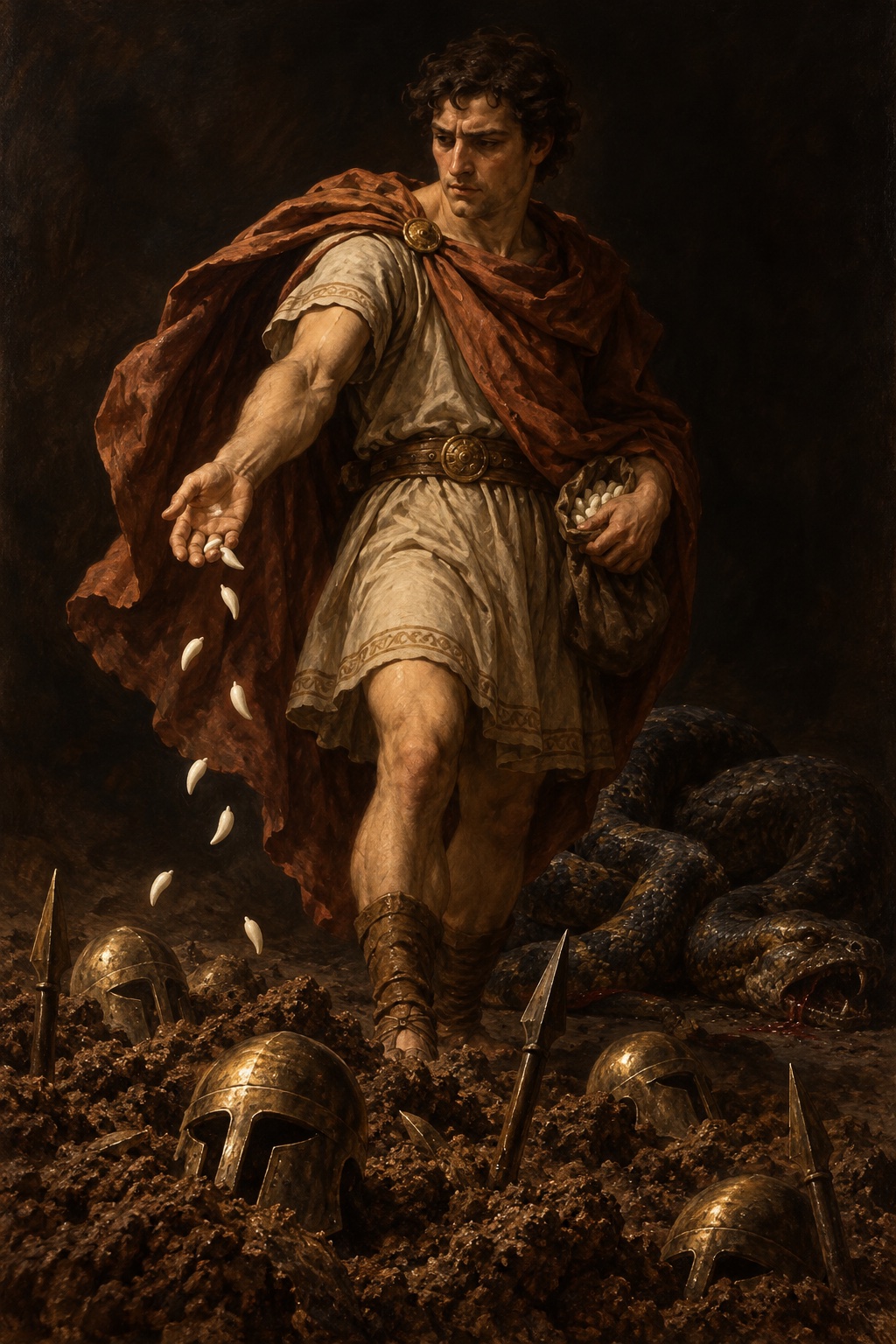
βουλόμενος δὲ Ἀθηνᾷ καταθῦσαι τὴν βοῦν, πέμπει τινὰς τῶν μεθ᾽ ἑαυτοῦ ληψομένους ἀπὸ τῆς Ἀρείας κρήνης ὕδωρ· φρουρῶν δὲ τὴν κρήνην δράκων, ὃν ἐξ Ἄρεος εἶπόν τινες γεγονέναι, τοὺς πλείονας τῶν πεμφθέντων διέφθειρεν. ἀγανακτήσας δὲ Κάδμος κτείνει τὸν δράκοντα, καὶ τῆς Ἀθηνᾶς ὑποθεμένης τοὺς ὀδόντας αὐτοῦ σπείρει. τούτων δὲ σπαρέντων ἀνέτειλαν ἐκ γῆς ἄνδρες ἔνοπλοι, οὓς ἐκάλεσαν Σπαρτούς. οὗτοι δὲ ἀπέκτειναν ἀλλήλους, οἱ μὲν εἰς ἔριν ἀκούσιον ἐλθόντες, οἱ δὲ ἀγνοοῦντες
“Wishing to sacrifice the cow to Athena, he sent some of his companions to draw water from the spring of Ares. But a dragon, which some said was the offspring of Ares, guarded the spring and destroyed most of those that were sent. In his indignation Cadmus killed the dragon, and by the advice of Athena sowed its teeth. When they were sown there rose from the ground armed men whom they called Sparti. These slew each other, some in a chance brawl, and some in ignorance.” — Apollodorus, Bibliotheke 3.4.1, tr. J. G. Frazer
Apollodorus keeps his distance from the serpent’s parentage. It guards the spring of Ares, but that it was the offspring of Ares is only what some said, ὃν ἐξ Ἄρεος εἶπόν τινες γεγονέναι. Nor does he say how Cadmus kills it: there is no weapon in the sentence, only his indignation and the verb. It is Athena who advises the sowing, and the men who grow from it take their name from the act: the teeth are σπαρέντων, sown, and the armed men are those οὓς ἐκάλεσαν Σπαρτούς, whom they called Sparti. Their first act is to kill one another, in a quarrel nobody meant, ἔριν ἀκούσιον, or in plain ignorance.
In either telling the killing stops short of all of them. Five survive — Echion, Udaeus, Chthonius, Hyperenor and Pelorus — and the first of them will marry into Cadmus’s own house.
Eight years for Ares, then a wedding
The serpent has to be paid for, and the payment is labour.
Κάδμος δὲ ἀνθ᾽ ὧν ἔκτεινεν ἀίδιον ἐνιαυτὸν ἐθήτευσεν Ἄρει· ἦν δὲ ὁ ἐνιαυτὸς τότε ὀκτὼ ἔτη. μετὰ δὲ τὴν θητείαν Ἀθηνᾶ αὐτῷ τὴν βασιλείαν κατεσκεύασε, Ζεὺς δὲ ἔδωκεν αὐτῷ γυναῖκα Ἁρμονίαν, Ἀφροδίτης καὶ Ἄρεος θυγατέρα. καὶ πάντες θεοὶ καταλιπόντες τὸν οὐρανόν, ἐν τῇ Καδμείᾳ τὸν γάμον εὐωχούμενοι καθύμνησαν. ἔδωκε δὲ αὐτῇ Κάδμος πέπλον καὶ τὸν ἡφαιστότευκτον ὅρμον, ὃν ὑπὸ Ἡφαίστου λέγουσί τινες δοθῆναι Κάδμῳ, Φερεκύδης δὲ ὑπὸ Εὐρώπης· ὃν παρὰ Διὸς αὐτὴν λαβεῖν
“But Cadmus, to atone for the slaughter, served Ares for an eternal year; and the year was then equivalent to eight years of our reckoning. After his servitude Athena procured for him the kingdom, and Zeus gave him to wife Harmonia, daughter of Aphrodite and Ares. And all the gods quitted the sky, and feasting in the Cadmea celebrated the marriage with hymns. Cadmus gave her a robe and the necklace wrought by Hephaestus, which some say was given to Cadmus by Hephaestus, but Pherecydes says that it was given by Europa, who had received it from Zeus.” — Apollodorus, Bibliotheke 3.4.2, tr. J. G. Frazer
The order of that passage is the point of it. Cadmus kills the serpent at the spring of Ares, serves Ares for the killing, and is then given the daughter of Ares for a wife. The eternal year is eight years long; only after it does Athena procure the kingdom, so the kingship of Thebes begins with a debt paid to Ares. Hesiod gives the marriage a single line in his genealogy of the gods, among the children Aphrodite bore to Ares: Harmonia, whom Κάδμος ὑπέρθυμος, high-spirited Cadmus, made his wife.
At the wedding all the gods come down to him. They leave the sky and feast in the Cadmea, which bears his name. The gift he gives the bride comes with two histories. Some say Hephaestus gave the necklace to Cadmus; Pherecydes says that it came from Europa, who had it from Zeus. On that account the sister he was told to stop looking for reaches him anyway, as a wedding present.
Then Apollodorus turns the marriage into a list. To Cadmus are born four daughters, Autonoe, Ino, Semele and Agave, and a son, Polydorus, and three of the daughters are married off in a single sentence: Ino to Athamas, Autonoe to Aristaeus, Agave to Echion, one of the sown men. Semele is the one left over, and the next sentence is about Zeus. Her son is Dionysus, and his coming to Thebes costs the house its next king.
The letters his companions brought
Herodotus, asking where the Greeks got their letters, finds the answer in the company Cadmus brought with him, and he is careful about whom he credits.
οἱ δὲ Φοίνικες οὗτοι οἱ σὺν Κάδμῳ ἀπικόμενοι, τῶν ἦσαν οἱ Γεφυραῖοι, ἄλλα τε πολλὰ οἰκήσαντες ταύτην τὴν χώρην ἐσήγαγον διδασκάλια ἐς τοὺς Ἕλληνας καὶ δὴ καὶ γράμματα, οὐκ ἐόντα πρὶν Ἕλλησι ὡς ἐμοὶ δοκέειν, πρῶτα μὲν τοῖσι καὶ ἅπαντες χρέωνται Φοίνικες· μετὰ δὲ χρόνου προβαίνοντος ἅμα τῇ φωνῇ μετέβαλλον καὶ τὸν ῥυθμὸν τῶν γραμμάτων
“Now these Phenicians who came with Cadmos, of whom were the Gephyraians, brought in among the Hellenes many arts when they settled in this land of Boeotia, and especially letters, which did not exist, as it appears to me, among the Hellenes before this time; and at first they brought in those which are used by the Phenician race generally, but afterwards, as time went on, they changed with their speech the form of the letters also.” — Herodotus, Histories 5.58.1, tr. G. C. Macaulay
The subject of that sentence is not Cadmus. It is the Φοίνικες οὗτοι οἱ σὺν Κάδμῳ ἀπικόμενοι, the Phoenicians who came with him, the Gephyraians among them. They settle in Boeotia and bring the Greeks many arts, and letters above all. Cadmus is the name that dates their arrival, and the letters are what his companions carried. Herodotus hedges the larger claim himself: the letters did not exist among the Greeks before, ὡς ἐμοὶ δοκέειν, as it appears to me.
Nor does he leave the letters as they arrived. At first they are the letters all Phoenicians use; then, as time goes on, the settlers change their speech and change the form of the letters with it. What comes to Boeotia with Cadmus is a Phoenician script, and it changes shape as the people who carried it change their language.
Into Illyria, and into a serpent
By the time Dionysus comes to Thebes, the kingdom has passed to Pentheus, Agave’s son by Echion, a grandson of Cadmus and of one of the sown men. He dies on Cithaeron, torn apart by his own mother in her madness. The sentence that sends Cadmus and Harmonia away gives no reason for going.
ὁ δὲ Κάδμος μετὰ Ἁρμονίας Θήβας ἐκλιπὼν πρὸς Ἐγχελέας παραγίνεται. τούτοις δὲ ὑπὸ Ἰλλυριῶν πολεμουμένοις ὁ θεὸς ἔχρησεν Ἰλλυριῶν κρατήσειν, ἐὰν ἡγεμόνας Κάδμον καὶ Ἁρμονίαν ἔχωσιν. οἱ δὲ πεισθέντες ποιοῦνται κατὰ Ἰλλυριῶν ἡγεμόνας τούτους καὶ κρατοῦσι. καὶ βασιλεύει Κάδμος Ἰλλυριῶν, καὶ παῖς Ἰλλυριὸς αὐτῷ γίνεται. αὖθις δὲ μετὰ Ἁρμονίας εἰς δράκοντα μεταβαλὼν εἰς Ἠλύσιον πεδίον ὑπὸ Διὸς ἐξεπέμφθη
“But Cadmus and Harmonia quitted Thebes and went to the Encheleans. As the Encheleans were being attacked by the Illyrians, the god declared by an oracle that they would get the better of the Illyrians if they had Cadmus and Harmonia as their leaders. They believed him, and made them their leaders against the Illyrians, and got the better of them. And Cadmus reigned over the Illyrians, and a son Illyrius was born to him. But afterwards he was, along with Harmonia, turned into a serpent and sent away by Zeus to the Elysian Fields.” — Apollodorus, Bibliotheke 3.5.4, tr. J. G. Frazer
The second oracle mirrors the first. Delphi told Cadmus where to found a city; this one tells the Encheleans, at war with the Illyrians, that they will win if they have Cadmus and Harmonia as their leaders. It works, and the man who left Thebes becomes a king a second time, over the Illyrians, with a son, Illyrius, who carries the people’s name.
The word for what he becomes is the word for what he killed. The guardian of the spring of Ares is a δράκων, and Cadmus κτείνει τὸν δράκοντα, killed the dragon; at the end he and Harmonia are turned εἰς δράκοντα. Frazer’s English says dragon the first time and serpent the second, but the Greek does not change. The founder who began Thebes by killing a serpent leaves the story as one, and Zeus sends him, with the daughter of Ares beside him, to the Elysian Fields.