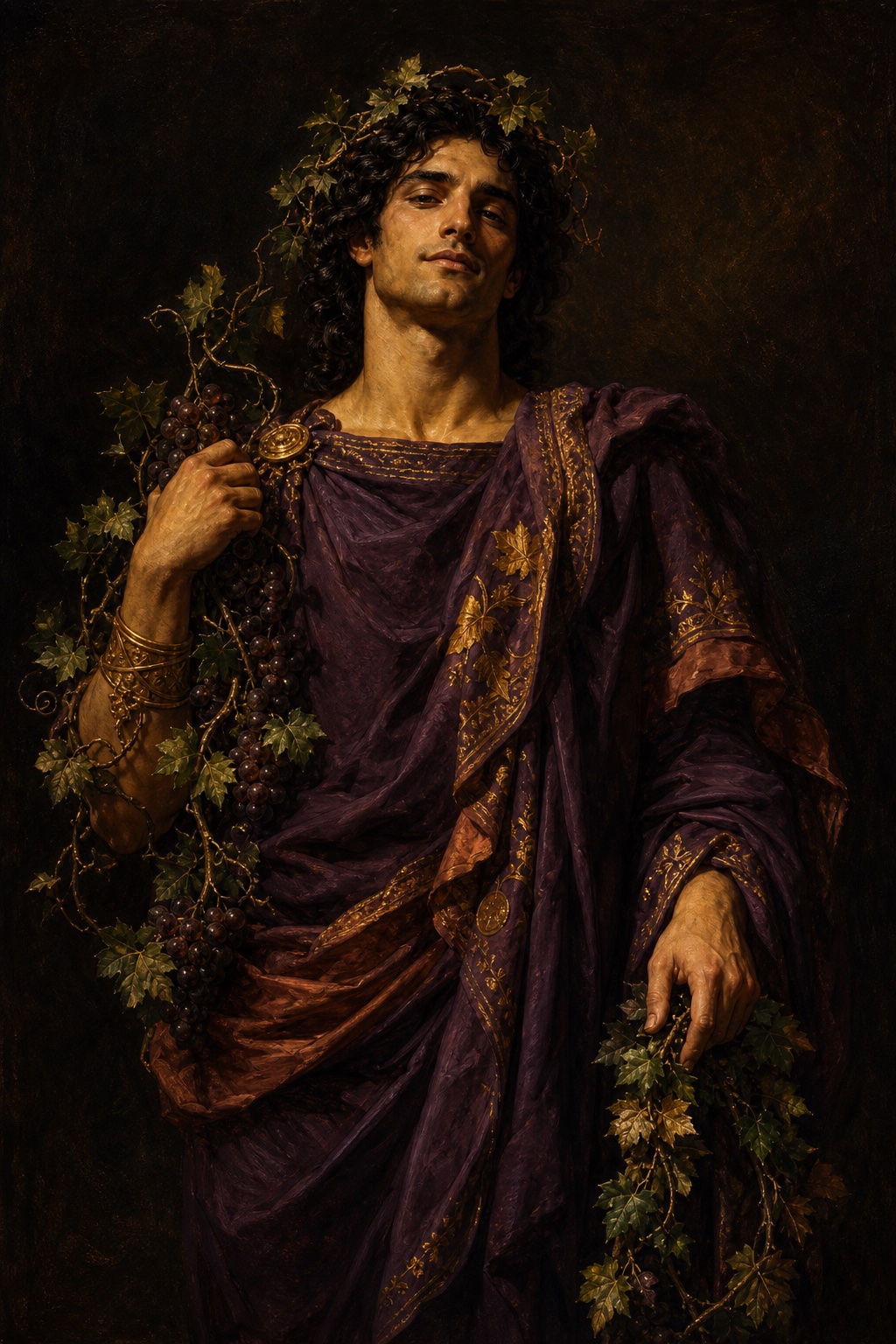
Seized by Tyrrhenian pirates
A crew of Tyrrhenian pirates spot a stranger waiting on a headland by the sea — dark-haired, wearing a purple robe, looking like the son of a king — and decide he is worth a ransom. They seize him, haul him aboard, and reach for rope to bind him, but the withies will not hold: they fall away from his wrists and ankles, and he only sits there smiling. The helmsman alone understands what this means and tells the crew they have bound a god — Zeus, or Apollo, or Poseidon — and begs them to set him ashore before he grows angry. The ship’s master mocks him for it, orders the sail hoisted, and reckons on selling their catch in Egypt or Cyprus or further still.
The ship becomes a vineyard
The pirates get their answer instead of their ransom.
τάχα δέ σφιν ἐφαίνετο θαυματὰ ἔργα. οἶνος μὲν πρώτιστα θοὴν ἀνὰ νῆα μέλαιναν ἡδύποτος κελάρυζ’ εὐώδης, ὤρνυτο δ’ ὀδμὴ ἀμβροσίη· ναύτας δὲ τάφος λάβε πάντας ἰδόντας. αὐτίκα δ’ ἀκρότατον παρὰ ἱστίον ἐξετανύσθη ἄμπελος ἔνθα καὶ ἔνθα, κατεκρημνῶντο δὲ πολλοὶ βότρυες· ἀμφ’ ἱστὸν δὲ μέλας εἱλίσσετο κισσὸς ἄνθεσι τηλεθάων, χαρίεις δ’ ἐπὶ καρπὸς ὀρώρει· πάντες δὲ σκαλμοὶ στεφάνους ἔχον
“But soon strange things were seen among them. First of all sweet, fragrant wine ran streaming throughout all the black ship and a heavenly smell arose, so that all the seamen were seized with amazement when they saw it. And all at once a vine spread out both ways along the top of the sail with many clusters hanging down from it, and a dark ivy-plant twined about the mast, blossoming with flowers, and with rich berries growing on it; and all the thole-pins were covered with garlands.” — Homeric Hymn 7, To Dionysus 34–42, tr. Evelyn-White
Nothing here is a threat in the ordinary sense — no thunderbolt, no monster underfoot. It is the ship’s own rigging turning fertile: the mast sprouting leaves, the sail growing a second and useless cargo of grapes, the dry wood answering to wine as if that had always been its true nature waiting under the grain. The revelation is horticultural before it is violent, which is exactly the shape of power this god deals in — he does not so much overpower the world as show what it does in his presence.
Lion, bear, and the leap into dolphins
By the time the crew is frightened enough to tell the helmsman to make for land, it is already too late. Dionysus turns lion in the bows and roars; amidships a shaggy bear rears up snarling; the sailors crowd terrified around the helmsman until the lion springs on the ship’s master and seizes him, and the rest leap overboard together rather than face the same fate, and are turned into dolphins in the water. Only the helmsman is spared — the one man who argued, from the start, for putting him ashore. Dionysus holds him back, tells him to take courage, that he has found favor, and names himself outright: son of Zeus and Semele. It is the god’s own account of his birth, volunteered in the middle of turning a crew into fish, offered as an aside to the miracle rather than as a scene in its own right.