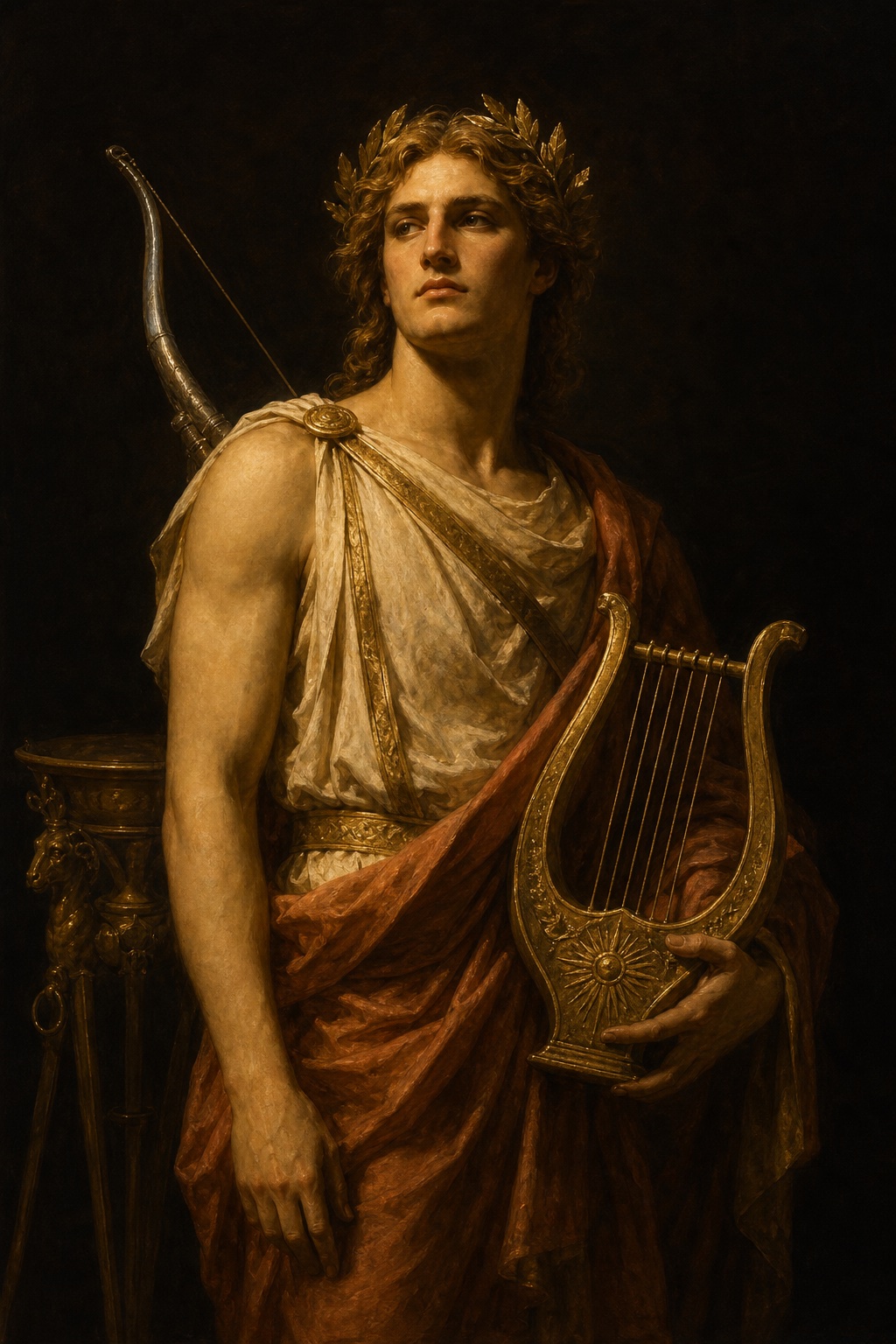
Apollo is born on Delos, the one island poor enough to risk Hera’s anger by sheltering Leto. He is fed nectar and ambrosia instead of milk, and the swaddling bands cannot hold him. His first words, in the Homeric Hymn, are a statement of office.
εἴη μοι κίθαρίς τε φίλη καὶ καμπύλα τόξα, χρήσω δ᾽ ἀνθρώποισι Διὸς νημερτέα βουλήν
“The lyre and the curved bow shall ever be dear to me, and I will declare to men the unfailing will of Zeus.” — Homeric Hymn 3, To Apollo 131–132, tr. Evelyn-White
The lyre and the bow, named in one breath, are the whole of him. He is the god of music, measure and proportion, and he is also the archer whose arrows bring plague: the Iliad opens with Apollo coming down from Olympus with his coming likened to nightfall, shooting the Greek army for nine days because Agamemnon insulted his priest. The god who imposes order is the same god who can withdraw it, and the Greeks did not experience that as a contradiction.
He goes to Delphi, kills the she-serpent that guards the site, and takes over the oracle that had been Gaia’s. From then on he speaks for Zeus to anyone who pays — and the record of that speech is a catalogue of accurate statements that ruined people. Croesus is told that if he attacks he will destroy a great empire, and destroys his own. Laius is told his son will kill him and takes the precautions that guarantee it. Cassandra, who refused him, is given true prophecy and the curse that no one will believe her. Apollo does not lie; the failure is always in the hearing. His two Delphic maxims — know yourself and nothing in excess — read less like comfort than like instructions for surviving contact with him.
His association with the sun is real but secondary. In Homer and Hesiod the sun is Helios, a separate god who drives it; Apollo acquires the identification later, through the epithet Phoibos, “bright”, and through fifth-century philosophical allegory, until by the Roman period Apollo simply is the sun. The same drift happens to his sister with the moon. It is a useful reminder that a pantheon is not a fixed chart: the Greeks kept reassigning portfolios for eight hundred years, and the tidy version most readers inherit is a late snapshot of a moving arrangement.