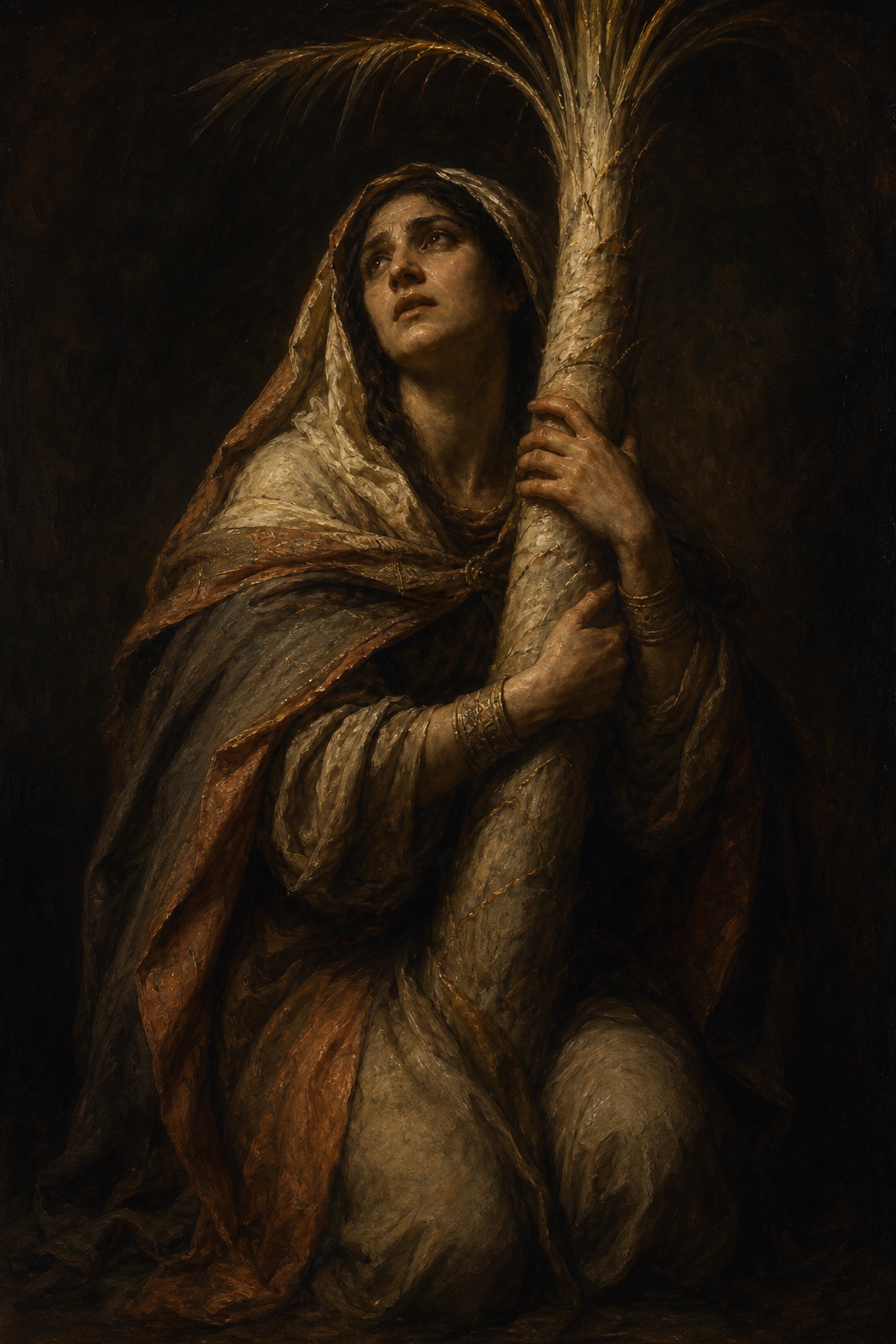
Leto’s myth is almost entirely one long refusal of hospitality. Pregnant by Zeus and pursued by Hera’s jealousy, she goes from land to land asking to be allowed to give birth, and land after land turns her away — not out of cruelty, the hymn is careful to say, but out of fear. Nobody wants to be the place that housed Hera’s grievance. The catalogue of refusals runs for dozens of lines, and its function is to make the eventual yes mean something.
Delos says yes because Delos has nothing. It is a bare rock, too poor to farm and too small to matter, and it strikes a bargain: it will take the risk if the child promises to build his temple there. That is the deal the whole hymn turns on, and it is unusually frank about the economics — a sanctuary is what a barren island has instead of soil.
ἀμφὶ δὲ φοίνικι βάλε πήχεε, γοῦνα δ’ ἔρεισε λειμῶνι μαλακῷ, μείδησε δὲ γαῖ’ ὑπένερθεν
“So she cast her arms about a palm tree and kneeled on the soft meadow while the earth laughed for joy beneath.” — Homeric Hymn 3, To Delian Apollo 117–118, tr. Evelyn-White
Nine days and nights of labour, and the birth itself takes half a line. What the hymn lingers on is the earth’s response — the ground laughing underneath her — because the point is not the pain but the reversal: the island that everyone thought worthless is the one that gets the god.
After that she effectively stops having a story of her own. She appears as an adjunct to her children, and specifically as the thing they avenge: Niobe boasts of having more children than Leto and loses all of them to Apollo’s and Artemis’s arrows; the giant Tityos assaults her and is pinned in the underworld with vultures at his liver. Both are punishments carried out by other people on her behalf. She is one of the few Olympian-adjacent figures whose power is entirely delegated.
The pattern is worth naming because it is not the usual one. Greek myth has plenty of mothers who are dangerous themselves — Gaia arming every challenger, Rhea smuggling out Zeus, Demeter starving the world until she gets Persephone back. Leto does none of that. She endures, and the endurance is converted into her children’s authority. Egypt tells a structurally similar story about Isis hiding in the marshes with the infant Horus, but Isis is the most capable magician in her pantheon and does her own rescuing. Leto simply keeps walking until someone lets her stop.