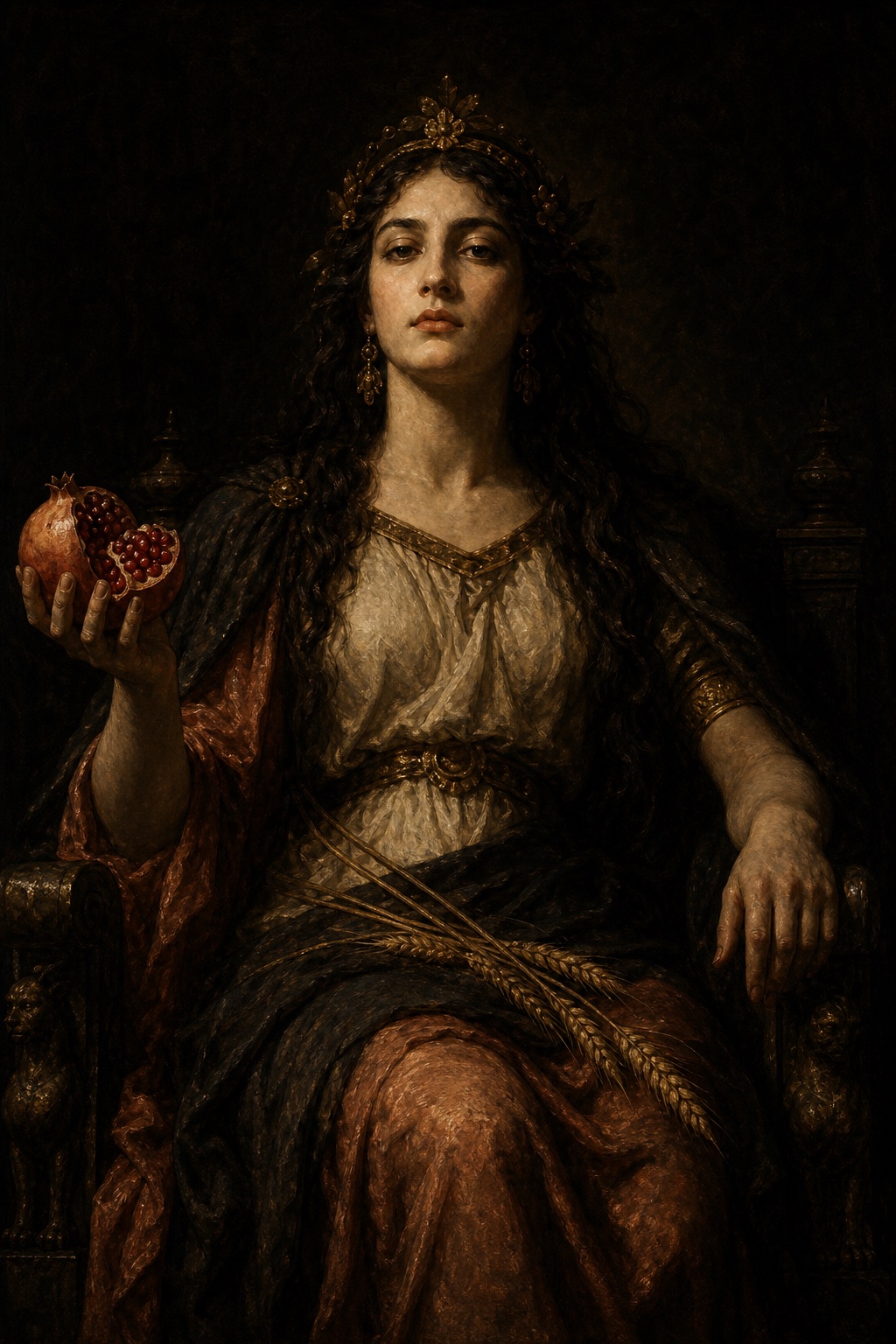
Persephone is the daughter of Zeus and Demeter, and her abduction is told at length in the Homeric Hymn to Demeter. She is gathering flowers in a soft meadow with the daughters of Oceanus when Earth, at Zeus’s prompting, grows a narcissus of extraordinary beauty as a snare; she reaches for it, the ground opens, and Hades comes up with his immortal horses and takes her below. Her mother hears the cry, searches nine days with torches, and finally withdraws her gift from the world until the grain will not come — which is what forces Zeus to negotiate.
The negotiation is undone by a technicality of underworld law. Hermes is sent to bring her back, Hades agrees, and then does one thing more.
ἔμβαλέ μοι ῥοιῆς κόκκον, μελιηδέ’ ἐδωδήν, ἄκουσαν δὲ βίῃ με προσηνάγκασσε πάσασθαι
“but he secretly put in my mouth sweet food, a pomegranate seed, and forced me to taste against my will.” — Homeric Hymn to Demeter 411–413, tr. Evelyn-White
Having eaten in the house of the dead, she belongs to it. The settlement divides her year: a third below with her husband, the rest above with her mother, and Demeter lets the earth bear again for as long as her daughter is with her. The Greeks read the corn’s disappearance and return in that arrangement, but the hymn is careful that the bargain is not a metaphor — it is a marriage contract enforced by what she swallowed.
What is striking is how completely she takes up the second role. In the Odyssey and the tragedies she is not a captive but dread Persephone, a queen with her own authority: she is the one Orpheus must persuade, the one who grants Sisyphus his return, the power that sends up the shades for Odysseus. The Greeks often avoided her name altogether and called her simply Kore, “the girl”, or Despoina, “the mistress” — the same goddess at two ends of the same story.