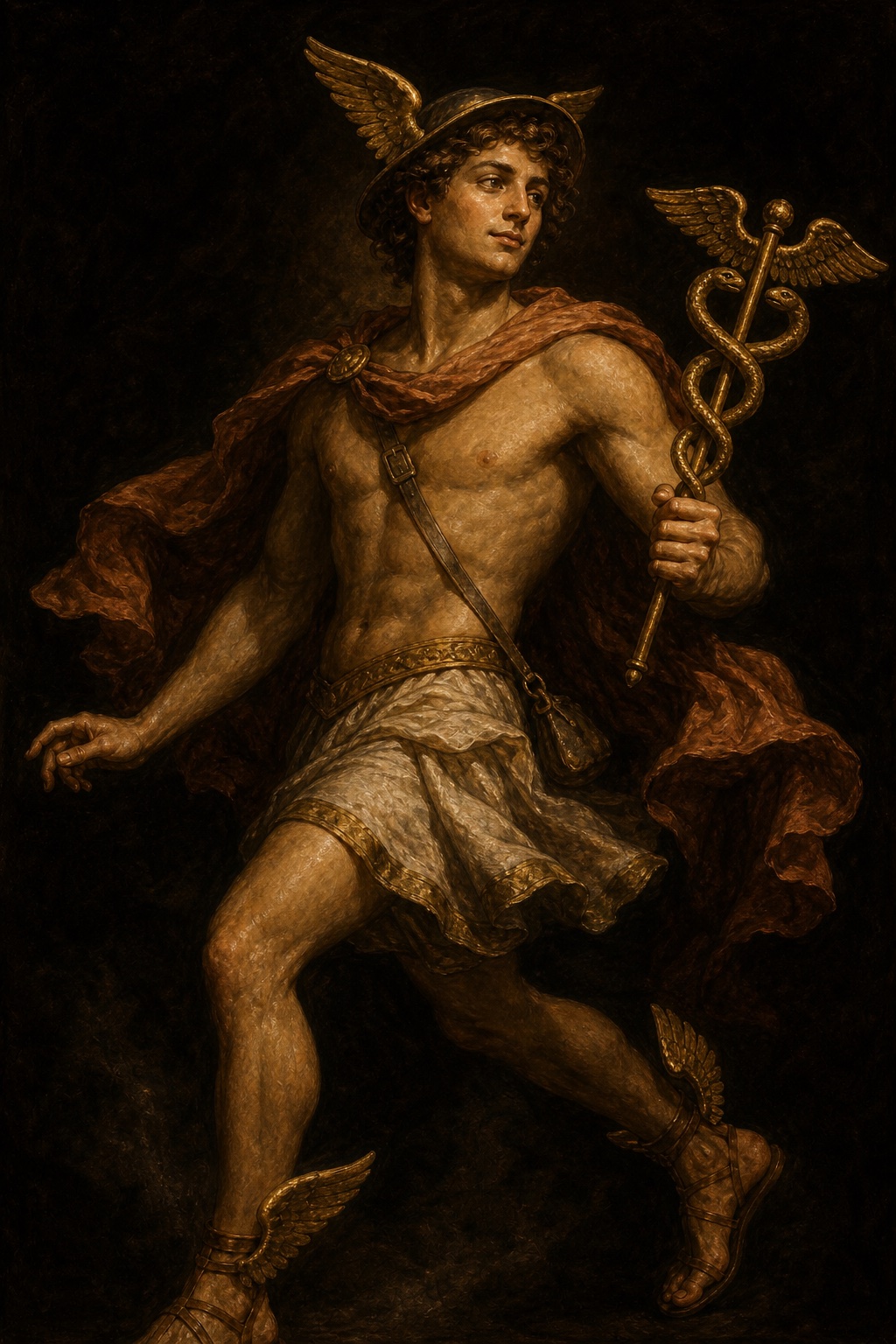
Hermes is the herald and messenger of the Olympians, born to Zeus and the nymph Maia in a cave on Mount Cyllene and precocious from his first hour: on the day of his birth he strings a lyre from a tortoise shell and steals Apollo’s sacred cattle, driving them backward to confuse his tracks. Quick talk settles the theft — he trades Apollo the lyre for the herd and a share of his brother’s prophetic skill, setting the pattern for a god who moves between rules rather than beneath them.
He carries the caduceus and wears winged sandals and a traveler’s cap, and his speed and cunning place him wherever boundaries need crossing: between gods and mortals as messenger, between city and road as patron of travelers, between buyer and seller as god of commerce, and between the living and the dead as the one psychopomp trusted to lead souls down to Hades. Stone herms mark roads and doorways under his protection, and thieves, merchants, and orators alike claim him as patron.
Ἑρμῆν ὕμνει Μοῦσα Διὸς καὶ Μαιάδος υἱόν, Κυλλήνης μεδέοντα καὶ Ἀρκαδίης πολυμήλου, ἄγγελον ἀθανάτων ἐριούνιον, ὃν τέκε Μαῖα νύμφη ἐϋπλόκαμος Διὸς ἐν φιλότητι μιγεῖσα
“Muse, sing of Hermes, the son of Zeus and Maia, lord of Cyllene and Arcadia rich in flocks, the luck-bringing messenger of the immortals whom Maia bare, the rich-tressed nymph, when she was joined in love with Zeus.” — Homeric Hymn 4, To Hermes 1–4, tr. H. G. Evelyn-White