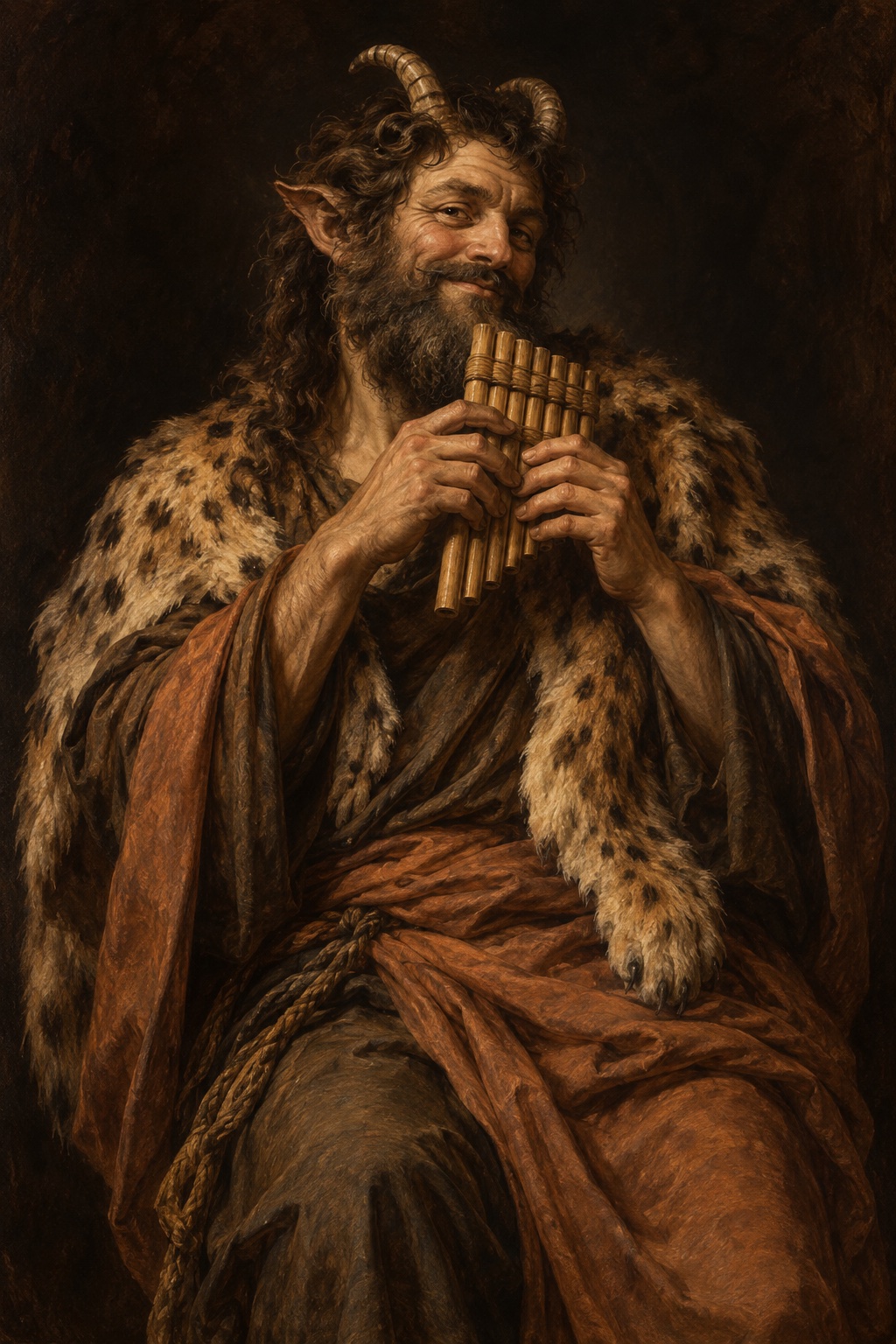
Goat-footed on the snowy crests
One short hymn carries nearly everything this wiki can say about Pan, and it opens by asking the Muse for him. The request is already a description. He is the dear son of Hermes; he has goat’s feet and two horns; he likes noise. He is not in a temple or a hall but out of doors, moving through wooded meadows with nymphs who dance, and the last thing the opening does is hand him his ground — every snowy crest, the peaks of the mountains, and the rocky ways between them — πετρήεντα κέλευθα, paths rather than peaks, which Evelyn-White renders as rocky crests.
Ἀμφί μοι Ἑρμείαο φίλον γόνον ἔννεπε Μοῦσα, αἰγιπόδην δικέρωτα φιλόκροτον ὅς τ’ ἀνὰ πίση δενδρήεντ’ ἄμυδις φοιτᾷ χορογηθέσι νύμφαις αἵ τε κατ’ αἰγίλιπος πέτρης στείβουσι κάρηνα Πᾶν’ ἀνακεκλόμεναι νόμιον θεὸν ἀγλαέθειρον αὐχμήενθ’, ὃς πάντα λόφον νιφόεντα λέλογχε καὶ κορυφὰς ὀρέων καὶ πετρήεντα κέλευθα.
“Muse, tell me about Pan, the dear son of Hermes, with his goat’s feet and two horns—a lover of merry noise. Through wooded glades he wanders with dancing nymphs who foot it on some sheer cliff’s edge, calling upon Pan, the shepherd-god, long-haired, unkempt. He has every snowy crest and the mountain peaks and rocky crests for his domain;” — Homeric Hymn 19, To Pan 1–7, tr. Evelyn-White
Two things in those lines set the terms for the rest. The first is that the poet does not introduce him alone. The nymphs are already calling him before the reader has seen him, and the word they call him by is νόμιον, of the pastures, which Evelyn-White renders as the shepherd-god. He arrives inside somebody else’s shout. The second is the verb λέλογχε, the ordinary Greek for holding something as an allotted portion: the high country is not where he happens to be, it is what he was given. And what he was given is cold and unploughed. Snow, bare rock and the paths between them are neither farmland nor city, and the only interiors the hymn ever puts him in are the house he is born in and the seats of the gods he is carried to.
The portrait finishes with two words most gods do not get. He is ἀγλαέθειρον αὐχμήενθ’ — long-haired and unkempt, in Evelyn-White’s English. Nothing in the poem tidies him up.
The hunt and the evening pipe
The middle of the hymn is a single day, and it divides in half at dusk. In the light he goes hither and thither through the close thickets, drawn for a while by soft streams, then presses on among towering crags and climbs to “the highest peak that overlooks the flocks” — μηλοσκόπον, the height from which sheep are watched. Then the hunting: he courses the glistening high mountains, and on the shouldered hills he speeds along “slaying wild beasts, this keen-eyed god”, ὀξέα δερκόμενος, seeing sharply. That is the first of this page’s two domains, and it comes from the hymn itself rather than from later tradition. The daylight half of Pan works ground too steep to farm, and works it as a predator.
The other half arrives with the evening, and only then. Not until he is coming back from the chase, the hymn says, does he sound his note, “playing sweet and low on his pipes of reed” — δονάκων, reeds. Then it does something for him that it does for nothing else it mentions: it sets him against a rival and gives him the win. Not even she could excel him in melody, it says, meaning the bird who in flower-laden spring pours out her lament and utters honey-voiced song amid the leaves. The poem never names her. It simply insists that the god with the goat’s feet out-sings her, and that is where this page’s second domain comes from.
The music brings company. The clear-voiced nymphs come and move with nimble feet, singing by some spring of dark water, and the mountain-top throws the sound back around them. He works the edge of their dancing, then slips into the middle of it and plies it nimbly with his feet. Here the hymn gives him his one garment — “a spotted lynx-pelt”, worn across the back — and his one soft place, a meadow where “crocuses and sweet-smelling hyacinths bloom at random in the grass”. Between the crag at noon and that meadow at evening lies the whole working day of the god, and the poem asks nothing of him in the course of it. Only at the very end does the singer turn and address him directly, hailing him as lord and seeking his favour with a song.
Born in the halls on Cyllene
The birth comes last, and the hymn reaches it through the nymphs’ own singing. They sing of the blessed gods and high Olympus, and of Hermes above all the rest — how he is the swift messenger of every god, and how he came to Arcadia, the land of many springs and mother of flocks, where his sacred place is as god of Cyllene. There, though a god himself, he tended curly-fleeced sheep in the service of a mortal man, because desire had come on him for the rich-tressed daughter of Dryops, νύμφῃ ἐϋπλοκάμῳ Δρύοπος. That phrase is all the mother this hymn has. She is a nymph, she has beautiful hair, and her father is Dryops. She is never given a name — not in this poem, and not in anything this entry can source — which is why the fields above record a father for Pan and no mother. There is no name to record.
τέκε δ’ ἐν μεγάροισιν Ἑρμείῃ φίλον υἱόν, ἄφαρ τερατωπὸν ἰδέσθαι, αἰγιπόδην δικέρωτα πολύκροτον ἡδυγέλωτα· φεῦγε δ’ ἀναί̈ξασα, λίπεν δ’ ἄρα παῖδα τιθήνη· δεῖσε γὰρ ὡς ἴδεν ὄψιν ἀμείλιχον ἠϋγένειον. τὸν δ’ αἶψ’ Ἑρμείας ἐριούνιος εἰς χέρα θῆκε δεξάμενος, χαῖρεν δὲ νόῳ περιώσια δαίμων. ῥίμφα δ’ ἐς ἀθανάτων ἕδρας κίε παῖδα καλύψας δέρμασιν ἐν πυκινοῖσιν ὀρεσκῴοιο λαγωοῦ πὰρ δὲ Ζηνὶ κάθιζε καὶ ἄλλοις ἀθανάτοισιν, δεῖξε δὲ κοῦρον ἑόν· πάντες δ’ ἄρα θυμὸν ἔτερφθεν ἀθάνατοι, περίαλλα δ’ ὁ Βάκχειος Διόνυσος· Πᾶνα δέ μιν καλέεσκον, ὅτι φρένα πᾶσιν ἔτερψε.
“And in the house she bare Hermes a dear son who from his birth was marvellous to look upon, with goat’s feet and two horns—a noisy, merry-laughing child. But when the nurse saw his uncouth face and full beard, she was afraid and sprang up and fled and left the child. Then luck-bringing Hermes received him and took him in his arms: very glad in his heart was the god. And he went quickly to the abodes of the deathless gods, carrying his son wrapped in warm skins of mountain hares, and set him down beside Zeus and showed him to the rest of the gods. Then all the immortals were glad in heart and Bacchic Dionysus in especial; and they called the boy Pan because he delighted all their hearts.” — Homeric Hymn 19, To Pan 35–47, tr. Evelyn-White
The child is τερατωπὸν ἰδέσθαι, marvellous — or monstrous — to look upon, from the first moment. The goat’s feet and the two horns are there at birth, and so, the hymn insists, is a full beard. That last detail is what makes the scene work, because the next thing that happens is that somebody runs. The τιθήνη, which Evelyn-White renders “the nurse”, sees his uncouth face and his full beard, is afraid, springs up, flees, and leaves the child where he lies.
Who she is, the hymn does not say, and this page will not decide it for her. A τιθήνη is a nurse, and the poem has just put a marriage, a house and a birth into the same few lines, so the word can be read as the mother herself in the act of nursing, or as a separate woman of the household whose work the newborn has just ended. Nothing in the Greek settles it. What the lines do settle is the reaction: the first person to look Pan in the face gets up and runs from him — which is the judgement the rest of the scene exists to overturn.
Named because he delighted them all
Hermes’ answer to the newborn is the exact opposite of the nurse’s, and the hymn sets the two one line apart. He receives the child, takes him in his arms, and is glad in his heart περιώσια, beyond measure. Then he covers him — δέρμασιν ἐν πυκινοῖσιν ὀρεσκῴοιο λαγωοῦ, in thick skins of a mountain hare — and goes quickly to the abodes of the deathless gods, sets him down beside Zeus, and shows him to the rest of them. The participle for the wrapping is καλύψας, having covered him: the face that sent the nurse out of the house is carried up hidden in fur, and then uncovered in front of every god there.
The verdict is unanimous. “Then all the immortals were glad in heart and Bacchic Dionysus in especial”, Evelyn-White has it, and out of that reaction the poem makes the name. The line is Πᾶνα δέ μιν καλέεσκον, ὅτι φρένα πᾶσιν ἔτερψε — they called him Pan because he delighted all their hearts. It is built as a pun: Πᾶνα is heard against πᾶσιν, “all”. The note in Evelyn-White’s edition says so outright, deriving the name from πάντες and pointing across to two other passages where a name is explained by its sound. One of them is already in this wiki. Hesiod names Pandora with the same construction — ὅτι πάντες, because all the Olympians gave her a gift. So what the hymn offers as the origin of the name is a joke about the effect a child had on a room, and this entry records it as the poem’s own wordplay rather than as a claim about where the word actually comes from.
Two lines later the hymn is over, and it is over in every sense. It gives Pan no consort, no child, no rite and no second episode, and it never takes him back down the mountain. Everything sourced on this page is either the portrait at the top of the poem or the birth at the bottom of it. The order is worth noticing, because it is deliberate: the poet shows the grown god holding his snowy crests first and the bearded newborn last, so that the name arrives only after the reader has seen everything it has to cover.