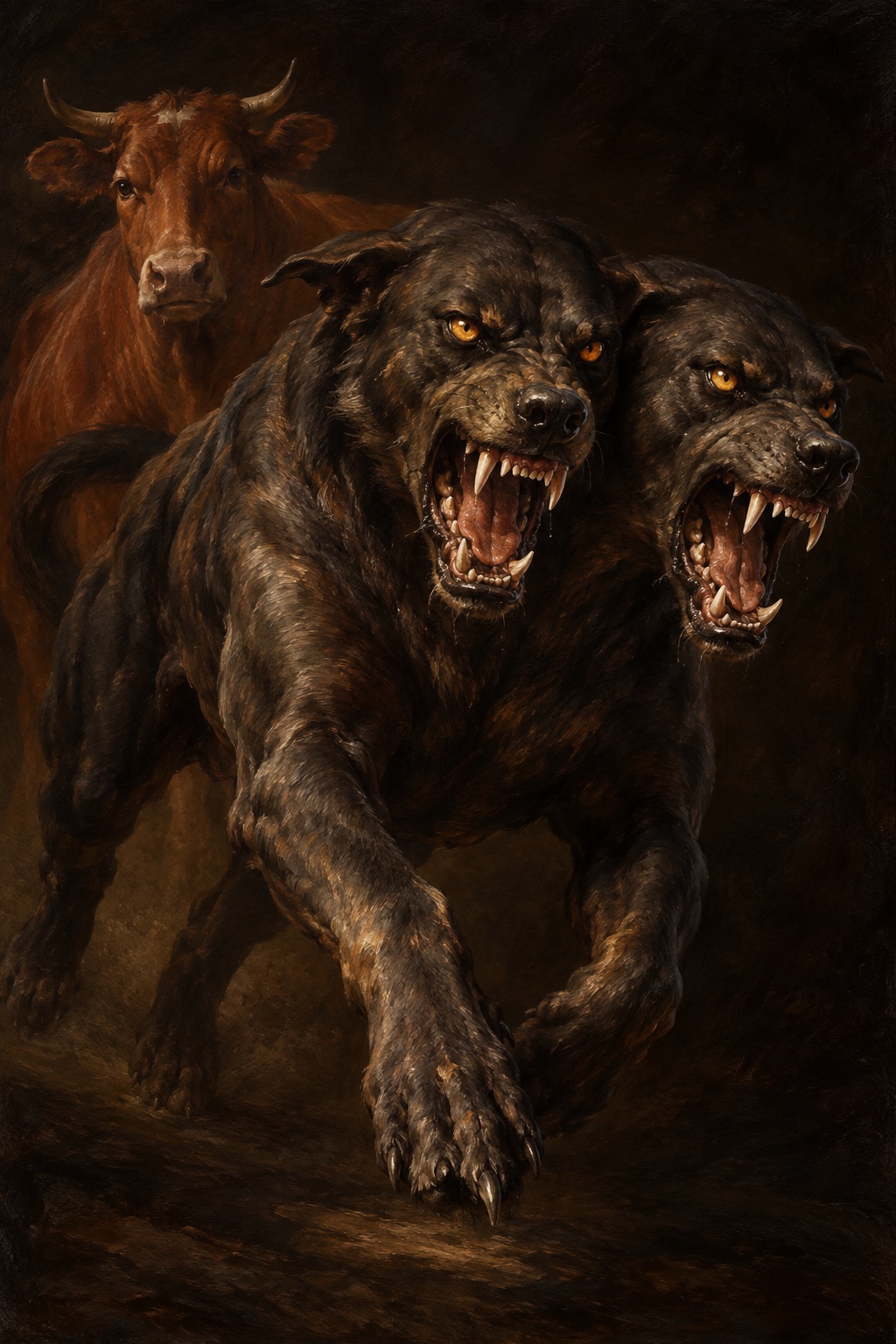
The first of Echidna’s children
Orthus is a dog, and in both of the ancient accounts that describe him he belongs to a master. Hesiod tells of his birth in the Theogony, in the list of the monsters that Echidna bore. The poem does not state the union as a fact. It reports it: Τυφάονά φασι, men say that Typhon, terrible, outrageous and lawless, lay in love with Echidna. Then it names the children in order, and Orthus comes first.
ἣ δ᾽ ὑποκυσαμένη τέκετο κρατερόφρονα τέκνα. Ὄρθον μὲν πρῶτον κύνα γείνατο Γηρυονῆι
“So she conceived and brought forth fierce offspring; first she bare Orthus the hound of Geryones” — Hesiod, Theogony 308–309, tr. Evelyn-White
The line gives Orthus two things before it gives him anything else: a place in the order of birth, πρῶτον, first, and a master. He is κύνα, a dog, and the dative Γηρυονῆι makes him Geryon’s dog from the moment he is born. Evelyn-White renders it the hound of Geryones. Hesiod tells nothing about the dog’s body in this line.
The list goes on. The second child is Cerberus, the brazen-voiced hound of Hades, and the third is the Hydra of Lerna, whom Hera raised in her anger against Heracles. So the two eldest children of Echidna are both hounds, and Hesiod names each of them by the master it serves, Geryon for the first and Hades for the second. He counts the heads of Cerberus, fifty of them, but he gives Orthus no head count at all. The poem has also already told of Orthus’s death. It comes a little earlier, in the passage on Geryon, so the dog dies in the Theogony before he is born.
Watchdog of the red cattle
Apollodorus gives Orthus a body and a task. In his account of the tenth labour, the fetching of Geryon’s cattle, he first sets the scene on Erytheia, an island near the Ocean that in his own day was called Gadira, and describes Geryon as three men grown into one body. Then he lists who looked after the herd.
εἶχε δὲ φοινικᾶς βόας, ὧν ἦν βουκόλος Εὐρυτίων, φύλαξ δὲ Ὄρθος ὁ κύων δικέφαλος ἐξ Ἐχίδνης καὶ Τυφῶνος γεγεννημένος
“He owned red kine, of which Eurytion was the herdsman and Orthus, the two-headed hound, begotten by Typhon on Echidna, was the watchdog” — Apollodorus, Bibliotheke 2.5.10, tr. J. G. Frazer
The sentence names the household in order: the red cattle, φοινικᾶς βόας, the herdsman Eurytion, and the guard. Apollodorus’s word for the guard is φύλαξ, and Frazer turns it into the watchdog. The parents are the same as in Hesiod, ἐξ Ἐχίδνης καὶ Τυφῶνος γεγεννημένος, born of Echidna and Typhon. Neither source gives Orthus any other role. He guards a herd that belongs to someone else, and the one deed that either source tells of him is the defence of that herd.
The body is one word, δικέφαλος, two-headed, and the word is Apollodorus’s alone. Hesiod counts heads elsewhere in the same stretch of the poem. His Geryon is τρικέφαλον, three-headed, and his Cerberus has fifty heads. But no line of the Theogony counts the heads of Orthus, so a picture of him with two heads follows Apollodorus. In Apollodorus’s version the master is three men joined in one body, and the dog has two heads.
Struck down on Erytheia
Heracles crosses the Ocean in a golden cup. Helios gave it to him in admiration, after Heracles, hot from the march, bent his bow at the god. On the island Orthus meets him before anyone else does.
καὶ παραγενόμενος εἰς Ἐρύθειαν ἐν ὄρει Ἄβαντι αὐλίζεται. αἰσθόμενος δὲ ὁ κύων ἐπ᾽ αὐτὸν ὥρμα· ὁ δὲ καὶ τοῦτον τῷ ῥοπάλῳ παίει, καὶ τὸν βουκόλον Εὐρυτίωνα τῷ κυνὶ βοηθοῦντα ἀπέκτεινε
“And having reached Erythia he lodged on Mount Abas. However the dog, perceiving him, rushed at him; but he smote it with his club, and when the herdsman Eurytion came to the help of the dog, Hercules killed him also” — Apollodorus, Bibliotheke 2.5.10, tr. J. G. Frazer
Heracles has only made camp on Mount Abas when the dog perceives him, αἰσθόμενος δὲ ὁ κύων, and charges. Eurytion comes only to help the dog, and Geryon does not come until later, when Menoetes, who pastures the cattle of Hades there, tells him what has happened. Heracles answers the charge with one blow of the club, τῷ ῥοπάλῳ παίει. The verb παίει means he strikes. Apollodorus keeps the verb of killing, ἀπέκτεινε, for Eurytion, and he says that the herdsman died τῷ κυνὶ βοηθοῦντα, while he was coming to help the dog. The dog’s own death is left to be understood from the story, and Frazer’s killed him also takes it that way.
Hesiod says outright that Orthus died. His eight lines on Geryon go straight from Geryon’s birth to Chrysaor and Callirrhoe to his death, and the death of the dog is part of the same sentence. Its first word, τὸν, him, stands for Geryon.
τὸν μὲν ἄρ᾽ ἐξενάριξε βίη Ἡρακληείη βουσὶ παρ᾽ εἰλιπόδεσσι περιῤῥύτῳ εἰν Ἐρυθείῃ ἤματι τῷ ὅτε περ βοῦς ἤλασεν εὐρυμετώπους Τίρυνθ᾽ εἰς ἱερὴν διαβὰς πόρον Ὠκεανοῖο Ὄρθον τε κτείνας καὶ βουκόλον Εὐρυτίωνα σταθμῷ ἐν ἠερόεντι πέρην κλυτοῦ Ὠκεανοῖο
“Him mighty Heracles slew in sea-girt Erythea by his shambling oxen on that day when he drove the wide-browed oxen to holy Tiryns, and had crossed the ford of Ocean and killed Orthus and Eurytion the herdsman in the dim stead out beyond glorious Ocean” — Hesiod, Theogony 289–294, tr. Evelyn-White
Here the verb is plain: Ὄρθον τε κτείνας, having killed Orthus. It is a participle, and it gives one of the things that Heracles had done before the main event. He had crossed the ford of Ocean and killed the dog and the herdsman, and on that day he killed Geryon and drove the oxen to holy Tiryns. Hesiod names no weapon, so the club comes from Apollodorus alone. He puts the killing σταθμῷ ἐν ἠερόεντι, in the dim stead out beyond the Ocean. On the order of the deaths the two accounts agree: the dog and the herdsman die first, and the master dies last. In both of them Orthus dies before Geryon has come into the fight.
Father of the Sphinx and the Nemean lion
Hesiod gives Orthus one more line, and in it he is a father. The line comes directly after the Chimera, the fire-breathing monster that Pegasus and Bellerophon killed.
ἣ δ᾽ ἄρα Φῖκ᾽ ὀλοὴν τέκε Καδμείοισιν ὄλεθρον Ὅρθῳ ὑποδμηθεῖσα Νεμειαῖόν τε λέοντα, τόν ῥ᾽ Ἥρη θρέψασα Διὸς κυδρὴ παράκοιτις γουνοῖσιν κατένασσε Νεμείης, πῆμ᾽ ἀνθρώποις
“Echidna was subject in love to Orthus and brought forth the deadly Sphinx which destroyed the Cadmeans, and the Nemean lion, which Hera, the good wife of Zeus, brought up and made to haunt the hills of Nemea, a plague to men” — Hesiod, Theogony 326–329, tr. Evelyn-White
The English names the mother, but the Greek does not. Hesiod’s line opens on a feminine pronoun, ἣ, she, and the name Echidna comes from Evelyn-White. The last female that the poem describes before this line is the Chimera, so the pronoun can point to her as well as to Echidna, and the line itself does not decide between them. The participle ὑποδμηθεῖσα, subdued, belongs to the mother, and Orthus is the one she was subject to. The Mythos Atlas reads the line as Evelyn-White does. On that reading Orthus fathers the Sphinx and the Nemean lion on his own mother, Echidna. On the other reading their mother is the Chimera.
Each of the two children gets its own phrase. The Sphinx is Καδμείοισιν ὄλεθρον, a ruin for the Cadmeans. The lion is the one that Hera raised and settled in the hills of Nemea as a plague to men. The lines after the quotation tell how the lion preyed on the people there and ruled over Tretus and Apesas, until the strength of Heracles overcame him. So in the Theogony the same hero brings down both Orthus and his son the lion.