Sent by Hera
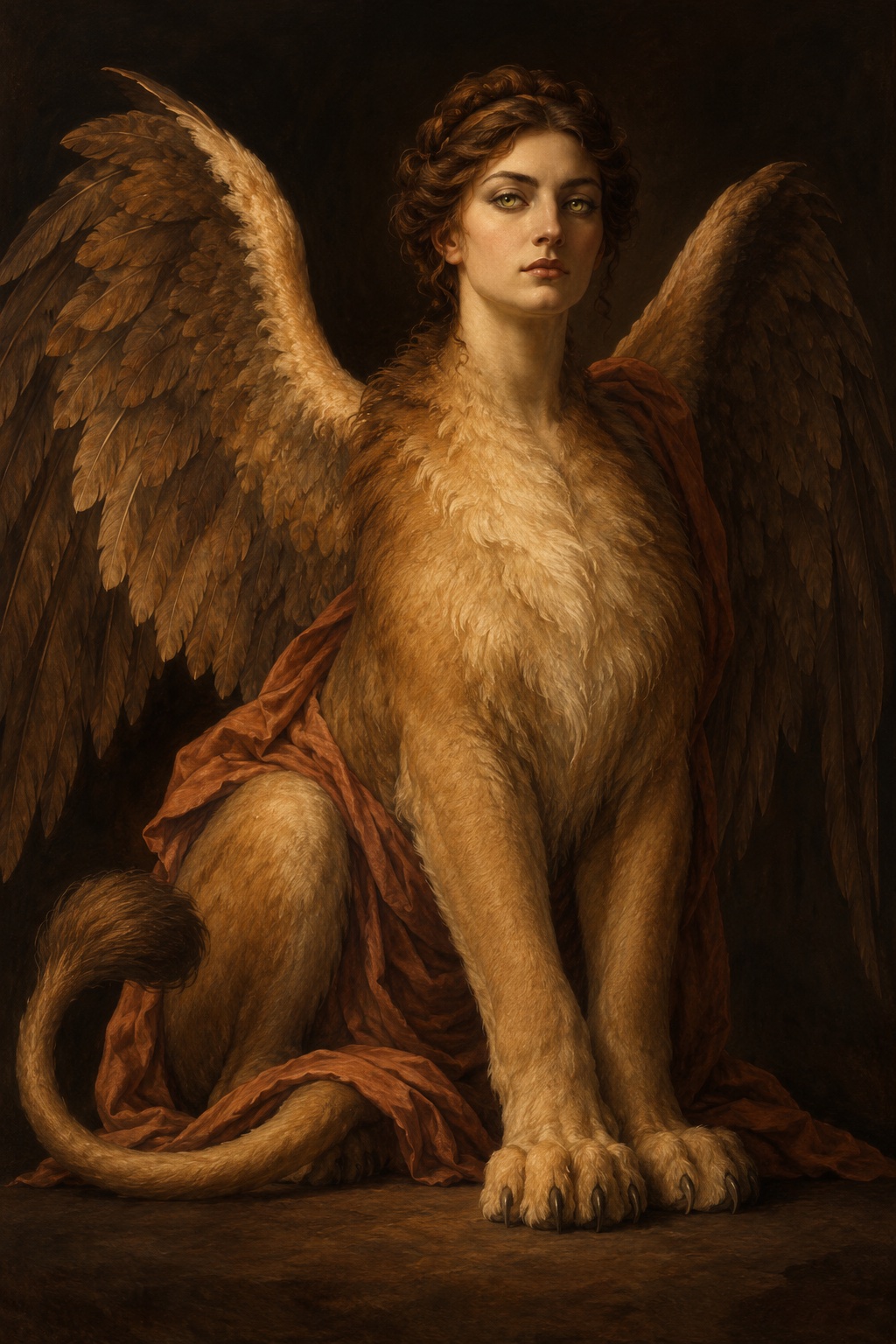
Apollodorus tells the whole story of the Sphinx in one passage of the Bibliotheke, at 3.5.8. Its first sentence says who sent her, who her parents were and what she looked like.
ἔπεμψε γὰρ Ἥρα Σφίγγα, ἣ μητρὸς μὲν Ἐχίδνης ἦν πατρὸς δὲ Τυφῶνος, εἶχε δὲ πρόσωπον μὲν γυναικός, στῆθος δὲ καὶ βάσιν καὶ οὐρὰν λέοντος καὶ πτέρυγας ὄρνιθος.
“For Hera sent the Sphinx, whose mother was Echidna and her father Typhon; and she had the face of a woman, the breast and feet and tail of a lion, and the wings of a bird.” — Apollodorus, Bibliotheke 3.5.8, tr. J. G. Frazer
The first words are ἔπεμψε γὰρ Ἥρα, For Hera sent. The Sphinx does not come to the Thebans by chance or by her own choice. She is sent, and the goddess who sends her is Hera. The passage gives Hera no motive. It names the sender, and then it goes straight to the Sphinx’s parents and her body.
The parents come in one clause. ἣ μητρὸς μὲν Ἐχίδνης ἦν πατρὸς δὲ Τυφῶνος: whose mother was Echidna and her father Typhon. Apollodorus names both of them plainly. Hesiod gives her a different father, Orthus, and his Greek does not name her mother at all. The last section of this entry reads his lines.
Then the body. εἶχε δὲ πρόσωπον μὲν γυναικός: she had the face of a woman. Everything else that Apollodorus names belongs to an animal. στῆθος δὲ καὶ βάσιν καὶ οὐρὰν λέοντος: the breast, the feet and the tail are a lion’s. πτέρυγας ὄρνιθος: the wings are a bird’s. He names three kinds, woman, lion and bird, and gives each one its parts. He tells nothing of her size, her colour or her voice. The word for her feet, βάσιν, means a step or a footing, and it comes back at the end of the passage in the answer to her riddle. This one sentence is her whole description in the two sources used here. Hesiod gives her one adjective and nothing more.
The riddle on Mount Phicium
The next sentences give her a riddle, set her in her place, and tell what she did to the Thebans who could not answer it.
μαθοῦσα δὲ αἴνιγμα παρὰ μουσῶν ἐπὶ τὸ Φίκιον ὄρος ἐκαθέζετο, καὶ τοῦτο προύτεινε Θηβαίοις. ἦν δὲ τὸ αἴνιγμα· τί ἐστιν ὃ μίαν ἔχον φωνὴν τετράπουν καὶ δίπουν καὶ τρίπουν γίνεται· χρησμοῦ δὲ Θηβαίοις ὑπάρχοντος τηνικαῦτα ἀπαλλαγήσεσθαι τῆς Σφιγγὸς ἡνίκα ἂν τὸ αἴνιγμα λύσωσι, συνιόντες εἰς ταὐτὸ πολλάκις ἐζήτουν τί τὸ λεγόμενόν ἐστιν, ἐπεὶ δὲ μὴ εὕρισκον, ἁρπάσασα ἕνα κατεβίβρωσκε.
“And having learned a riddle from the Muses, she sat on Mount Phicium, and propounded it to the Thebans. And the riddle was this: — What is that which has one voice and yet becomes four-footed and two-footed and three-footed? Now the Thebans were in possession of an oracle which declared that they should be rid of the Sphinx whenever they had read her riddle; so they often met and discussed the answer, and when they could not find it the Sphinx used to snatch away one of them and gobble him up.” — Apollodorus, Bibliotheke 3.5.8, tr. J. G. Frazer
The riddle is not her own. μαθοῦσα δὲ αἴνιγμα παρὰ μουσῶν: she learned it from the Muses. Apollodorus does not say how the Muses came to give it, or why. With the riddle she takes up a place. ἐπὶ τὸ Φίκιον ὄρος ἐκαθέζετο: she sat on Mount Phicium. The verb ἐκαθέζετο is one of sitting down and taking a seat. From that seat, καὶ τοῦτο προύτεινε Θηβαίοις, she propounded it to the Thebans. She puts the riddle to them as a people, and they look for the answer together.
The riddle itself is one question. τί ἐστιν ὃ μίαν ἔχον φωνὴν τετράπουν καὶ δίπουν καὶ τρίπουν γίνεται: what is it that has one voice and becomes four-footed and two-footed and three-footed? Frazer’s and yet has no word of its own in the Greek. The Greek says only ὃ μίαν ἔχον φωνὴν, which, having one voice, becomes. But the question does turn on that contrast. The voice stays one while the count of feet changes. The counts come as four, two and three, which is not the order of the numbers. The answer shows that it is the order of a life.
An oracle binds the Thebans to the riddle. χρησμοῦ δὲ Θηβαίοις ὑπάρχοντος: they had an oracle that they would be rid of the Sphinx ἡνίκα ἂν τὸ αἴνιγμα λύσωσι, when they solved the riddle. Frazer’s English is whenever they had read her riddle. The Greek verb, λύσωσι, means to loosen or to solve. It comes back twice at the end of the passage, in Creon’s proclamation and in the verb for what Oedipus does. The oracle gives the Thebans no other way out, so they meet. συνιόντες εἰς ταὐτὸ πολλάκις ἐζήτουν: they came together often and searched for what the words meant.
Each failure has a cost. ἐπεὶ δὲ μὴ εὕρισκον, ἁρπάσασα ἕνα κατεβίβρωσκε: when they did not find it, she snatched one of them and ate him. The number is exact, ἕνα, one. The verb κατεβίβρωσκε is in the imperfect tense, which here marks an act done again and again, and Frazer brings that out with used to snatch away one of them and gobble him up. In this account she does not kill at random. She kills when the Thebans fail to find the answer, and she takes one of them at a time.
The answer and the fall
The passage names only one of her victims, and he is the last of them. His death brings Creon into the story, and Creon’s offer brings the man who answers.
πολλῶν δὲ ἀπολομένων, καὶ τὸ τελευταῖον Αἵμονος τοῦ Κρέοντος, κηρύσσει Κρέων τῷ τὸ αἴνιγμα λύσοντι καὶ τὴν βασιλείαν καὶ τὴν Λαΐου δώσειν γυναῖκα. Οἰδίπους δὲ ἀκούσας ἔλυσεν, εἰπὼν τὸ αἴνιγμα τὸ ὑπὸ τῆς Σφιγγὸς λεγόμενον ἄνθρωπον εἶναι· γίνεσθαι, γὰρ τετράπουν βρέφος ὄντα τοῖς τέτταρσιν ὀχούμενον κώλοις, τελειούμενον δὲ δίπουν, γηρῶντα δὲ τρίτην προσλαμβάνειν βάσιν τὸ βάκτρον. ἡ μὲν οὖν Σφὶγξ ἀπὸ τῆς ἀκροπόλεως ἑαυτὴν ἔρριψεν
“When many had perished, and last of all Creon’s son Haemon, Creon made proclamation that to him who should read the riddle he would give both the kingdom and the wife of Laius. On hearing that, Oedipus found the solution, declaring that the riddle of the Sphinx referred to man; for as a babe he is four-footed, going on four limbs, as an adult he is two-footed, and as an old man he gets besides a third support in a staff. So the Sphinx threw herself from the citadel” — Apollodorus, Bibliotheke 3.5.8, tr. J. G. Frazer
πολλῶν δὲ ἀπολομένων: many had died, and the last of them was Αἵμονος τοῦ Κρέοντος, Haemon, the son of Creon. After that death Creon makes his proclamation. κηρύσσει Κρέων τῷ τὸ αἴνιγμα λύσοντι: to the one who solves the riddle he offers the kingdom and the wife of Laius. Here the verb of the oracle comes back. The answer that the Thebans looked for together now carries a reward, open to anyone who finds it. The passage says nothing more about the kingdom or about Laius.
Οἰδίπους δὲ ἀκούσας ἔλυσεν: Oedipus heard, and he solved it. His answer is one word, ἄνθρωπον, a human being, and Frazer writes that the riddle referred to man. Then Oedipus explains the three counts. As a baby a man goes on four limbs, τοῖς τέτταρσιν ὀχούμενον κώλοις. As an adult he goes on two. As an old man he takes a third, τρίτην προσλαμβάνειν βάσιν τὸ βάκτρον, and the third is the staff. The word for it is βάσιν, the same word that the first sentence used for the Sphinx’s lion feet. Frazer renders it feet there and support here. The explanation accounts for the feet only. It says nothing about the one voice.
ἡ μὲν οὖν Σφὶγξ ἀπὸ τῆς ἀκροπόλεως ἑαυτὴν ἔρριψεν: So the Sphinx threw herself from the citadel. Nobody kills her. Oedipus does not fight her. He answers the question, and the Sphinx ends her own life. The small word οὖν, so, makes the fall follow from the answer, and in this way the oracle comes true. Apollodorus gives no reason of her own for the leap. He also does not tell how she came from her seat on Mount Phicium to the citadel. This is the end of her story in Apollodorus, and neither source gives her a killer.
Hesiod’s Phix
Hesiod mentions the Sphinx in the Theogony, in the lines on the Nemean lion. She has only a few words there, and the lion has the rest.
The Greek opens on ἣ δ᾽ ἄρα, and she, and it does not say who she is. Then comes the Sphinx. Φῖκ᾽ ὀλοὴν τέκε Καδμείοισιν ὄλεθρον: she bore the deadly Phix, a ruin for the Cadmeans. Evelyn-White renders the lines Echidna was subject in love to Orthus and brought forth the deadly Sphinx which destroyed the Cadmeans. Three differences from Apollodorus are in these words.
The first is the name. Hesiod’s word is Φῖκ᾽, a form of the name Phix, cut short before the vowel of the next word. Apollodorus writes Σφίγγα and Σφὶγξ, and Evelyn-White’s English uses the name Sphinx for Hesiod’s Phix too. Hesiod’s Phix is close in sound to Apollodorus’s Φίκιον ὄρος, the mountain where she sits, but neither text links the two names.
The second is the parents. The mother is not in Hesiod’s Greek at all, and the name Echidna is Evelyn-White’s. Apollodorus supplies the mother outright, μητρὸς μὲν Ἐχίδνης, so this entry gives her Echidna for a mother on the strength of both. The father is different. Ὅρθῳ ὑποδμηθεῖσα: the mother was subject in love to Orthus. For Apollodorus the father is Typhon. The same Hesiodic line goes on to the second child of that union, Νεμειαῖόν τε λέοντα, the Nemean lion. In Hesiod, therefore, the Sphinx and the Nemean lion are born together, of one mother and one father.
The third is the victims. Hesiod gives the Sphinx no body and no deed of her own. He gives her one adjective, ὀλοὴν, deadly, and one purpose, Καδμείοισιν ὄλεθρον, a ruin for the Cadmeans. Evelyn-White turns the noun into a verb, which destroyed the Cadmeans. Apollodorus’s victims are the Thebans, and he tells how she destroyed them, one at a time.
Hera is in Hesiod’s lines too, but she does not belong to the Sphinx there. τόν ῥ᾽ Ἥρη θρέψασα: the pronoun is masculine, and it is the lion that Hera brought up. In Hesiod, Hera rears the lion. In Apollodorus, Hera sends the Sphinx. Hesiod has no riddle, no Muses, no Mount Phicium, no Oedipus and no fall from the citadel. All of those come from Apollodorus.