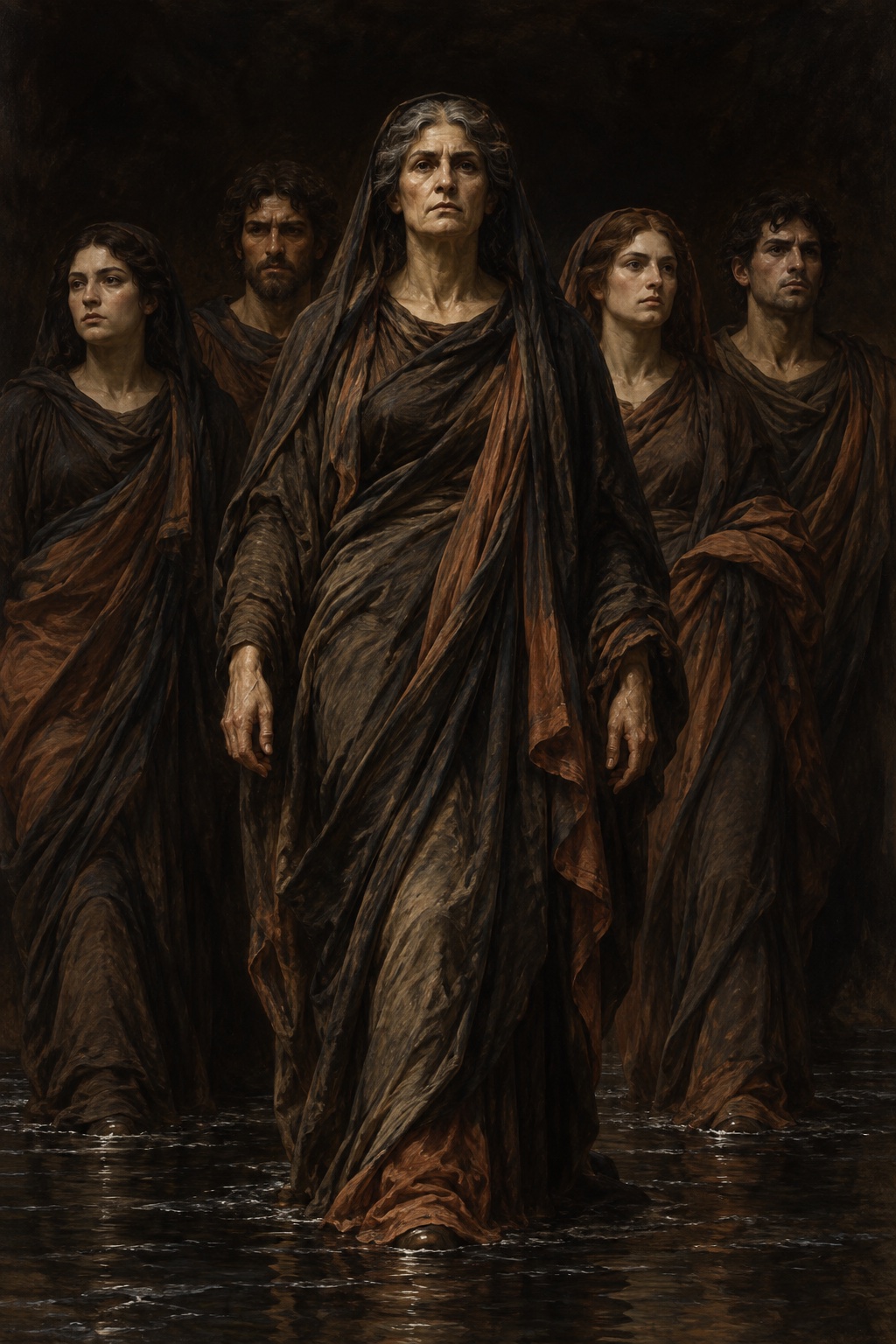
First to Olympus
The Theogony names her three times in twenty lines, and the last of them is the one that made her what she is. The Titan war has not yet been decided. Zeus calls the deathless gods to Olympus and promises office to whoever fights beside him against the Titans: whoever was without office or right under Cronus will be raised to both, as is just. It is a recruiting speech, and it is aimed at gods who have so far had nothing. The first answer to it does not come from any of the great Olympians.
ἦλθε δ᾽ ἄρα πρώτη Στὺξ ἄφθιτος Οὔλυμπόνδε σὺν σφοῖσιν παίδεσσι φίλου διὰ μήδεα πατρός. τὴν δὲ Ζεὺς τίμησε, περισσὰ δὲ δῶρα ἔδωκεν. αὐτὴν μὲν γὰρ ἔθηκε θεῶν μέγαν ἔμμεναι ὅρκον, παῖδας δ᾽ ἤματα πάντα ἕο μεταναιέτας εἶναι. ὣς δ᾽ αὔτως πάντεσσι διαμπερές, ὥς περ ὑπέστη, ἐξετέλεσσ᾽· αὐτὸς δὲ μέγα κρατεῖ ἠδὲ ἀνάσσει.
“So deathless Styx came first to Olympus with her children through the wit of her dear father. And Zeus honoured her, and gave her very great gifts, for her he appointed to be the great oath of the gods, and her children to live with him always. And as he promised, so he performed fully unto them all. But he himself mightily reigns and rules.” — Hesiod, Theogony 397–403, tr. Evelyn-White
Four things in those seven lines carry the whole page. She comes πρώτη, first, ahead of every other god who would eventually take Zeus’s side. She does not come alone; she brings her four children with her. She comes on advice, διὰ μήδεα πατρός, through the wit of her dear father, which makes Oceanus the one who read the war correctly and sent his daughter to the winning side before there was a winner. And she is paid. Zeus honoured her and gave her περισσὰ δὲ δῶρα, very great gifts, and Hesiod itemises exactly two of them: her children are to live with Zeus always, and she herself is appointed θεῶν μέγαν ἔμμεναι ὅρκον, to be the great oath of the gods.
That last phrase is stranger than it looks in English, and it is worth reading slowly. Zeus does not make her the guardian of oaths, or the witness of them, or their punisher. He makes her the oath. From this moment on, the most binding thing any god can say is her name and her water, and every later Styx-oath in Greek poetry is a draft drawn on this one grant. Nothing in the passage makes her Zeus’s servant either. The grammar runs the other way: he is the giver, she is the honoured, and the transaction closes with the line that he himself mightily reigns and rules. She got what she came for, and so did he.
Emulation, Victory, Strength and Force
The earlier introduction, fourteen lines before, is a genealogy rather than an act, and it explains why her arrival on Olympus was worth so much. Hesiod places her in the catalogue of the Oceanids, the daughters of Oceanus and Tethys — Clymene, Eurynome, Metis and the rest — and later calls her the eldest of them. Then he gives her a husband and four children. The husband is Pallas, a Titan, the son of Crius; he shares a name with an epithet of a far better-known goddess, and the two have nothing to do with each other.
Στὺξ δ᾽ ἔτεκ᾽ Ὠκεανοῦ θυγάτηρ Πάλλαντι μιγεῖσα Ζῆλον καὶ Νίκην καλλίσφυρον ἐν μεγάροισιν· καὶ Κράτος ἠδὲ Βίην ἀριδείκετα γείνατο τέκνα, τῶν οὐκ ἔστ᾽ ἀπάνευθε Διὸς δόμος, οὐδέ τις ἕδρη, οὐδ᾽ ὁδός, ὅππη μὴ κείνοις θεὸς ἡγεμονεύῃ, ἀλλ᾽ αἰεὶ πὰρ Ζηνὶ βαρυκτύπῳ ἑδριόωνται.
“And Styx the daughter of Ocean was joined to Pallas and bare Zelus (Emulation) and trim-ankled Nike (Victory) in the house. Also she brought forth Cratos (Strength) and Bia (Force), wonderful children. These have no house apart from Zeus, nor any dwelling nor path except that wherein God leads them, but they dwell always with Zeus the loud-thunderer.” — Hesiod, Theogony 383–388, tr. Evelyn-White
Her children are Emulation, Victory, Strength and Force. They are not a family so much as a description of what winning is made of, and a god at war would want all four of them on his side. Read in that order, the two passages stop being a genealogy and a reward and become one transaction. Styx did not arrive on Olympus as a petitioner. She arrived with Victory and Force behind her, before the fighting started, and the terms she was given were that the four would never be separated from Zeus again: no house apart from him, no seat, no road except where he leads them.
Hesiod says this of them at 383–388, before the war, and Zeus confirms it at 401 as part of her payment, which is the poem agreeing with itself rather than repeating itself. The one physical detail in the passage belongs to the second child: Nike is καλλίσφυρον, trim-ankled. She has no wings here. The wings are a later convention of art, and nothing in Hesiod puts them on her.
The house on silver pillars
Much later the poem comes back to Styx, in the part that describes what lies under the earth, and this is where she actually lives. She lives apart from the gods, Hesiod says, in a glorious house vaulted over with great rocks and propped up to heaven all round with silver pillars. Rarely does the daughter of Thaumas, swift-footed Iris, come to her with a message over the sea’s wide back. The rarity is the point. The great oath of the gods is kept a long way from Olympus, in a house no one visits unless something has gone badly wrong.
Something going badly wrong is the rest of the passage. When strife and quarrel arise among the deathless gods, and when one of those who live in the house of Olympus lies, Zeus sends Iris to bring the great oath of the gods from far away in a golden jug — the famous cold water which trickles down from a high and beetling rock. Note whose hands the jug is in. It is Iris who carries it, on Zeus’s errand, and the jug is her instrument and not Styx’s. Styx holds nothing in this scene and says nothing. She is the water.
Hesiod is precise about where that water comes from. Far under the wide-pathed earth a branch of Oceanus flows through the dark night out of the holy stream, and a tenth part of his water is allotted to her. With nine silver-swirling streams her father winds about the earth and the sea’s wide back and then falls into the main, but the tenth flows out from a rock, and that tenth is a sore trouble to the gods. Her share of Oceanus is the one tenth that does not return to the sea, and it is the dangerous one. This is also where two of this page’s three domains come from: the sea, because she is her father’s daughter and one of his Oceanids, and the underworld, because the tenth part of him that is hers runs under the earth in the dark.
What a false oath costs
The third domain is justice, and Hesiod spells out the mechanism with the precision of a statute. Whoever of the deathless gods that hold the peaks of snowy Olympus pours a libation of her water and is forsworn lies breathless until a full year is completed. He never comes near to taste ambrosia and nectar. He lies spiritless and voiceless on a strewn bed, and a heavy trance overshadows him. When he has spent that long year in his sickness, another penance and a harder one follows the first: for nine years he is cut off from the eternal gods and never joins their councils or their feasts, nine full years. In the tenth year he comes again to join them.
No one administers this. There is no trial, no accuser and no judge in the passage — only a god who poured the water, swore falsely, and now cannot breathe. That is what it means to be made the oath rather than its guardian. The penalty is not a punishment Styx decides to inflict; it is what her water does to a liar, and it costs a god ten years of everything that makes him a god: speech, movement, the food of the immortals, and the company of the others.
The Iliad shows the rule working from the other end, in a scene where Styx never appears. Hypnos has been asked by Hera to put Zeus to sleep, and he has been burned once already for doing her a favour of that kind. He will not move for a golden throne. He moves for a promised wife, and even then he refuses to take Hera’s word for it: he tells her exactly how to swear, by the Στυγὸς ὕδωρ, the water of Styx, with one hand on the earth and the other on the sea, calling the gods below with Cronus to witness. Hera swears as he tells her, and only then does the plan go forward. The whole of that bargain rests on a grant made in the Theogony, to a goddess who is not in the room and has no idea it is being used.
The texts give her almost nothing to look at. They do not describe her face, her age or her clothing, and Zeus’s very great gifts are never itemised beyond the two Hesiod names, so there is no object in her hands at the moment of her greatest honour. What the poem does give is a rank and a posture. She is ἄφθιτος, deathless, and at 776 Evelyn-White calls her terrible Styx, eldest daughter of back-flowing Ocean — an elder, not a young nymph. The one picture in the sources is the arrival itself: five figures coming up to Olympus ahead of everyone else, a mother and four children, on her father’s advice. The dark robes and the leaning urn of later art are convention, and the silver pillars and the beetling rock are her house, not her body.