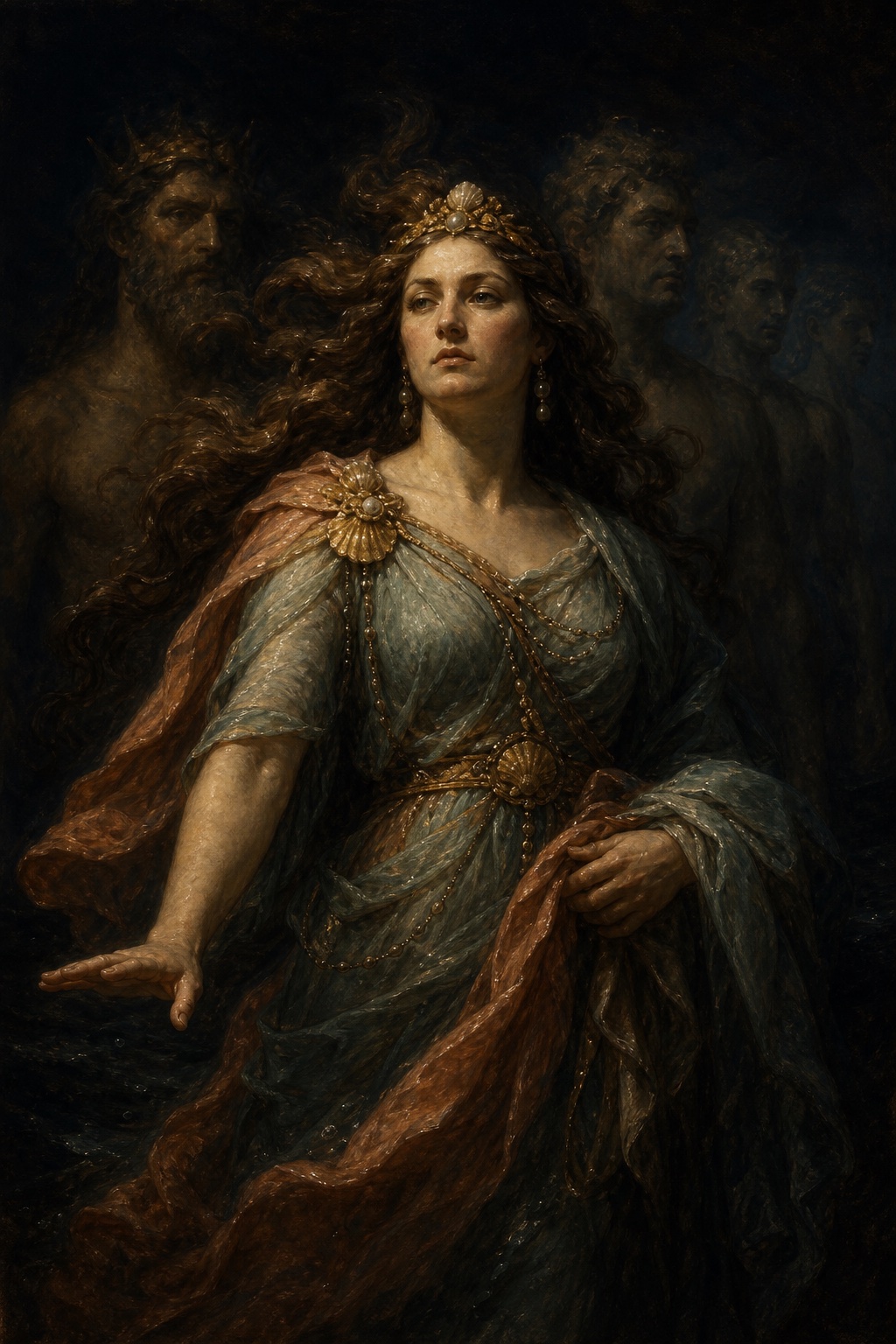
One of three thousand
Clymene enters the Theogony in a crowd. Tethys bears to Oceanus first the rivers of the world and then a second brood, and Hesiod pauses before naming any of them to say what the daughters are for.
τίκτε δὲ θυγατέρων ἱερὸν γένος, αἳ κατὰ γαῖαν ἄνδρας κουρίζουσι σὺν Ἀπόλλωνι ἄνακτι καὶ Ποταμοῖς, ταύτην δὲ Διὸς πάρα μοῖραν ἔχουσι
“Also she brought forth a holy company of daughters who with the lord Apollo and the Rivers have youths in their keeping — to this charge Zeus appointed them” — Hesiod, Theogony 346–348, tr. Evelyn-White
The verb is κουρίζω, to rear a boy to manhood, and it gives the Oceanids a job rather than a genealogy: they bring the young through to adulthood, sharing the work with Apollo and with their own brothers the rivers. It is one of the very few functions the Theogony assigns to a whole class of goddesses at once, and it is assigned by Zeus, which places it on the same footing as the honours he hands out to the great Olympians.
Then Hesiod runs through several dozen of them by name — Peitho, Admete, Ianthe, Electra, Doris, Prymno, Urania, Hippo, and on down a list that includes Asia and a Calypso whom Hesiod never calls the daughter of Atlas — before admitting that there are three thousand in all. Clymene is the ninth name in it, between Hippo and Rhodea, with nothing said about her that is not said about all of them.
The marriage that matters
Some hundred and fifty lines later she is picked out of the crowd for the only episode the earliest tradition gives her.
Κούρην δ᾽ Ἰαπετὸς καλλίσφυρον Ὠκεανίνην ἠγάγετο Κλυμένην καὶ ὁμὸν λέχος εἰσανέβαινεν
“Now Iapetus took to wife the neat-ankled maid Clymene, daughter of Ocean, and went up with her into one bed” — Hesiod, Theogony 507–508, tr. Evelyn-White
Two lines, and the entire Iapetid line follows from them: Atlas, who holds the sky; Menoetius, blasted for presumption; Prometheus, who steals fire; Epimetheus, who takes the gift. It is arguably the most consequential marriage in the poem after Zeus’s own, and the bride is characterized by exactly one adjective — καλλίσφυρος, fair-ankled, a stock epithet of women in epic that tells a reader nothing about her at all.
A name with almost nothing attached
What survives of Clymene is a function shared with three thousand sisters and a marriage recorded in two lines. She does not speak, act, intervene on behalf of her sons, or appear at any later point in Hesiod. When Prometheus is chained and Atlas is set under the sky, their mother is not mentioned; the Theogony deals with the sons as their father’s, and Iapetus is the name they are called by.
That thinness is itself worth recording rather than filling in. The name is common enough in Greek myth to attach to more than one figure — a later and quite separate tradition gives it to the mother of Phaethon by the Sun — and the temptation with a bare name in an old catalogue is always to lend it a story from somewhere else. What the earliest source actually supports is smaller and stranger: a goddess whose only attested acts are helping to raise the young of the world, and bearing four sons who between them account for most of what mortals had to endure.