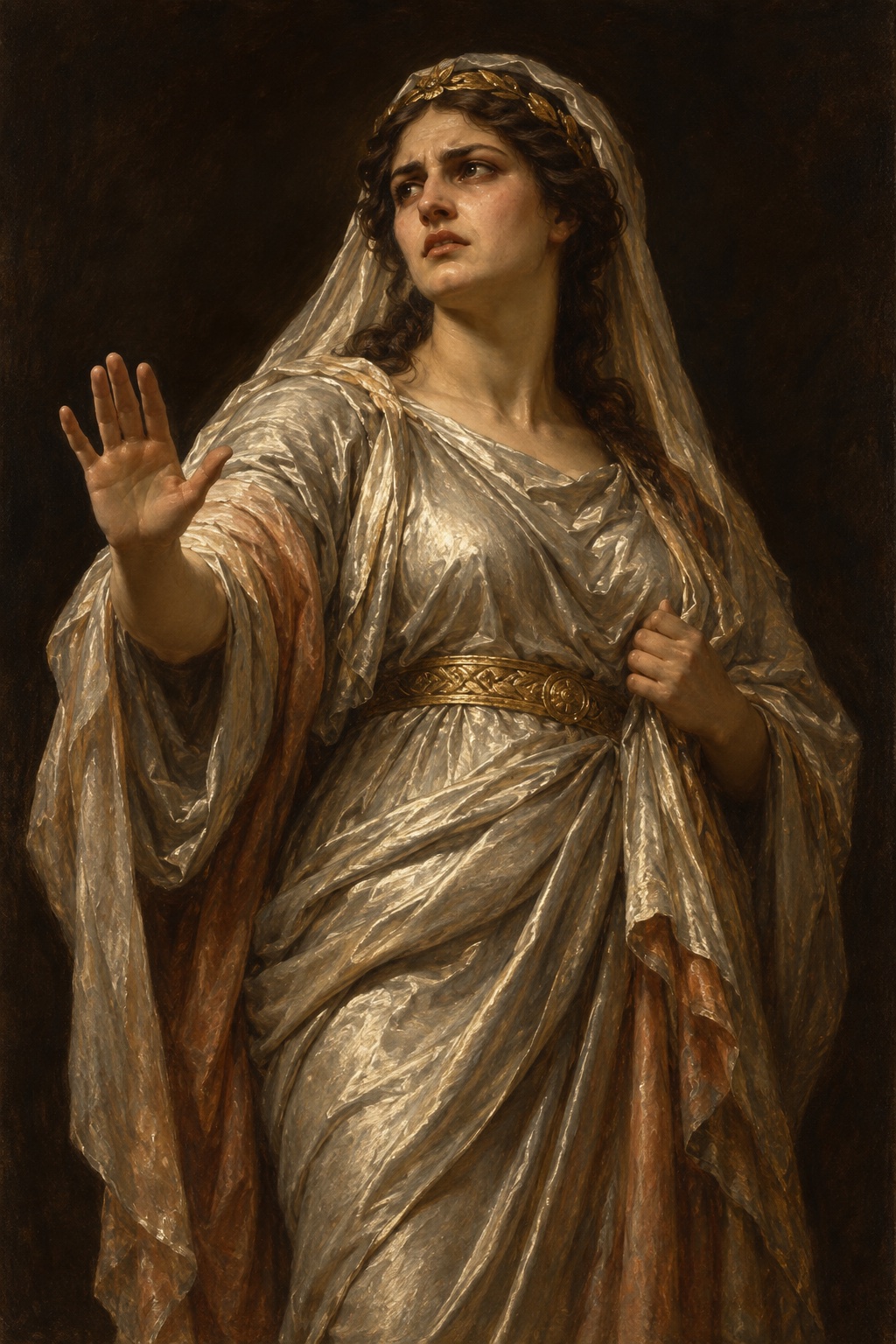
The daughter of Atlas
The Odyssey names her before it shows her. In the assembly of the gods in the first book, Athena raises the case of a man kept far off on an island, in the halls of a goddess whom Homer identifies in one phrase and one relation: the daughter of Atlas of baneful mind, the Titan who knows the depths of every sea and himself holds the tall pillars that keep earth and heaven apart. That is the whole of her ancestry in the poem. One father, no mother, no sister, no city. She is placed by whose daughter she is and by how far out she lives, and both halves of that placement point at the same thing — deep water, and a long way across it.
Book five arrives at the island and finds a stalemate rather than a captivity. Odysseus sits out the days on the rocks and the beaches looking at the barren sea and weeping, and spends the nights in the hollow caves; the phrase Homer gives the arrangement is four words long, παρ’ οὐκ ἐθέλων ἐθελούσῃ — beside her, he unwilling, she willing. This wiki records no relation between the two of them for exactly that reason. He is not her husband, she has not taken him prisoner, and there is no key in the vocabulary for a bed that one party wants and the other does not.
Cruel are ye, O ye gods
Zeus rules in the fifth book that the man is to go home, and sends Hermes across the water with the order. Calypso hears him out, shudders, and answers. What she says first is not about Odysseus at all.
σχέτλιοί ἐστε, θεοί, ζηλήμονες ἔξοχον ἄλλων, οἵ τε θεαῖσ’ ἀγάασθε παρ’ ἀνδράσιν εὐνάζεσθαι ἀμφαδίην, ἤν τίς τε φίλον ποιήσετ’ ἀκοίτην. ὣς μὲν ὅτ’ Ὠρίων’ ἕλετο ῥοδοδάκτυλος Ἠώς, τόφρα οἱ ἠγάασθε θεοὶ ῥεῖα ζώοντες, ἕως μιν ἐν Ὀρτυγίῃ χρυσόθρονος Ἄρτεμις ἁγνὴ οἷσ’ ἀγανοῖσι βέλεσσιν ἐποιχομένη κατέπεφνεν. ὣς δ’ ὁπότ’ Ἰασίωνι ἐϋπλόκαμος Δημήτηρ, ᾧ θυμῷ εἴξασα, μίγη φιλότητι καὶ εὐνῇ νειῷ ἔνι τριπόλῳ· οὐδὲ δὴν ἦεν ἄπυστος Ζεύς, ὅς μιν κατέπεφνε βαλὼν ἀργῆτι κεραυνῷ. ὣς δ’ αὖ νῦν μοι ἄγασθε, θεοί, βροτὸν ἄνδρα παρεῖναι
“Cruel are ye, O ye gods, and quick to envy above all others, seeing that ye begrudge goddesses that they should mate with men openly, if any takes a mortal as her dear bed-fellow. Thus, when rosy-fingered Dawn took to herself Orion, ye gods that live at ease begrudged her, till in Ortygia chaste Artemis of the golden throne assailed him with her gentle shafts and slew him. Thus too, when fair-tressed Demeter, yielding to her passion, lay in love with Iasion in the thrice-ploughed fallow land, Zeus was not long without knowledge thereof, but smote him with his bright thunder-bolt and slew him. And even so again do ye now begrudge me, O ye gods, that a mortal man should abide with me.” — Homer, Odyssey 5.118–129, tr. Murray
It is an argument, built the way an argument is built, and it does not begin with her feelings. It begins with a rule she says the gods enforce in one direction only: goddesses may not take mortal men ἀμφαδίην, openly, in the daylight, as an acknowledged thing. Then two precedents, chosen because they are the same case twice. Eos took Orion and Artemis shot him. Demeter lay with Iasion in a thrice-ploughed field and Zeus killed him with a thunderbolt. Both times the goddess is untouched and the man is dead, which is the point: the punishment for a goddess’s love falls on the mortal, so a divine lover is a sentence passed on the person she chose. Only in the last line does she reach her own case, and she puts it in the same grammar as the other two — you begrudge me, again, that a mortal man should be here.
The complaint is not that she is being disobeyed. She never argues that Zeus is wrong or that she can refuse him, and a few lines later she concedes outright that no god can evade or make void the will of Zeus. What she disputes is the fairness of the standard, and she raises it in front of Hermes, who is only the courier, because there is nobody else on the island to raise it with. It is also, on the evidence of the poem, true. A god who takes a mortal woman is not made to pay for it; her two counter-examples are the shape the reverse case takes every time.
Not inferior in form or stature
She gives way that same day and tells Odysseus he may go. He does not believe her. He will not set foot on a raft, he says, unless she swears a mighty oath not to plot any fresh mischief against him — and her answer to that is the most disarming thing she does in the book. She smiles, strokes him with her hand, tells him he is a knave and not stunted in wit to have thought of such a thing, and then swears the oath anyway, by earth and the broad heaven and the down-flowing water of Styx. He gets his tools the next morning and the raft is finished on the fourth day. Between the oath and the timber there is a meal. She sets out for him the food that mortal men eat, sits down facing him while her handmaids set ambrosia and nectar in front of her, and waits until they have both had their fill. Then she speaks first.
διογενὲς Λαερτιάδη, πολυμήχαν’ Ὀδυσσεῦ, οὕτω δὴ οἶκόνδε φίλην ἐς πατρίδα γαῖαν αὐτίκα νῦν ἐθέλεις ἰέναι; σὺ δὲ χαῖρε καὶ ἔμπης. εἴ γε μὲν εἰδείης σῇσι φρεσίν, ὅσσα τοι αἶσα κήδε’ ἀναπλῆσαι, πρὶν πατρίδα γαῖαν ἱκέσθαι, ἐνθάδε κ’ αὖθι μένων σὺν ἐμοὶ τόδε δῶμα φυλάσσοις ἀθάνατός τ’ εἴης, ἱμειρόμενός περ ἰδέσθαι σὴν ἄλοχον, τῆς τ’ αἰὲν ἐέλδεαι ἤματα πάντα. οὐ μέν θην κείνης γε χερείων εὔχομαι εἶναι, οὐ δέμας οὐδὲ φυήν, ἐπεὶ οὔ πως οὐδὲ ἔοικε θνητὰς ἀθανάτῃσι δέμας καὶ εἶδος ἐρίζειν
“Son of Laertes, sprung from Zeus, Odysseus of many devices, would’st thou then fare now forthwith home to thy dear native land! Yet, even so fare thee well. Howbeit if in thy heart thou knewest all the measure of woe it is thy fate to fulfil before thou comest to thy native land thou wouldest abide here and keep this house with me, and wouldest be immortal, for all thy desire to see thy wife for whom thou longest day by day. Surely not inferior to her do I declare myself to be either in form or stature, for in no wise is it seemly that mortal women should vie with immortals in form or comeliness.” — Homer, Odyssey 5.203–213, tr. Murray
It opens with the poem’s full formal address for him — son of Laertes, sprung from Zeus, man of many devices — and then, in the same breath, lets him go: fare thee well. Everything after that is offered from a position she has already surrendered. She does not threaten, bargain, or delay. She tells him what she knows and he does not, which is how much suffering stands between this beach and Ithaca, and she offers the one thing that would make the suffering irrelevant: stay here, keep this house with me, and be ἀθάνατος, deathless. It is the largest gift anyone offers Odysseus in the poem, and it is made after the refusal is already certain.
Then the comparison, and it is the weakest part of the speech because it is the only part that is about her. She does not name Penelope — the wife stays that woman, the one he longs after every day — and the claim she makes is careful and general: mortal women cannot contend with immortals in body or in looks, so she cannot be the lesser of the two. It is a true statement of the rule and a bad reading of the man, and one line of narration later he tells her so, gently, agreeing with every word of it and going anyway. His answer is on this wiki’s entry for Odysseus and belongs there; what belongs here is the speech it answers. Read in that order the two pages hold one exchange between them, her offer and then his reply, the way the poem has it.
The loom, the veil, and the axe
Homer is unusually specific about what her hands are doing. When Hermes reaches the cave he hears her before he sees her, singing with a sweet voice as she goes to and fro before the loom, weaving with a golden shuttle. On the morning of the departure she dresses: a great robe, silvery and fine and graceful, a beautiful golden girdle at her waist, and on her head a καλύπτρην, a veil. Then she puts a great bronze axe in his hands, sharpened on both sides and fitted with a haft of olive wood, and after it a polished adze, and leads him to the edge of the island where the tall dry timber stands. On the fifth day she bathes him, clothes him in fragrant raiment, and stows the stores aboard herself: a skin of dark wine, a second and greater one of water, provisions in a wallet.
That inventory is the argument of this page in miniature. Every object in it is something she hands over. The loom is the only one she keeps, and the last thing the poem records her doing for him is sending out a gentle warm wind behind the raft.
The veil is worth one line, carefully phrased. Καλυψώ is built on the same root as καλύπτω, to cover or conceal, and the word Homer chooses for the head-covering she puts on in this scene is καλύπτρη — the same root, in the same passage, on the woman whose island has kept a man out of sight of the world for years. No ancient source consulted for this entry makes that connection, and it is offered here as an observation about the Greek rather than as an etymology anyone in antiquity wrote down. What the line does establish, plainly and without inference, is that Homer dresses her: robe, girdle, veil, a complete and layered outfit described in three lines. Nothing anywhere in the book describes her unclothed, so the covering is what the text says rather than what this page has decided to say about it.
Beside the rest of the Odyssey, she is the one obstacle to the homecoming that is not an enemy. Poseidon is hostile, the Cyclops is hostile, the sea itself is hostile. Calypso is opposed by nothing except what she wants, and from the moment Zeus overrules that she equips the escape personally, from the axe down to the wine. Homer keeps the difficulty visible in a single formula: she is δῖα θεάων, bright among goddesses, in the same lines in which she is losing.