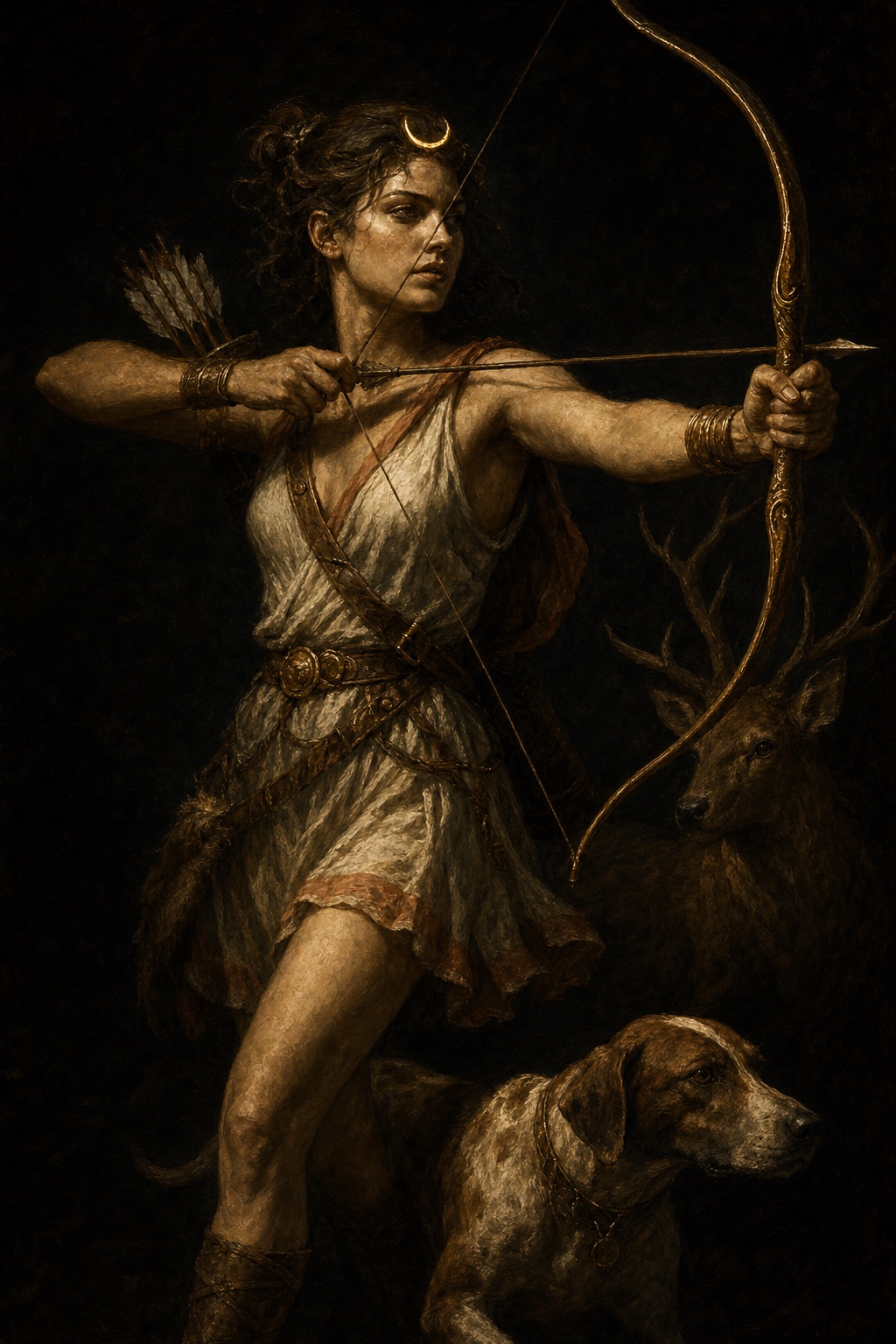
Artemis is Apollo’s twin, born first, and the tradition that she assisted at her brother’s birth immediately afterwards is the neatest statement of her double nature: a virgin goddess who is also the one women called on in labour.
Ἄρτεμιν ἀείδω χρυσηλάκατον κελαδεινὴν παρθένον αἰδοίην ἐλαφηβόλον ἰοχέαιραν αὐτοκασιγνήτην χρυσαόρου Ἀπόλλωνος ἣ κατ’ ὄρη σκιόεντα καὶ ἄκριας ἠνεμοέσσας ἄγρῃ τερπομένη παγχρύσεα τόξα τιταίνει πέμπουσα στονόεντα βέλη· τρομέει δὲ κάρηνα ὑψηλῶν ὀρέων, ἰάχει δ’ ἔπι δάσκιος ὕλη δεινὸν ὑπὸ κλαγγῆς θηρῶν
“I sing of Artemis, whose shafts are of gold, who cheers on the hounds, the pure maiden, shooter of stags, who delights in archery, own sister to Apollo with the golden sword. Over the shadowy hills and windy peaks she draws her golden bow, rejoicing in the chase, and sends out grievous shafts. The tops of the high mountains tremble and the tangled wood echoes awesomely with the outcry of beasts.” — Homeric Hymn 27, To Artemis 1–7, tr. Evelyn-White
She belongs to the country outside the city — mountains, marshes, the untilled land — and she is the mistress of wild animals who is also constantly hunting them. Both halves are firm. She protects the young of every species and demands their deaths in season; she is invoked by girls before marriage and by women in childbirth, and she has no husband and will not have one.
Her punishments are the most frightening in Greek myth because they are so rarely proportionate. Actaeon, hunting, blunders into her bathing; she turns him into a stag and his own fifty hounds tear him apart before they recognise him. Callisto, one of her followers, is raped by Zeus and then expelled and shot for having lost her virginity. Niobe boasts of having more children than Leto, and Artemis and Apollo kill all of them in an afternoon. Agamemnon shoots a deer in her grove and the fleet cannot sail until he cuts his daughter’s throat at Aulis. What these have in common is not wickedness but trespass: something crossed a boundary — of sight, of chastity, of speech, of ground — and the boundary answered.
Her greatest sanctuary was not Greek in any simple sense. The Artemision at Ephesus, one of the seven wonders, housed a goddess covered from waist to shoulder in rows of ovoid protuberances — read variously as breasts, bull testicles or amber gourds — attended by eunuch priests, and much closer to an Anatolian mother goddess than to the huntress of the hymns. The Greeks called her Artemis anyway. Like her brother’s absorption of the sun, her identification with the moon comes later than Homer, borrowed from Selene and then treated as though it had always been hers.