The long-winged Moon
Selene is the daughter of the Titans Hyperion and Theia, sister to Helios, the sun, and Eos, the dawn — the same single sentence of Hesiod’s that gives her brother his own parentage. Of the three, she is the one with the only surviving hymn addressed to her: the short Homeric Hymn 32, far less often read than her brother’s episode in the Hymn to Demeter. It opens by asking the Muses to “tell of the long-winged Moon” — an odd word to give a goddess rather than a bird, and even Evelyn-White’s own edition allows that it may mean nothing more than “far-flying,” Selene crossing the sky the way a bird crosses it rather than growing wings of her own.
Bathed in Ocean, driving at full speed
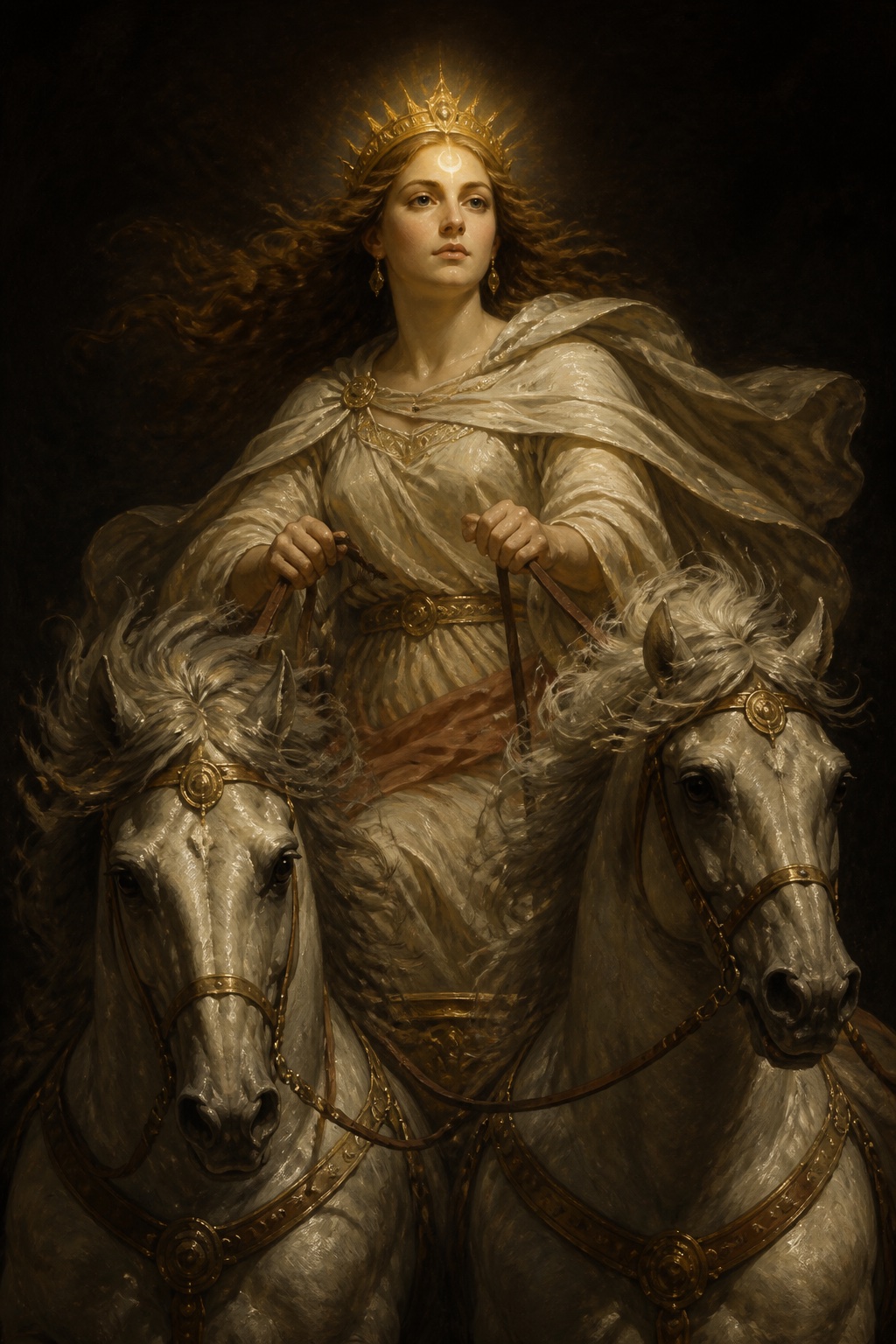
The hymn gives her one continuous action, repeated evening by evening: she bathes in the waters of Oceanus, dresses, yokes her own team, and drives across the sky at the point in the month when her light is strongest.
Μήνην ἀείδειν τανυσίπτερον ἔσπετε Μοῦσαι ἡδυεπεῖς κοῦραι Κρονίδεω Διὸς ἵστορες ᾠδῆς· ἧς ἄπο αἴγλη γαῖαν ἑλίσσεται οὐρανόδεικτος κρατὸς ἀπ’ ἀθανάτοιο, πολὺς δ’ ὑπὸ κόσμος ὄρωρεν αἴγλης λαμπούσης· στίλβει δέ τ’ ἀλάμπετος ἀὴρ χρυσέου ἀπὸ στεφάνου, ἀκτῖνες δ’ ἐνδιάονται, εὖτ’ ἂν ἀπ’ Ὠκεανοῖο λοεσσαμένη χρόα καλὸν εἵματα ἑσσαμένη τηλαυγέα δῖα Σελήνη ζευξαμένη πώλους ἐριαύχενας αἰγλήεντας ἐσσυμένως προτέρωσ’ ἐλάσῃ καλλίτριχας ἵππους, ἑσπερίη, διχόμηνος· ὃ δὲ πλήθει μέγας ὄγμος, λαμπρόταταί τ’ αὐγαὶ τότ’ ἀεξομένης τελέθουσιν οὐρανόθεν· τέκμωρ δὲ βροτοῖς καὶ σῆμα τέτυκται. τῇ ῥά ποτε Κρονίδης ἐμίγη φιλότητι καὶ εὐνῇ· ἡ δ’ ὑποκυσαμένη Πανδείην γείνατο κούρην ἐκπρεπὲς εἶδος ἔχουσαν ἐν ἀθανάτοισι θεοῖσι. Χαῖρε ἄνασσα θεὰ λευκώλενε δῖα Σελήνη πρόφρον ἐϋπλόκαμος
“And next, sweet voiced Muses, daughters of Zeus, well-skilled in song, tell of the long-winged Moon. From her immortal head a radiance is shown from heaven and embraces earth; and great is the beauty that ariseth from her shining light. The air, unlit before, glows with the light of her golden crown, and her rays beam clear, whensoever bright Selene having bathed her lovely body in the waters of Ocean, and donned her far-gleaming raiment, and yoked her strong-necked, shining team, drives on her long-maned horses at full speed, at eventime in the mid-month: then her great orbit is full and then her beams shine brightest as she increases. So she is a sure token and a sign to mortal men. Once the Son of Cronos was joined with her in love; and she conceived and bare a daughter Pandia, exceeding lovely amongst the deathless gods. Hail, white-armed goddess, bright Selene, mild, bright-tressed queen!” — Homeric Hymn 32, To Selene 1–18, tr. Evelyn-White
She is already dressed — in “far-gleaming raiment” — before the hymn ever puts her behind her team; the yoking and the driving are the last two things she does before the sky fills with her light. The hymn is exact about the timing, too: “at eventime in the mid-month,” when her disc is full and her beams are at their brightest, so this is not a nightly commute but the specific, recurring high point of her cycle.
Team, crown, and the light of her own head
Three things belong to her alone in this scene, and none of them is inherited from her father. Her team is “strong-necked” and “long-maned,” driven “at full speed” once she has yoked it herself. Her golden crown is named outright as the source of the light that makes “the air, unlit before” glow. And a third radiance comes from nowhere external at all: “from her immortal head a radiance is shown from heaven and embraces earth,” independent of the crown, as though the goddess herself, and not only her regalia, were the source of moonlight. The hymn never names a chariot: “yoked… drives” implies one, the way it does for Helios, but the word itself is absent from the Greek, and the vehicle is an inference rather than something the hymn actually says.
A night with the son of Cronus
Genealogy is not the point of this hymn, but one line of it survives, folded into the very end almost as an aside: “Once the Son of Cronos was joined with her in love; and she conceived and bare a daughter Pandia, exceeding lovely amongst the deathless gods.” Pandia appears nowhere else in the eighteen lines quoted here, and the union that gives rise to her is dispatched in a line and a half; the hymn moves straight from it to its closing address, hailing her as “white-armed goddess, bright Selene, mild, bright-tressed queen.” Those are the hymn’s own last words on her, not a summary imposed afterward: bathed, crowned, radiant, driving her team at full speed, and, in passing, a mother by Zeus.